Hilsa Fish: Bangladesh's Iconic GI Product — Complete Buyer's Guide (2026)
Hilsa (Ilish) — Bangladesh's second GI product (2017), iconic Padma-Meghna river fish. Complete buyer's guide: biology, 2017 GI registration, quality grades, export markets, HS codes (03028911/19/91/99), cold-chain logistics, authenticity verification, 451 verified suppliers.
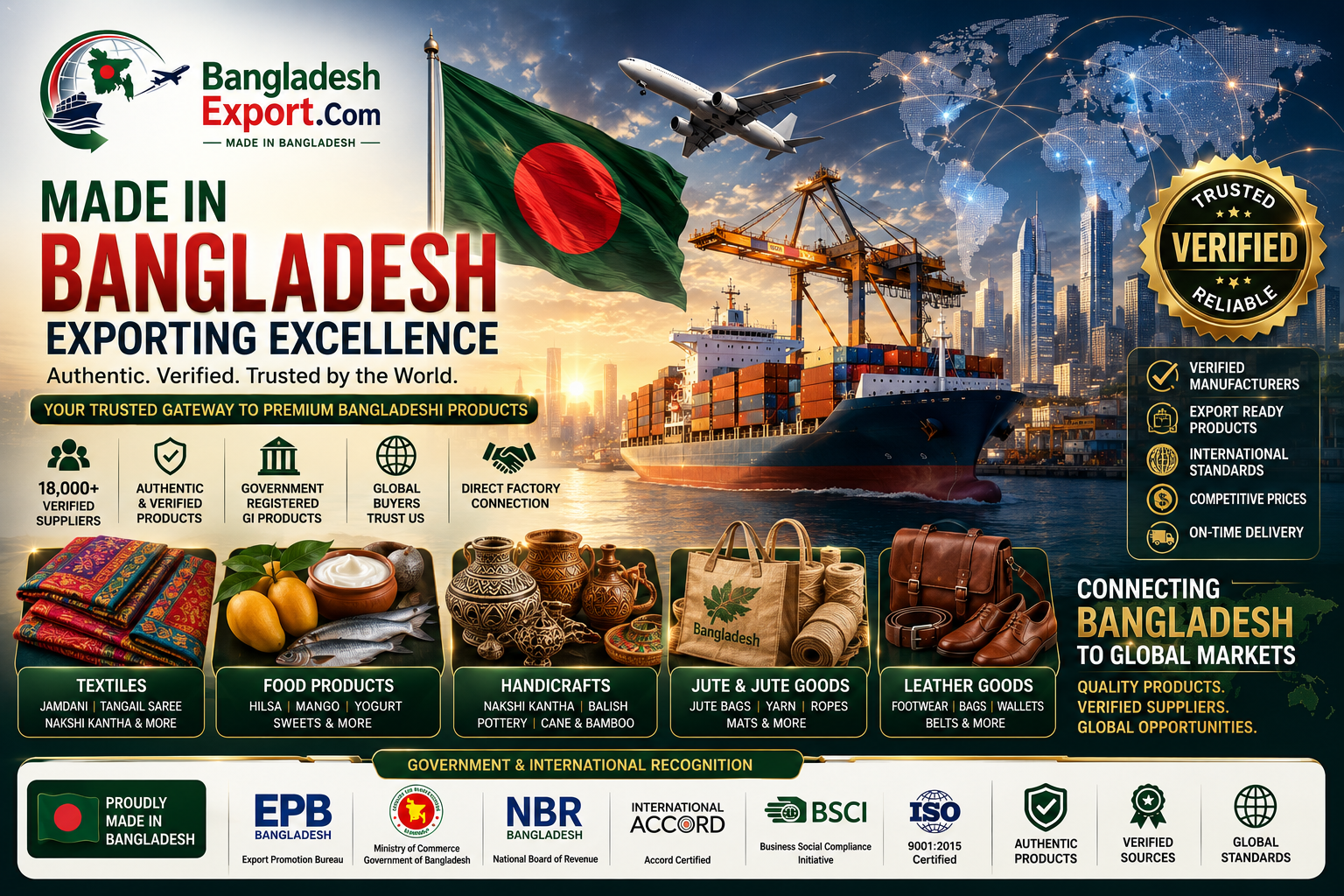
Hilsa (Tenualosa ilisha) — known locally as "Ilish" — is Bangladesh's iconic Padma-Meghna river fish and the country's second Geographical Indication (GI) registered product, granted GI status by DPDT in 2017. Annual Hilsa exports exceed USD 200 million, driven by the 13-million-strong Bangladeshi diaspora in the Middle East, UK, and USA, plus strong demand in India (especially West Bengal) during Durga Puja. A single premium Hilsa can retail in Middle Eastern grocers at USD 50–150 per fish. Yet Hilsa is also the most counterfeited Bangladeshi GI product — Myanmar and Indian-origin Hilsa are routinely sold under the Bangladeshi name — making verified sourcing critical for any international buyer.
This guide is the complete buyer's reference for international importers, distributors, diaspora retailers and seafood wholesalers sourcing authentic Bangladesh-origin Hilsa. It covers fish biology, the 2017 GI registration, the Padma-Meghna river system, freshness grades, cold-chain logistics, HS codes, packaging standards, authenticity verification, and direct sourcing from verified seafood exporters on BangladeshExport.com.
🐟 Hilsa Biology & the Padma-Meghna River System
Buyers can verify the official list of Bangladesh's registered Geographical Indication (GI) products through the Bangladesh Trade Portal maintained by the Government of Bangladesh. Refer to the official GI products page for the latest latest registrations and updates:
bangladeshtradeportal.gov.bd — GI Products Page
Hilsa (Tenualosa ilisha) is an anadromous fish — it lives in the saltwater of the Bay of Bengal but migrates upstream into the Padma (Ganges), Meghna, and Jamuna river systems to spawn. This migratory pattern is what makes the Bangladesh river system the world's premier Hilsa habitat: the convergence of the Padma and Meghna rivers creates a vast brackish-water estuary that supports the largest Hilsa fishery on Earth, accounting for an estimated 65–75% of global Hilsa catches.
The fish is biologically distinctive: silver-colored, averaging 500–1,500 grams (with premium fish reaching 2,000+ grams), with a distinctive fatty belly that gives Hilsa its characteristic rich flavor. The fat content varies seasonally — fish caught during the monsoon (August–October, known locally as "Padma Ilish season") are considered the premium grade due to peak fat content and flavor. Outside this window, Hilsa quality is lower and prices reflect it.
The Bangladesh government protects the fishery through seasonal fishing bans (March–April for Jatka protection, and 8-day bans during peak breeding in October), with strict enforcement by the Department of Fisheries. These conservation measures are why Bangladesh's Hilsa stock has remained healthy while other regional fisheries have declined — and why authentic Bangladesh-origin Hilsa commands a premium over Myanmar or Indian-origin supplies.
🏛️ GI Registration Details
Hilsa was registered as Bangladesh's second GI product in 2017, one year after Jamdani Saree became the first. The DPDT registration legally protects the "Hilsa of Bangladesh" / "Ilish of Bangladesh" name for fish caught in the Padma-Meghna river system and the adjacent Bay of Bengal coastal waters of Bangladesh. The registered region covers the river systems of Bhola, Barishal, Chandpur, Patuakhali, Pirojpur, Jhalokati, Barguna, Lakshmipur, Noakhali, and adjacent districts.
The legal implication for buyers is significant: a fish sold as "Bangladesh Hilsa" or "Padma Ilish" in any WTO member state must genuinely originate from the registered Bangladeshi waters. Myanmar-origin Hilsa (frequently laundered through third-country transshipment), Indian-origin Hilsa from the Hooghly or other river systems, and Pakistani-origin Hilsa from the Indus delta cannot legally carry the Bangladeshi name. Importers who source verified Bangladesh-origin Hilsa have legal recourse against counterfeit competition in their destination markets under TRIPS enforcement provisions.
For buyers, the practical verification chain is: (1) DPDT GI registration certificate from the exporter, (2) Department of Fisheries-origin certificate, (3) catch location documentation (district of landing), (4) BangladeshExport.com multi-source supplier verification. See our 4-layer GI verification framework for the complete process.
📊 Quality Characteristics & Freshness Grades
Hilsa quality is graded by size, fat content, freshness, and catch season. Understanding these grades helps buyers specify exactly what they want in an RFQ and avoid paying premium prices for lower-grade fish.
| Grade | Weight (per fish) | Fat Content | Season | Use Case |
|---|---|---|---|---|
| A Premium (Padma Ilish) | 1,200–2,000+ g | High (monsoon peak) | Aug–Oct | Premium retail, weddings, Eid |
| A Standard | 800–1,200 g | Medium-high | Year-round | Standard retail, restaurants |
| B Grade | 500–800 g | Medium | Year-round | Mid-market retail, processing |
| C Grade | 300–500 g | Lower | Year-round | Pickle and paste production |
| Roe (Hilsa egg) | By-weight | N/A | Sep–Nov | Premium retail, diaspora demand |
Freshness indicators for whole Hilsa: bright silver skin with a metallic sheen, clear and bulging eyes, red gills, firm flesh that springs back when pressed, and a fresh sea-river brine smell (not ammonia or "fishy" off-odors). Frozen Hilsa should be uniformly frozen with no freezer burn, no discoloration, and packaged with the catch date and origin district clearly labeled.
🌍 Main Export Markets & Buyer Industries
Hilsa demand is concentrated in markets with significant Bengali and South Asian diaspora populations, with seasonal peaks driven by religious and cultural events.
- Saudi Arabia, UAE, Qatar, Oman, Kuwait, Bahrain: Largest export market by volume. Demand peaks during Ramadan (iftar tables) and Eid. Premium grade Hilsa retails at USD 50–150 per fish in Middle Eastern Bangladeshi grocers.
- United Kingdom: Strong demand from the 600,000+ British-Bangladeshi community in London (Brick Lane, Whitechapel), Birmingham, Manchester. Premium retailers stock fresh-chilled and frozen Hilsa year-round.
- United States & Canada: Growing market driven by the 500,000+ Bangladeshi-American community in New York, New Jersey, Washington DC, Toronto. Frozen Hilsa dominates due to FDA import restrictions on fresh fish.
- India (West Bengal, Tripura, Assam): Historically the largest regional market — Bengali communities on both sides of the border share the Hilsa cultural tradition. Trade is regulated by bilateral agreements; legal export volumes fluctuate with diplomatic relations.
- Malaysia, Singapore, Australia: Smaller but growing diaspora markets, primarily frozen Hilsa via air-freight consolidation.
For buyers serving diaspora markets, the seasonal demand pattern is critical: Ramadan (shifts annually on the Hijri calendar), Eid-ul-Fitr, Eid-ul-Adha, Durga Puja (September–October), and the Bengali New Year (Pohela Boishakh, April 14) are the demand peaks. Plan orders 4–6 weeks ahead of these dates.
🏷️ HS Codes & Customs Classification
Bangladesh uses the 8-digit HS code system. Hilsa has four dedicated HS code entries in the Bangladesh tariff schedule, distinguishing fresh/chilled from frozen and wrapped/canned (up to 2.5 kg) from bulk packaging:
| HS Code | Description | Typical Use |
|---|---|---|
| 03028911 | Hilsha fish, fresh or chilled, wrapped/canned up to 2.5 kg | Premium retail packs, air-freight to diaspora grocers |
| 03028919 | Hilsha fish, fresh or chilled, excl. wrapped/canned up to 2.5 kg (bulk) | Bulk air-freight to wholesale importers |
| 03028991 | Other than Hilsha fish, frozen, wrapped/canned up to 2.5 kg | Frozen retail packs (longer shelf life) |
| 03028999 | Other than Hilsha fish, frozen, excl. wrapped/canned up to 2.5 kg (bulk) | Bulk frozen, sea-freight viable |
Always confirm the correct HS code with the exporter based on product state (fresh/chilled vs. frozen) and packaging format. The HS code affects the Bangladesh customs duty drawback eligibility for the exporter, destination-country import duty, and preferential-treatment eligibility under GSP or FTA. For full HS code lookup across all chapters, see our HS code directory.
📦 Packaging, Cold Chain & Shipping
Hilsa is highly perishable and requires strict cold-chain management. The packaging and shipping method you choose determines whether your product arrives in premium condition or as a quality-compromised write-off.
Fresh/chilled Hilsa (premium grade, air-freight only): Each fish is individually cleaned, scaled, and wrapped in food-grade plastic film. Fish are packed in EPS (expanded polystyrene) insulated boxes with gel ice packs maintaining 0–4°C. Box capacity typically 5–20 kg. Air-freight transit 3–7 days globally. Shelf life after arrival: 3–5 days refrigerated. This is the format Middle Eastern premium grocers stock during Ramadan.
Frozen Hilsa (standard grade, air or sea freight): Each fish is individually quick-frozen (IQF) at -30°C within 4 hours of catch, then glazed with a thin ice layer to prevent freezer burn. Packed in corrugated cartons with polyethylene liner, 10–25 kg per carton. Maintained at -18°C throughout transit. Sea-freight viable (20–35 days transit) for frozen bulk shipments. Shelf life: 6–12 months at -18°C.
Hilsa roe (eggs): Premium by-product sold separately. Harvested September–November, IQF-frozen, vacuum-packed in 200–500 g packs. Limited supply — pre-booking with exporters is essential. Roe retails at USD 40–80 per kg in diaspora markets.
For all formats, the exporter must provide: Certificate of Origin (from Chamber of Commerce or Department of Fisheries), Health Certificate (Department of Fisheries-issued), Phytosanitary-equivalent fish health certificate, and the DPDT GI registration copy. See our sourcing documentation guide for the full export documentation set.
✅ How to Identify Authentic Bangladesh Hilsa
Hilsa is the most counterfeited Bangladeshi GI product. Myanmar-origin Hilsa (visually similar but considered inferior flavor), Indian-origin Hilsa from the Hooghly and other river systems, and even unrelated river shad species are routinely sold under the "Padma Ilish" name in diaspora markets. Use this verification checklist:
- Origin documentation: The exporter must provide a Department of Fisheries-issued origin certificate naming the landing district (Bhola, Chandpur, Patuakhali, etc.). No origin certificate = high fraud risk.
- GI registration certificate: The exporter must hold a valid DPDT GI registration for Hilsa. Request the registration number and verify independently with DPDT.
- Catch season declaration: Premium "Padma Ilish" is caught August–October during the monsoon peak. Fish sold as "Padma Ilish" outside this window, particularly during the March–April Jatka ban, is suspect.
- Size and shape: Authentic adult Hilsa is 500–2,000 g with a distinctive silver color, deep body, and pronounced median dorsal scutes (saw-toothed belly). Smaller fish (under 300 g) are likely Jatka (juvenile Hilsa) — illegal to catch and of inferior quality.
- Visual freshness: Bright metallic silver skin, clear bulging eyes, red gills, firm flesh. Dull skin, sunken eyes, brown gills, or soft flesh indicate staleness — and may indicate the fish was frozen and thawed multiple times.
- Export packaging labeling: Each carton must show the exporter name, catch date, origin district, net weight, storage temperature, and "Product of Bangladesh" origin marking. Missing or generic labeling is a fraud signal.
- Price reasonability: Authentic Bangladesh Hilsa has a price floor set by the fishery's regulated catch limits. Export prices significantly below USD 8/kg for whole frozen Hilsa should be treated as fraud signals (likely Myanmar or Indian origin laundered as Bangladeshi).
For the full four-layer verification framework — including how BangladeshExport.com cross-checks seafood exporters against multiple government databases — see our GI verification guide.
🤝 Where to Source Verified Hilsa Exporters
BangladeshExport.com hosts 451 verified seafood and fisheries suppliers, cross-referenced against the EPB registered-exporter list, the Department of Fisheries, and the Bangladesh Frozen Foods Exporters Association (BFFEA) member directory. To source authentic Hilsa directly from verified exporters:
- Browse verified seafood suppliers: View 451 verified seafood and fisheries suppliers — filter by Hilsa in product listings, look for the "Verified" badge.
- Post a free RFQ: Submit a Request for Quotation specifying "Hilsa (Ilish)" with grade (A Premium / A Standard / B / frozen), quantity, target price, catch season if applicable, and destination country. Verified exporters respond within 24–72 hours.
- Check exporter credentials: On each supplier profile, verify EPB registration, BFFEA membership, Department of Fisheries licences, and CBCCTG bonded warehouse licence (for exporters using bonded cold-storage facilities). The "Verified" badge means at least two independent data sources confirm these.
- Order a small sample shipment first: For new supplier relationships, order 50–200 kg of frozen Hilsa as a trial. Inspect quality, packaging, and documentation accuracy before placing a multi-ton bulk order.
- Finalize directly with the exporter: Communicate via in-platform messaging, negotiate payment terms (L/C recommended for first orders over USD 10,000), arrange pre-shipment inspection. BangladeshExport.com takes no commission on any deal.
For Bangladeshi Hilsa exporters reading this: register as a supplier on BangladeshExport.com (free), select "Seafood & Fisheries" as your category, and upload your DPDT GI registration certificate and Department of Fisheries export licence. Our verification team will validate your documents at no cost, and your profile will display the "Verified" badge — making you discoverable to the global buyers searching for authentic Bangladesh Hilsa.
You can also explore relevant industry associations supporting Bangladesh seafood exporters, including the Save Our Sea marine conservation initiative and the broader Bangladesh exporters' association directory.
🚀 Source Authentic Bangladesh Hilsa — Free RFQ
Post a free Request for Quotation on BangladeshExport.com for authentic Bangladesh-origin Hilsa from verified seafood exporters. Specify grade, quantity, catch season preference, and destination — verified suppliers respond within 24–72 hours. No middlemen, no commission, completely free for buyers.
🚀 Post a Free RFQ → 🔍 Browse 451 Verified Seafood Suppliers🎯 Conclusion
Bangladesh Hilsa is the country's most commercially significant GI food product — legally protected, internationally recognized, and supported by 451 verified seafood exporters on BangladeshExport.com. For global buyers serving the Bengali and South Asian diaspora, sourcing authentic Bangladesh-origin Hilsa is a defensible, high-margin business with established seasonal demand peaks and clear authenticity verification paths.
The buyers who succeed with Hilsa long-term are those who source directly from verified exporters, document the origin chain rigorously, respect the seasonal catch patterns, and build multi-year supplier relationships. BangladeshExport.com makes that process free, transparent, and built on multi-source verification — start with a free RFQ today, or browse our verified seafood supplier directory to see who is already registered.
For the complete catalog of 60+ Bangladesh GI products, see our full GI products list. For the broader context on why Bangladesh GI products are gaining global demand, see our 2026 global demand analysis.
❓ Frequently Asked Questions
What is Bangladesh Hilsa fish and why is it a GI product?
Bangladesh Hilsa (Tenualosa ilisha, locally "Ilish") is an anadromous fish from the Padma-Meghna river system and the adjacent Bay of Bengal coastal waters. It was registered as Bangladesh's second GI product in 2017 by DPDT. The GI registration legally protects the "Hilsa of Bangladesh" name for fish caught in the registered Bangladeshi waters. Bangladesh accounts for an estimated 65–75% of global Hilsa catches, and the regulated fishery with seasonal conservation bans has kept the stock healthy while other regional fisheries declined.
Which is the best season to import Bangladesh Hilsa?
The premium "Padma Ilish" season is August–October (monsoon period), when Hilsa fat content and flavor peak. This is when Grade A Premium Hilsa (1,200–2,000+ g fish) is most available and commands the highest retail prices. Other demand peaks include Ramadan (shifts annually), Eid-ul-Fitr, Eid-ul-Adha, Durga Puja (September–October), and the Bengali New Year (Pohela Boishakh, April 14). Order 4–6 weeks ahead of these dates.
Can I import fresh Hilsa or only frozen?
Both. Fresh/chilled Hilsa is air-freighted in EPS insulated boxes with gel ice packs (0–4°C, 3–7 day transit, 3–5 day shelf life after arrival). Frozen Hilsa is IQF-processed at -30°C and shipped at -18°C (6–12 month shelf life, air or sea freight). Middle Eastern premium grocers stock fresh-chilled during Ramadan; US/Canada importers typically use frozen due to FDA fresh-fish import restrictions.
What is the HS code for Bangladesh Hilsa?
Bangladesh uses the 8-digit HS code system. Hilsa has four dedicated codes: 03028911 (fresh/chilled, wrapped up to 2.5 kg), 03028919 (fresh/chilled, bulk), 03028991 (frozen, wrapped up to 2.5 kg), 03028999 (frozen, bulk). See the HS code table above for details and our HS code directory for full tariff and duty information.
How do I verify that Hilsa is authentic Bangladesh-origin?
Verify via: (1) Department of Fisheries-issued origin certificate naming the landing district; (2) exporter's DPDT GI registration certificate; (3) catch season declaration (premium Padma Ilish is caught August–October); (4) visual freshness indicators (silver skin, clear eyes, red gills); (5) export packaging labeling (exporter name, catch date, origin district, "Product of Bangladesh"); (6) price reasonability — significantly below USD 8/kg suggests Myanmar or Indian-origin substitution. The full verification checklist is in the section above.
How many verified Hilsa suppliers are on BangladeshExport.com?
BangladeshExport.com hosts 451 verified seafood and fisheries suppliers, cross-referenced against the EPB registered-exporter list, Department of Fisheries, and BFFEA member directory. Not all 451 export Hilsa specifically, but you can post a free RFQ specifying "Hilsa (Ilish)" with your grade and quantity requirements, and verified Hilsa-capable suppliers will respond within 24–72 hours.
What is the minimum order quantity (MOQ) for Bangladesh Hilsa?
Typical MOQ for Hilsa exports is 500–2,000 kg by weight. For first-time buyers, exporters may accept a 50–200 kg trial shipment at a slightly higher per-kg price. Fresh/chilled Hilsa is air-freighted in EPS boxes (5–20 kg per box); frozen Hilsa is shipped in cartons (10–25 kg per carton). Bulk orders of 5+ tons are typically shipped frozen via sea freight to reduce per-kg shipping cost.