Balish Misti of Netrokona: Bangladesh Heritage GI Sweet — Buyer's Guide (2026)
Balish Misti of Netrokona — Bangladesh's 2024 GI sweet, pillow-shaped (1-2kg) celebration sweet with chhana, malai topping, dual-texture. HS 21069090, 7-point authenticity, 435 food suppliers.
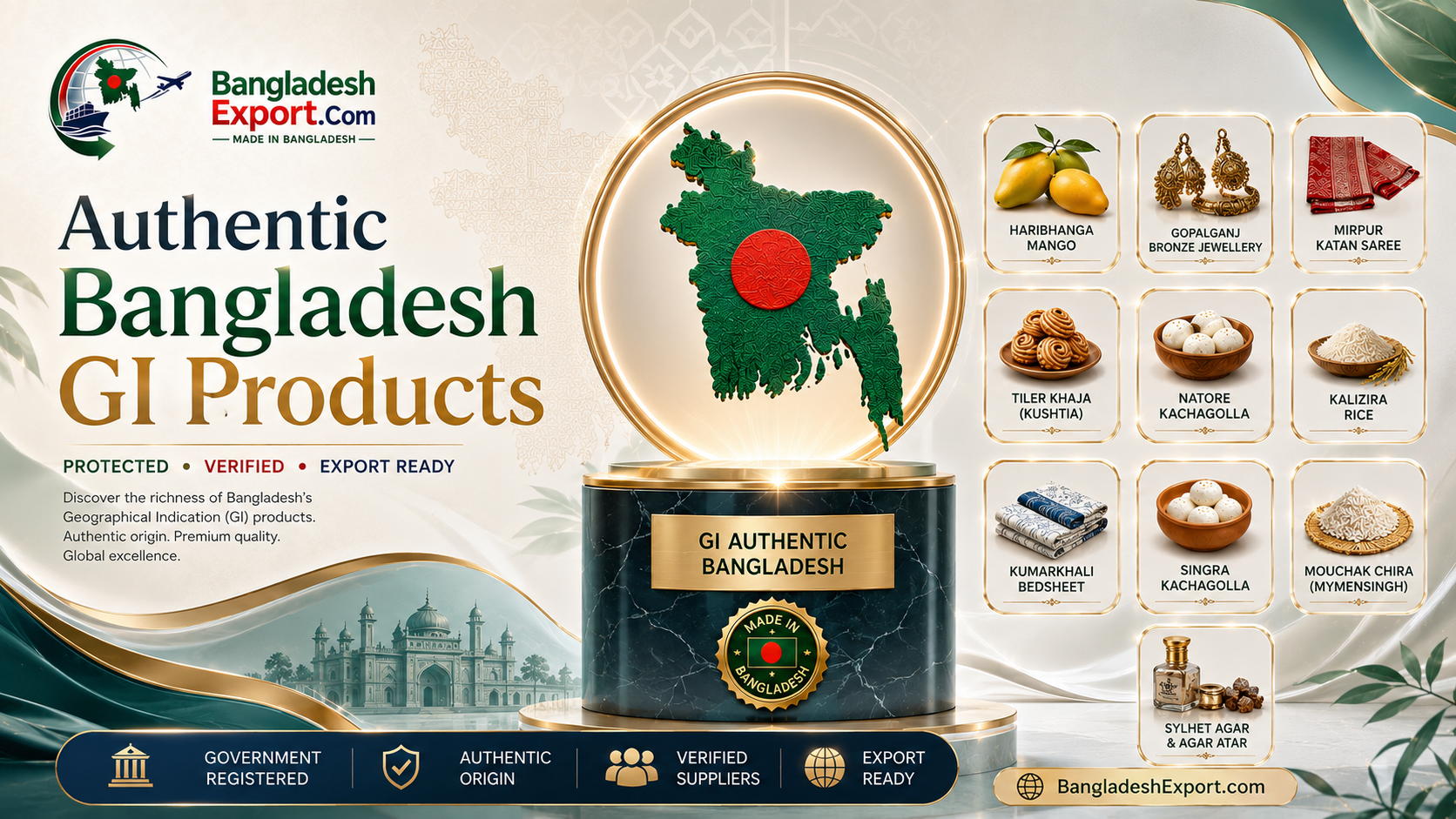
Shaped like a pillow, soft as cotton, and soaked in syrup — the Balish Misti of Netrokona is one of Bangladesh's most visually distinctive GI sweets. The name "Balish" means "pillow" in Bengali, and the sweet's elongated, pillow-like shape is its defining visual characteristic. Registered as a Bangladesh GI product in 2024, Balish Misti is a century-old tradition from Netrokona district in northern Bangladesh, made from chhana (cottage cheese), flour, sugar, and topped with malai (milk skin). A single Balish Misti is large — typically 30–40 cm long and weighing 1–2 kg — designed to serve 8–10 people, making it a celebration sweet rather than an individual portion.
This guide is for international diaspora grocers, ethnic-food distributors, premium sweet retailers, and Bangladeshi food exporters sourcing authentic Balish Misti of Netrokona. We cover the sweet's century-old history, the 2024 GI registration, the production technique, quality characteristics, export markets, HS codes, packaging and cold-chain logistics, authenticity verification, certifications, and direct sourcing from verified food suppliers on BangladeshExport.com.
📜 A Century of Pillow-Shaped Sweet Heritage
Buyers can verify the official list of Bangladesh's registered Geographical Indication (GI) products through the Bangladesh Trade Portal: bangladeshtradeportal.gov.bd — GI Products Page
The Balish Misti tradition in Netrokona traces back approximately 100 years, with local confectioner families in the Netrokona Sadar area — particularly the Gayanath area and the families of Makhan Lal Pal, Suren Pal, and the Modak family — credited with developing the distinctive pillow-shaped format. Netrokona district, situated in northern Bangladesh along the Indian border with Meghalaya, is part of the broader haor-Brahmaputra cultural belt that has produced many of Bengal's distinctive sweet-making traditions. The district's specific agricultural wealth — abundant dairy production from the indigenous Bengal cow breeds, plentiful sugarcane, and high-quality wheat — provided the raw materials that the local confectioner community needed to develop the Balish Misti and other regional sweets.
The sweet was created for communal consumption — its large size made it ideal for sharing at family gatherings, weddings, religious festivals (both Hindu and Muslim), and community celebrations. The pillow shape was reportedly inspired by the traditional Bengali floor pillow (balish) that was ubiquitous in rural Bengali homes — the sweet's creators deliberately mimicked this familiar shape to make the sweet visually distinctive and culturally resonant. The Balish Misti became particularly associated with the Bengali New Year (Pohela Boishakh) celebrations, weddings, and Eid festivals, where its large communal format made it the natural centerpiece for shared dessert courses. The sweet's reputation spread across northern Bengal through the river trade networks, with Netrokona Balish Misti becoming a recognized regional specialty by the 1950s.
Over the century of its production, the Balish Misti became Netrokona's signature sweet — the product that locals would bring as gifts when visiting relatives in other districts, and the sweet that visitors to Netrokona would seek out as a regional specialty. The sweet's tradition is maintained today by approximately 30–40 commercial confectioners in Netrokona Sadar upazila, with another 20–30 in the surrounding upazilas of Mohanganj, Barhatta, Atpara, Kalmakanda, Durgapur, Purbadhala, and Kendua. The 2024 GI registration — part of DPDT's historic wave of Bangladesh GI protections — formally protected the "Balish Misti of Netrokona" name. The registration was supported by the Bangladesh Sweet Manufacturers' Association, the Netrokona Sweet Manufacturers' Cooperative, and the Netrokona Chamber of Commerce & Industry. See our complete 60-product GI list and our guides to other GI Bengali sweets: Kachagolla of Natore, Muktagacha Monda, Porabari Chomchom, Rasmalai of Cumilla, Rosogolla of Gopalganj, Chanar Payesh of Sherpur, and Sandesh of Jamurki.
🏛️ GI Registration and the Netrokona Production Region
Balish Misti of Netrokona was registered by the Department of Patents, Designs and Trademarks (DPDT) under the Ministry of Industries in 2024. The GI registration protects the name "Balish Misti of Netrokona" or "Netrokona Balish Misti" for the traditional pillow-shaped chhana-flour-sugar sweet topped with malai, produced in Netrokona district using traditional techniques. The protected production region covers the entire Netrokona district, with the primary production center in Netrokona Sadar upazila — particularly the Gayanath area — and extension to the surrounding upazilas of Mohanganj, Barhatta, Atpara, Kalmakanda, Durgapur, Purbadhala, and Kendua. Netrokona Sadar alone accounts for approximately 60% of the district's Balish Misti production, with an estimated 30–40 commercial confectioners operating in the upazila.
Buyers should request a GI registration certificate from the supplier and verify the production location — the GI protection does not extend to chhana-based pillow-shaped sweets produced in Mymensingh, Kishoreganj, Sunamganj, or other neighboring districts even when those products use a similar shape and technique. Verification follows the methodology in our GI verification guide.
🥛 Production Technique — The Pillow-Shape Challenge
The authentic Balish Misti is produced using a traditional multi-stage technique that combines elements of chhana-sweet preparation with a unique shaping and finishing method. The complete production workflow involves six stages:
Stage 1 — Chhana preparation: Fresh whole cow milk (4–5% fat content, sourced from Netrokona's indigenous Bengal cow breeds — particularly the Red Chittagong and Non-descript Deshi cattle) is brought to a rolling boil in a stainless steel or copper vat. Food-grade lemon juice or traditional whey acid is added slowly while stirring, causing the milk proteins to coagulate into soft chhana curds. The chhana is drained through muslin cloth for 30–45 minutes, then pressed under a weighted board for 1–2 hours to remove excess moisture. The final chhana should have approximately 50–55% moisture content — slightly drier than chhana used for chomchom or rosogolla, because the Balish Misti's large format requires a firmer base.
Stage 2 — Dough preparation: The pressed chhana is hand-kneaded for 10–15 minutes until smooth and pliable. A small amount of refined wheat flour (maida) — typically 5–10% of the chhana weight — is incorporated during kneading. The flour acts as a binder — without it, the chhana would not hold the large pillow shape during frying. The dough is kneaded until completely smooth, with no visible lumps or flour streaks. Some premium producers also add a small amount of semolina (suji) for additional texture.
Stage 3 — Shaping (the defining step): The chhana-flour dough is shaped by hand into a large, elongated, pillow-like form — typically 30–40 cm long, 8–10 cm wide, and 4–5 cm thick, weighing 1–2 kg per piece. This is the most technically demanding step: the dough must be shaped firmly enough to hold its form during frying, but gently enough to avoid cracking. The shape is achieved entirely by hand — no molds are used. The confectioner uses both palms to roll the dough into a cylindrical shape, then flattens the top and bottom, and finally tapers the ends to create the characteristic pillow form. A skilled confectioner can shape a Balish Misti in 2–3 minutes; the skill takes years to master and is typically passed from father to son within confectioner families.
Stage 4 — Deep-frying: The shaped pillow is deep-fried in ghee (traditional) or refined vegetable oil (modern cost-reduced variant) in a large flat pan (kadai) at 140–160°C for 8–12 minutes, with careful turning every 2–3 minutes to ensure even browning. The frying serves two purposes: it sets the shape permanently (the firm golden-brown exterior holds the soft interior together during the subsequent syrup soaking) and it develops the caramelized flavor that characterizes the sweet's exterior. The frying is done at a lower temperature than typical Bengali sweet frying to prevent the exterior from browning too quickly before the interior is cooked. The fried pillow is removed from the oil when the exterior is uniform golden-brown and the surface feels firm to the touch.
Stage 5 — Syrup soaking: The fried pillow is transferred immediately to a warm sugar syrup (60–65% concentration, flavored with green cardamom pods) maintained at 60–70°C. The pillow soaks for 4–8 hours, during which the syrup permeates the interior. The chhana absorbs the syrup and becomes soft and spongy, while the fried exterior retains its firm texture. This creates the dual-texture profile: firm golden-brown exterior, soft syrup-soaked interior. The syrup temperature must be maintained above 50°C throughout the soaking period to ensure proper penetration; cold syrup would not permeate the dense fried exterior.
Stage 6 — Malai topping: Before serving, the Balish Misti is topped with a thick layer of fresh malai (milk skin — the thick cream that forms on the surface of slowly heated full-fat milk). The malai is prepared separately by slowly heating full-fat cow milk in a wide shallow pan for 30–45 minutes at 70–80°C, allowing the cream to rise and thicken. The malai is spooned onto the top surface of the Balish Misti in a thick even layer (1–2 cm), creating a three-layer eating experience: malai topping, fried exterior, syrup-soaked interior. The malai must be applied immediately before consumption or packaging for sale — it does not keep well and is the main factor limiting the Balish Misti's shelf life.
A single Balish Misti takes 6–10 hours from start to finish (including syrup soaking time). The sweet has a refrigerated shelf life of 3–5 days — shorter than most GI Bengali sweets because of the malai topping, which spoils faster than the chhana base. For export, vacuum-sealed packaging with extended-shelf-life malai (treated with permitted preservatives) can extend shelf life to 7–10 days refrigerated.
📊 Quality Characteristics and Grading
| Grade | Size | Weight | Exterior | Interior | Malai | Retail Range (USD) |
|---|---|---|---|---|---|---|
| A Premium (Gayanath) | 35–40 cm long | 1.5–2 kg | Golden-brown, firm, uniform | Ultra-soft, syrup-saturated | Thick (1.5–2 cm) fresh malai | 15–30 per piece |
| A Standard | 25–30 cm long | 1–1.5 kg | Brown, firm | Soft, syrup-soaked | Standard (0.5–1 cm) malai | 8–15 per piece |
| B Grade | 20–25 cm long | 0.5–1 kg | Light brown, less uniform | Standard texture | Thin or no malai | 4–8 per piece |
| Export Grade (Vacuum-packed) | 30–35 cm long | 1.2–1.8 kg | Golden-brown, uniform, vacuum-sealed | Soft, syrup-soaked, preservative-stabilized | Stabilized malai (preserved) | 18–28 per piece |
Authentic premium Balish Misti has six distinguishing physical characteristics: (1) large pillow shape (30–40 cm long, 1.5–2 kg per piece — the largest format of any GI Bengali sweet); (2) golden-brown firm exterior that holds its shape when handled; (3) ultra-soft syrup-soaked interior — the syrup should be visible and drip slightly when the sweet is cut; (4) thick fresh malai topping (1–2 cm) covering the entire top surface; (5) cardamom-scented syrup with subtle rose-water undertones; (6) a dual-texture eating experience (firm exterior yielding to soft interior, with creamy malai on top). The sweet is designed to be cut into slices (typically 8–10 slices per piece) and shared — one Balish serves 8–10 people.
🌍 Export Markets and Buyer Segments
- Middle East (UAE, Saudi Arabia, Qatar, Kuwait, Oman): Largest diaspora market — Bangladeshi expatriates (over 4 million workers) buy Balish Misti for Eid al-Fitr and Eid al-Adha celebrations, where the large communal format is ideal for sharing with extended family and guest gatherings. Retail USD 15–30 per piece in Bangladeshi grocery stores in Dubai, Abu Dhabi, Doha, Riyadh. Peak demand during Ramadan and the two Eid festivals. Annual estimated demand: 50,000–100,000 pieces.
- UK (London, Birmingham, Manchester, Bradford): British-Bangladeshi community celebrations — the Balish Misti is particularly popular for weddings and Pohela Boishakh (Bengali New Year) celebrations. Retail GBP 12–25 per piece in Bangladeshi grocery stores in Tower Hamlets, Birmingham, Manchester.
- USA & Canada: Diaspora celebration demand — Bangladeshi communities in New York (Jackson Heights), Detroit (Hamtramck), Toronto (East End), Los Angeles. Pasteurized-milk variants and vacuum-packed export grade required for FDA compliance. Retail USD 18–35 per piece.
- EU (Germany, France, Netherlands, Italy): Niche diaspora market — Bangladeshi communities in Berlin, Paris, Amsterdam, Rome. Retail EUR 15–28 per piece. EU buyers require full HACCP certification and BSTI certification.
- Australia, New Zealand: Niche diaspora and premium ethnic-food market. Retail AUD 25–45 / NZD 28–50 per piece. Strict dairy-import requirements.
- Southeast Asia (Malaysia, Singapore): Diaspora demand — Bangladeshi workers and expatriates in Kuala Lumpur and Singapore. Retail MYR 70–120 / SGD 22–40 per piece.
- India (especially West Bengal): Cultural affinity market — large-format chhana sweets are also a Bengali Indian tradition (with the "Ledikeni" and "Chhanar Jilipi" being related varieties). Cross-border formal and informal trade. Retail INR 1,000–2,000 per piece in border markets.
🏷️ HS Codes and Customs Classification
| HS Code | Description | Typical Use |
|---|---|---|
| 21069090 | Other food preparations not elsewhere specified | Primary classification for Balish Misti (chhana-flour-sugar-malai sweet) |
| 21069020 | Food preparations containing mawa (dairy-based sweets) | Alternative classification (when malai is classified as mawa-derivative) |
| 04069000 | Cheese, nes | When classified as chhana-based cheese product |
| 21069099 | Food preparations, nes | Generic food preparation classification |
Most Bangladesh Customs entries for Balish Misti exports use HS 21069090 (other food preparations nes). Buyers should consult their customs broker and verify destination market dairy-import requirements — the malai topping and chhana base both trigger dairy-product import regulations in many markets.
📦 Packaging, Cold Chain, and Shipping
Balish Misti is highly perishable — the chhana base, the syrup moisture, and especially the malai topping give it a refrigerated shelf life of only 3–5 days without preservatives. The large format (1–2 kg per piece) also requires custom packaging — standard sweet-packaging formats do not accommodate the Balish's pillow dimensions. Fresh export packaging: rigid food-grade plastic containers (35×15×8 cm) with snap-on lids, each holding one Balish Misti with foam-padded inserts to prevent shifting during transit. For premium retail, the container is wrapped in branded cellophane with a tamper-evident seal and traceability code. For export grade, vacuum-sealed food-grade pouches with modified-atmosphere packaging (MAP) and preservative-stabilized malai extend shelf life to 7–10 days refrigerated. Cold chain: 2–4°C throughout transit and storage — Balish Misti should never be frozen (freezing damages the chhana texture and causes the malai to separate), and should never be stored above 8°C for more than 6 hours.
Shipping options: (1) Air freight — mandatory for all export shipments due to the short shelf life, transit time 1–3 days to most destinations, cost USD 8–18 per piece (high per-unit cost due to the large dimensions and weight); (2) Special packaging for air freight — EPS insulated boxes with gel ice packs (2–4°C maintained for 48–72 hours) within corrugated cartons, with 2–4 Balish per master carton. Required documentation includes: Phytosanitary Certificate (for any plant-derived ingredients — cardamom, flour), Health Certificate (Department of Livestock Services for dairy components), Certificate of Origin (Netrokona Chamber of Commerce & Industry), DPDT GI registration certificate copy, BSTI certification under BDS 1705 (Dairy-based products standard), HACCP / BRC certification (for EU and UK buyers), Halal certification (for Middle East buyers — confirming no animal-derived ingredients except dairy). See our export documentation guide for the complete document checklist.
✅ Authenticity Verification — Seven-Point Checklist
To verify that a sweet marketed as "Balish Misti of Netrokona" is authentic, perform the following seven-point inspection:
- Shape inspection: Distinctive pillow shape — elongated oval (25–40 cm long, 8–10 cm wide, 4–5 cm thick); round, ball-shaped, or small-format sweets are not authentic Balish Misti.
- Exterior inspection: Golden-brown firm exterior with uniform color and a slight sheen from the frying; pale, uneven, or burnt exterior indicates non-traditional production.
- Interior inspection: Soft, syrup-soaked interior — when the sweet is cut, the syrup should be visible and drip slightly; dry interior indicates insufficient syrup soaking or non-traditional production.
- Malai inspection: Thick fresh malai topping (1–2 cm) covering the entire top surface; absence of malai, thin malai, or stale/discolored malai indicates non-premium production.
- Flavor and aroma: Cardamom-scented syrup with subtle rose-water undertones; caramelized exterior flavor; creamy malai flavor; clean sweet finish without bitterness.
- Format verification: Large format — 1–2 kg per piece, serving 8–10 people; small individual portions are not authentic Balish Misti (likely Chomchom, Rosogolla, or other GI sweets).
- DPDT GI registration + Netrokona production documentation: Supplier provides a copy of the DPDT GI registration certificate for "Balish Misti of Netrokona"; BSTI certification under BDS 1705; Netrokona Chamber of Commerce membership; traceability code linking to the producing facility in Netrokona district.
🏛️ Certifications and Institutional Support
The Balish Misti supply chain is supported by multiple institutional certifications and agencies. The Bangladesh Standards and Testing Institution (BSTI), under the Ministry of Industries, issues product certification under BDS 1705 (Dairy-based products standard) — buyers should request the supplier's BSTI certification number. The Department of Livestock Services (DLS), under the Ministry of Fisheries and Livestock, issues health certificates for dairy-product export. The Bangladesh Food Safety Authority (BFSA) provides regulatory oversight. For EU export, full HACCP certification is required; the British Retail Consortium (BRC) Global Standard for Food Safety is required by major UK retailers. For Middle East export, Halal certification from a recognized Halal authority (such as the Islamic Foundation Bangladesh or a GCC-recognized Halal certifier) is required — Balish Misti is naturally Halal-compliant as it contains no animal-derived ingredients except dairy. For organic claims, EU Organic, USDA NOP, or equivalent certification applies. The Bangladesh Sweet Manufacturers' Association and the Netrokona Sweet Manufacturers' Cooperative provide industry coordination.
Institutional support for export comes from the Export Promotion Bureau (EPB) for market intelligence and trade-fair participation; the Netrokona Sweet Manufacturers' Cooperative for production-side coordination; and the Ministry of Agriculture's Department of Agricultural Marketing for export-oriented production subsidies. Buyers seeking institutional supplier referrals can contact the Netrokona Chamber of Commerce & Industry directly or browse the broader Bangladesh exporters' association directory on BangladeshExport.com.
🤝 Sourcing Verified Balish Misti Manufacturers — Five-Step Process
- Browse verified food suppliers: Start with our 435 verified Food & Beverage suppliers — filter by district (Netrokona) and subcategory (Sweets / Confectionery / Dairy) to shortlist 5–10 suppliers.
- Post a free RFQ: Submit a Request for Quotation specifying "Balish Misti of Netrokona" with grade (A Premium Gayanath / A Standard / B / Export Vacuum-packed), size (25–40 cm), quantity, packaging (rigid container, vacuum-sealed), destination port, and required certifications (BSTI, HACCP, BRC, Halal). Verified suppliers respond within 24–72 hours.
- Check credentials: For each shortlisted supplier, verify (a) BSTI certification under BDS 1705, (b) BFSA registration, (c) Department of Livestock Services dairy-processing licence, (d) DPDT GI registration copy, (e) Netrokona Chamber of Commerce membership, (f) HACCP / BRC / Halal certification (if claimed), (g) EPB export track record.
- Order a trial shipment: Request 5–20 pieces trial shipment by air freight (each piece is 1–2 kg, serving 8–10 people). Pay via L/C or escrow. Evaluate against the seven-point authenticity checklist and conduct lab testing (fat content, moisture content, microbial load) at a recognized laboratory. Visit the production facility in Netrokona Sadar in person if bulk order exceeds USD 30,000.
- Finalize directly: For orders over USD 3,000, use irrevocable L/C at sight from a top-50 international bank; for smaller orders, advance payment with 50% deposit and 50% against shipping documents is standard. BangladeshExport.com does not charge commission.
If you are a Netrokona Balish Misti manufacturer: register as a supplier on BangladeshExport.com (free). The platform connects you directly with verified international buyers without intermediary margins.
🚀 Source Authentic Netrokona Balish Misti — Free RFQ
Post a free RFQ for authentic Balish Misti of Netrokona. Specify grade, size, quantity, and destination. The large format (1–2 kg per piece, serves 8–10) makes this a celebration sweet — ideal for Eid, weddings, and family gatherings. Peak demand during Ramadan and the two Eid festivals. Verified suppliers respond within 24–72 hours.
🚀 Post a Free RFQ → 🔍 Browse 435 Verified Food & Beverage Suppliers🎯 Conclusion
Balish Misti of Netrokona is one of Bangladesh's most visually distinctive GI sweets — the pillow shape (30–40 cm, 1–2 kg per piece), the large communal format (serves 8–10 people), the dual-texture (firm golden-brown exterior, soft syrup-soaked interior), and the fresh malai topping create a product that is both a celebration centerpiece and a unique culinary experience. For diaspora grocers, ethnic-food distributors, and premium sweet retailers serving Bangladeshi communities in the Middle East, UK, USA, EU, and Australia, authentic Netrokona Balish Misti is a high-margin celebration sweet with consistent demand peaks during Eid al-Fitr, Eid al-Adha, weddings, and Pohela Boishakh. The chilled cold-chain requirements (2–4°C, air freight essential, 3–5 day shelf life without preservatives) are demanding, but the high per-unit price (USD 15–30 per piece) and the unique cultural positioning make Balish Misti a defensible premium sourcing decision. BangladeshExport.com makes sourcing free and transparent — start with a free RFQ today.
For the complete catalog of 60+ Bangladesh GI products, see our complete GI products list. For other Bangladeshi GI sweets, see our Kachagolla of Natore guide, Porabari Chomchom guide, Rasmalai of Cumilla guide, Rosogolla of Gopalganj guide, Chanar Payesh of Sherpur guide, and Sandesh of Jamurki guide. For broader context on Bangladesh food-export trends, see our 2026 global demand analysis. For step-by-step verification methodology, see our GI verification guide.
❓ Frequently Asked Questions
What makes Balish Misti of Netrokona a GI product?
Balish Misti of Netrokona was registered as a Bangladesh GI product by DPDT in 2024. The registration protects the name "Balish Misti of Netrokona" for the traditional pillow-shaped chhana-flour-sugar sweet topped with malai, produced in Netrokona district using the century-old traditional technique. The name "Balish" means "pillow" in Bengali — referring to the sweet's distinctive elongated shape (30–40 cm long, 1–2 kg per piece). The GI registration legally distinguishes authentic Netrokona Balish Misti from chhana-based pillow-shaped sweets produced in other districts and from other GI Bengali sweets like Chomchom, Rosogolla, and Kachagolla.
How is Balish Misti different from Chomchom or Rosogolla?
Three main differences. First, shape and size: Balish Misti is a large pillow shape (30–40 cm long, 1–2 kg per piece); Chomchom is a small oval (4–5 cm, 25–35g); Rosogolla is a small round ball (2–3 cm, 15–20g). Second, serving format: Balish serves 8–10 people (communal celebration sweet); Chomchom and Rosogolla are individual portions. Third, topping: Balish has a thick fresh malai (milk skin) topping (1–2 cm); Chomchom is rolled in mawa or coconut; Rosogolla has no topping. Balish is a celebration centerpiece sweet; the others are everyday individual sweets.
What is the HS code for Balish Misti exports?
Balish Misti uses HS codes 21069090 (other food preparations not elsewhere specified — primary classification), 21069020 (food preparations containing mawa — when malai is classified as mawa-derivative), 04069000 (cheese, nes — when classified as chhana-based cheese product), or 21069099 (food preparations, nes). Most Bangladesh Customs entries use 21069090.
How do I verify that Balish Misti is authentic?
Use the seven-point checklist: (1) pillow shape 25–40 cm long (not round or ball-shaped); (2) golden-brown firm exterior with uniform color; (3) soft syrup-soaked interior (syrup visible when cut); (4) thick fresh malai topping (1–2 cm) on top surface; (5) cardamom-scented syrup with rose-water undertones; (6) large format 1–2 kg per piece serving 8–10 people; (7) DPDT GI registration certificate + Netrokona production documentation (BSTI under BDS 1705, Netrokona Chamber membership, traceability code).
What is the MOQ for Balish Misti?
Typical MOQ is 10–100 pieces (each piece is 1–2 kg, serving 8–10 people). Trial shipments of 5–10 pieces are available. Bulk festival-season orders (Ramadan, Eid) can reach 500–2,000 pieces per shipment via dedicated air freight charter. Air freight is mandatory for all export shipments due to the short shelf life (3–5 days refrigerated without preservatives, 7–10 days with preservative-stabilized malai in vacuum packaging).
Why is Balish Misti's shelf life shorter than other GI Bengali sweets?
The fresh malai (milk skin) topping is the main factor — fresh malai spoils faster than chhana, mawa, or sugar-based components. Without preservatives, Balish Misti has a 3–5 day refrigerated shelf life, versus 5–7 days for Porabari Chomchom (which has mawa or coconut coating instead of malai) and 2–3 months for Tiler Khaja (which has no dairy component). For export, vacuum-sealed packaging with preservative-stabilized malai extends shelf life to 7–10 days refrigerated. Freezing is not recommended as it damages the chhana texture and causes the malai to separate.
Where can I find verified Balish Misti suppliers?
BangladeshExport.com hosts 435 verified Food & Beverage suppliers. Post a free RFQ specifying "Balish Misti of Netrokona" with your grade, size, quantity, destination, and required certifications — verified Netrokona-district manufacturers will respond within 24–72 hours.