World Trade Report 2026: LDCs Face 16.5% GDP Loss Without WTO Modernisation
WTO report warns that replacing multilateral trade with FTA networks could cut LDC GDP by 16.5% and exports by 45%, with Bangladesh among 37 LDC WTO members at risk
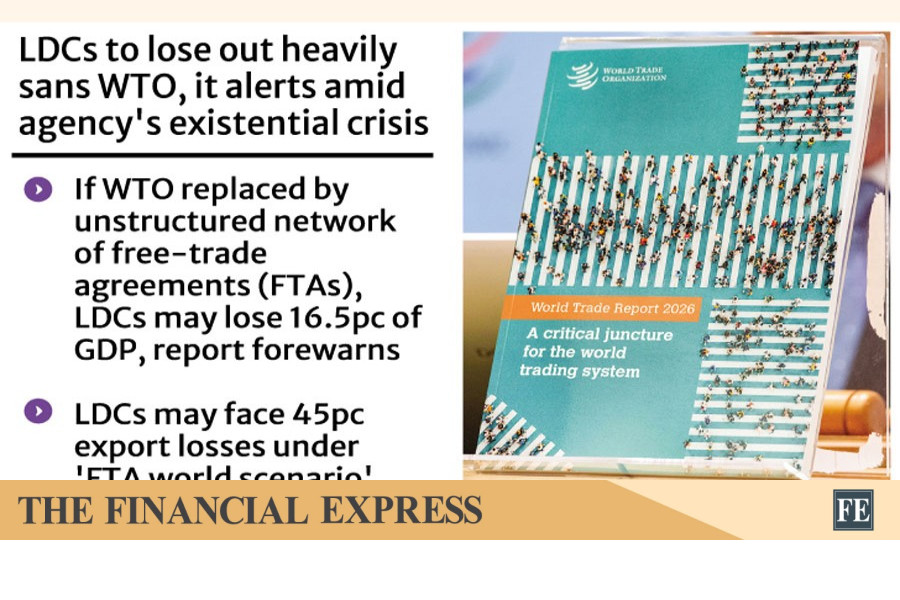
🌏 A lack of modernising the global trading system and the absence of the World Trade Organisation (WTO) would create an uneven turf in which the least-developed countries (LDCs) would lose out in terms of economic growth and exports. The intergovernmental agency dealing with world trade governance rang the alarm bell in the wake of its virtual existential crisis with big powers dabbling in tariff and trade wars.
📊 The World Trade Report 2026, released in Geneva at the WTO Public Forum 2026, warns that if the current structure of multilateral trade cooperation is replaced by an unstructured network of free-trade agreements (FTAs), LDCs may lose 16.5 per cent of gross domestic product (GDP) — more than three times the losses projected for high-income economies. There are currently 44 LDCs on the United Nations (UN) list, of which 37, including Bangladesh, have become WTO members to date. Four LDCs are negotiating to join the WTO now.
📜 Three Scenarios: Geo-Fragmented, FTA World, And Cooperation
WTO Chief Economist Robert Staiger, along with report coordinators Roberta Piermartini and Kathryn Lundquist, presented the report's key features. "The report's model simulations compare alternative futures for trade cooperation," said Staiger. The modelling compares three stylised futures for the global trading system.
In a geo-fragmented world scenario — where the world splits more sharply along geopolitical lines — global GDP would fall by 5.1 per cent and global exports by 18.6 per cent. Under this scenario, real GDP is projected to decline by 10.6 per cent in LDCs and 7.3 per cent in middle-income economies, compared with 2.9 per cent in high-income economies. The disproportionate impact on LDCs — with GDP losses 3.7 times greater than high-income economies — underscores the structural vulnerability of developing countries to the erosion of multilateral trade governance.
- 📊 LDC GDP loss in FTA world scenario: 16.5%
- 📊 LDC GDP loss in geo-fragmented scenario: 10.6%
- 📊 High-income GDP loss: 2.9% (geo-fragmented)
- 📊 LDC export losses (FTA world): up to 45%
- 📊 LDC export losses (geo-fragmented): 33%
- 📊 Global GDP decline (geo-fragmented): 5.1%
- 📊 Global GDP decline (FTA world): 6.9%
- 📊 Global export decline (FTA world): 26.9%
- 📊 Global output decline (inaction): up to 10%
- 👥 Total LDCs: 44 (37 WTO members, including Bangladesh)
⚠ FTA World: LDC Export Losses Up To 45%
Again, in an 'FTA world' scenario — where multilateral cooperation is replaced by a network of free-trade agreements without cooperation between the groupings and the absence of WTO — global GDP would fall by 6.9 per cent and global exports by 26.9 per cent. LDCs may face as high as 45 per cent of losses in their exports under the FTA world scenario, though the losses would be lower at 33 per cent under a geo-fragmented scenario.
The 45% export loss projection for LDCs in an FTA world is staggering — it would effectively halve the export earnings of the world's poorest countries. For Bangladesh, which exports over $48 billion annually (with 84% from RMG), a 45% export loss would translate into approximately $21.6 billion in annual export revenue erosion — a blow that would be economically catastrophic for a country preparing to graduate from LDC status in November 2026.
🏛 WTO Director-General's Response
WTO Director-General Ngozi Okonjo-Iweala made the formal statement on the report followed by a panel discussion. The report cautions that inaction to upgrade the trading system could reduce global output by up to 10 per cent. The WTO Public Forum 2026 — the platform for the report's release — brought together trade ministers, policymakers, business leaders and civil society representatives to discuss the future of the multilateral trading system.
The report's title — 'A critical juncture for the world trading system' — captures the urgency of the moment. The WTO has been under sustained pressure from major powers pursuing unilateral tariff actions, bilateral trade deals and geo-economic fragmentation strategies. The Appellate Body — the WTO's dispute settlement mechanism — has been non-functional since 2019 when the United States blocked new appointments. Without a functioning dispute settlement system, the rules-based trading order that has underpinned global trade since 1995 is increasingly vulnerable to erosion.
🌏 Implications For Bangladesh And LDC Graduation
For Bangladesh, the World Trade Report 2026 findings carry particular significance as the country approaches LDC graduation in November 2026. Post-graduation, Bangladesh will lose access to certain preferential market access arrangements (including EU EBA preferences), making the country more dependent on a functioning multilateral trading system to maintain export market access. If the multilateral system erodes and the world shifts toward FTA-based trade, Bangladesh — which has not signed a single FTA in 25 years — would face severe competitive disadvantage against peers that have established FTA networks.
The report's findings reinforce the case for Bangladesh to accelerate its own trade agreement negotiations — particularly with the EU, US and regional partners — as a hedge against the potential erosion of multilateral trade governance. They also underscore the importance of Bangladesh's active engagement in WTO reform discussions, particularly the push to restore the Appellate Body and modernise multilateral trade rules for the digital economy.
🤝 What Comes Next
The coming months will reveal whether the WTO can translate the report's warnings into concrete reform momentum — or whether the geopolitical forces driving trade fragmentation will overwhelm the multilateral system. For Bangladesh and other LDCs, the stakes could not be higher: the difference between a functioning WTO and an FTA world is the difference between manageable post-graduation transition and potentially catastrophic export revenue loss.
The report's clear quantification of the costs of inaction — 16.5% GDP loss for LDCs, 45% export loss in an FTA world — provides the evidence base that developing country trade ministers need to advocate for multilateral system modernisation at upcoming WTO ministerial conferences and in bilateral engagements with major trading powers. The question is whether the major powers — whose GDP losses are projected to be only one-third of LDC losses — will be sufficiently motivated by the shared global cost to invest political capital in WTO reform.
This news was originally published by The Financial Express. For the full original report, please visit: https://thefinancialexpress.com.bd/economy/world-trade-report-urges-multilateral-trading-system-upgrade
📬 Get Bangladesh Trade News in your inbox
Weekly digest of export industry news, policy updates, and market analysis.
📰 Related Stories