Bangladesh RMG Factories Can Generate 1,768 MWp From Rooftop Solar: CPD Study
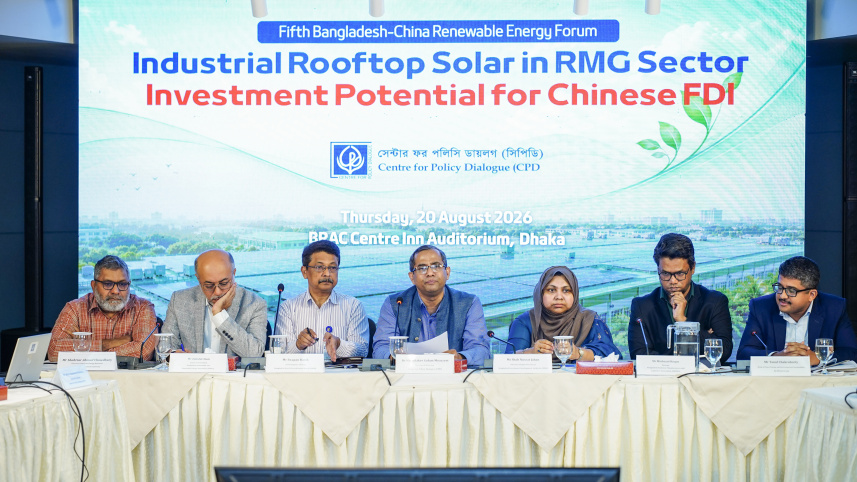
Dhaka, August 20, 2026 — Bangladesh's ready-made garment (RMG) factories have the potential to generate up to 1,768 megawatt-peak (MWp) of electricity through rooftop solar installations — enough to meet roughly 40 percent of the sector's electricity demand and provide significant relief amid persistent energy shortages, according to a comprehensive study by the Centre for Policy Dialogue (CPD) presented at a discussion on Chinese investment potential for rooftop solar in the RMG sector on 20 August 2026 at the BRAC Centre Inn in Dhaka.
📊 The Numbers Behind the Potential
- ☀ 1,768 MWp — total rooftop solar potential of Bangladesh's RMG sector
- 🏢 29,500 MW — Bangladesh's installed power generation capacity
- ⛽ ~50% — actual generation vs installed capacity (due to fuel shortages)
- 📏 9.7 million m² — total RMG rooftop space mapped by CPD
- 📊 5.5 m² per kWp — conversion ratio used
- 🏭 485 MWp — potential from small RMG factories
- 🏭 637 MWp — potential from medium RMG factories
- 🏭 646 MWp — potential from large RMG factories
- 📈 40% — median demand coverage for large factories
- 📈 33% — median demand coverage for medium factories
- 📈 38% — median demand coverage for small factories
- 🧬 350 factories — used to train machine-learning model
- 📊 337 factories — directly measured actual demand
🌞 Rooftop Solar Breakdown by Factory Size
The CPD study mapped nearly 9.7 million square metres of rooftop space across the RMG sector — using a conversion ratio of 5.5 square metres per kilowatt-peak of solar capacity. The findings show significant potential across all factory size categories:
- 🏭 Small factories: 485 MWp — median 38% demand coverage
- 🏭 Medium factories: 637 MWp — median 33% demand coverage
- 🏭 Large factories: 646 MWp — median 40% demand coverage
- 📊 Total: 1,768 MWp — combined rooftop solar potential
The fact that large factories can meet roughly 40 percent of their electricity demand from rooftop solar — with median coverage rather than maximum theoretical coverage — suggests that the study's findings are conservative and based on realistic operational assumptions rather than idealised conditions. For individual large RMG factories consuming 5–10 MW of electricity, a 40 percent rooftop solar contribution would represent 2–4 MW of self-generated clean power — reducing both grid dependence and exposure to diesel generator backup costs.
⛽ The Energy Crisis Context
The CPD study's findings take on added urgency given the deepening energy crisis in Bangladesh. Although the country has an installed power generation capacity of 29,500 MW, fuel shortages restrict actual generation to roughly half of that amount — meaning the gap between nameplate capacity and usable generation is roughly 14,000 MW. The crisis has deepened over the past month after an accident at a floating liquefied natural gas (LNG) terminal in Cox's Bazar curtailed gas supplies, forcing gas-fired power plants to scale back output.
For the RMG sector, the energy crisis translates directly into production disruptions, diesel generator costs, missed shipment deadlines, and eroded export competitiveness. Many factories have been forced to either curtail shifts, switch to expensive diesel backup during peak power cuts, or temporarily shut down operations during the worst supply shortfalls. Rooftop solar offers a structural solution — generating electricity on-site, during daylight hours when many RMG factories operate at peak demand, without requiring grid expansion or new fuel imports.
🧵 Methodology: Machine Learning + Direct Measurement
The CPD study used a sophisticated methodology that combined direct measurement with machine-learning-based estimation — a notable upgrade over the simple rooftop-area-to-capacity calculations used in earlier solar potential studies:
- 📊 350 factories — actual monthly consumption figures used as training data
- 🧬 Machine-learning model — trained on parameters including factory type, size, workforce, location, and machinery
- 📏 9.7 million m² rooftop space — mapped across the broader RMG factory population
- 📊 337 factories — directly matched for actual measured demand
- 📊 5.5 m² per kWp — conversion ratio applied to mapped rooftop area
The ML-based approach is significant because it allows the CPD to estimate electricity demand for factories where direct consumption data was not available — using factory characteristics (size, workforce, machinery type, location) as proxies. This produces a more accurate picture of total sectoral demand than simple averaging, and allows the rooftop solar potential to be assessed in terms of actual factory-level demand coverage rather than abstract capacity figures.
🌐 Chinese Investment Opportunity
The CPD presented the findings at a discussion specifically focused on the Chinese investment potential for rooftop solar in the RMG sector — signalling an explicit interest in mobilising Chinese capital and technology expertise for the initiative. China is the world's largest manufacturer of solar PV modules, with leading companies like LONGi, Jinko Solar, Trina Solar, JA Solar, and Canadian Solar producing high-quality panels at globally competitive prices. Chinese financiers, including the China Development Bank and Exim Bank of China, have also been active in financing solar projects across Belt and Road Initiative partner countries.
For Bangladesh's RMG sector, a Chinese-financed rooftop solar programme could deliver several benefits:
- 💰 Competitive financing — concessional or low-cost capital from Chinese DFIs
- 🧵 Proven technology — high-quality solar PV modules from leading Chinese manufacturers
- ⏳ Speed of deployment — Chinese EPC contractors have experience delivering rooftop solar at scale
- 🌐 Technology transfer — building local capacity for solar installation, maintenance, and operations
- 🌾 ESG compliance — helping RMG factories meet Western buyers' sustainability requirements
🤝 Strategic Significance for the RMG Export Economy
The 1,768 MWp rooftop solar potential identified by CPD is strategically significant for Bangladesh's RMG export economy on multiple dimensions:
- ⛽ Energy supply security — reducing dependence on grid power and diesel generators
- 💰 Cost reduction — solar generation is cheaper than diesel backup and increasingly competitive with grid power
- 🌏 ESG credentials — Western brands require suppliers to demonstrate renewable energy adoption as a condition for orders
- 🌏 Carbon footprint — reducing the carbon intensity of Bangladeshi RMG exports to comply with EU CBAM and similar measures
- 📊 Grid relief — 1,768 MWp of distributed generation would free up significant grid capacity for other industrial users
- 💼 Investor confidence — reliable on-site power makes RMG factories more attractive investment targets
The ESG dimension is particularly important. Major Western RMG buyers — including H&M, Zara (Inditex), Gap, Walmart, Marks & Spencer, C&A, Primark, and others — have committed to science-based emission reduction targets that require their suppliers to adopt renewable energy. Many of these buyers have set specific rooftop solar installation targets for their Bangladeshi supplier factories as a condition for continued sourcing. The CPD study's finding that 1,768 MWp of rooftop solar potential exists across the sector provides a quantitative basis for these buyer commitments — and creates an opportunity for Bangladesh to position itself as a leader in sustainable RMG manufacturing among Asian competitors.
🌐 The Bigger Picture: Energy Sector Reform
The CPD study's findings also have significant implications for Bangladesh's broader energy sector reform agenda. The fact that the RMG sector alone could generate 1,768 MWp of electricity — equivalent to roughly 6 percent of the country's installed generation capacity — demonstrates that distributed renewable generation has the potential to play a meaningful role in addressing the energy crisis. The government's broader renewable energy strategy has been criticised for its slow pace, with utility-scale solar and wind projects facing land acquisition, grid integration, and financing challenges.
Rooftop solar on industrial facilities bypasses many of these challenges — the land is already in industrial use, the grid connection is already in place at the factory, and the financing can be structured as commercial transactions between factory owners and solar developers (rather than complex utility IPP contracts). The CPD's RMG sector study suggests that scaling rooftop solar across all of Bangladesh's industrial sectors — including textiles, pharmaceuticals, leather, agro-processing, plastics, and ceramics — could unlock several thousand MWp of distributed clean generation, providing a structural contribution to the country's energy security and climate commitments.
For CPD Executive Director Dr Fahmida Khatun and her team, the study represents a meaningful contribution to evidence-based policy making in Bangladesh's energy sector. By quantifying the rooftop solar potential with rigorous methodology — combining direct measurement, machine learning, and satellite mapping — the CPD has provided policymakers, investors, and RMG factory owners with the data needed to make informed decisions about scaling rooftop solar deployment. The challenge now is execution: whether Chinese investors, RMG factory owners, and the Bangladesh government can come together to translate this 1,768 MWp potential into actual installed capacity over the coming years — and whether the broader policy framework (including net metering regulations, grid integration protocols, and financing instruments) can be aligned to support rather than hinder the rapid scale-up that the energy crisis demands.
This news was originally published by The Daily Star. For the full original report, please visit: https://www.thedailystar.net/business/news/rmg-factories-can-generate-1768mwp-rooftop-solar-cpd-4252406
Related on BangladeshExport
📬 Get Bangladesh Trade News in your inbox
Weekly digest of export industry news, policy updates, and market analysis.
📰 Related Stories