Rising Fuel, Fertiliser Import Bills May Stir Bangladesh Forex Volatility
Import payments up 12.1 percent against 5.8 percent export growth as the trade deficit widens to $3.82 billion, central bank data shows
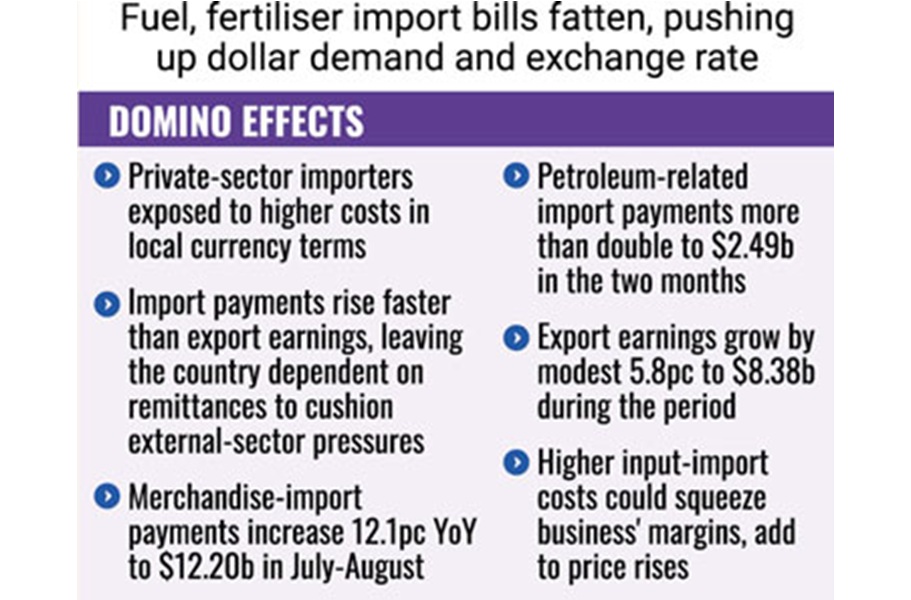
💱 Bangladesh could feel renewed volatility in the foreign-exchange market as higher international prices of fuels and fertilisers fatten import bills and increase demand for the US dollar, financial experts warn. One of the domino effects of higher price indices exposes private-sector importers to higher costs in local currency, people familiar with the matter told The Financial Express — a transmission channel that ultimately lands on working capital, production costs and consumer prices.
⚡ The risk is growing as import payments rise faster than export earnings, leaving the country increasingly dependent on remittances to cushion external-sector pressures, said people working at the central bank. Bangladesh Bank data show merchandise-import payments increased 12.1 percent year on year to $12.20 billion in July-August of the current fiscal year, while export earnings grew by a modest 5.8 percent to $8.38 billion — and the resulting trade deficit widened to $3.82 billion from $2.96 billion a year earlier, according to the central bank's balance-of-payments statistics.
🗽 Higher global energy and fertiliser prices on the back of the Middle East crisis could intensify the pressure if they persist or rise further, a senior central bank official said, noting that Bangladesh relies heavily on imported petroleum products, liquefied natural gas and chemical fertilisers, making its import expenditure vulnerable to international commodity-price movements, shipping costs and geopolitical disruptions. When pressures come on the current account, the forex market becomes volatile, and we have to sell dollars to ease the volatility, the official said, wishing anonymity — adding that market turbulence could snowball into commodity imports and feed inflationary pressure across the economy.
🛢 The petroleum bill more than doubles
📈 The numbers make the exposure plain. Petroleum-related import payments more than doubled to $2.49 billion in July-August from $1.25 billion in the same period a year earlier, according to Bangladesh Bank data — an increase that highlights how a rise in global prices can inflate the import bill even without any comparable increase in the physical volume of goods purchased. Higher import bills translate directly into greater demand for dollars, as importers need more foreign currency to settle payments for the same quantities of fuels, fertilisers and other commodities; if export receipts and other dollar inflows do not keep pace, the resulting imbalance puts upward pressure on the exchange rate.
💵 The market has already shown its sensitivity. The interbank dollar rate reached around Tk 123.82 on July 30, according to published reports, amid increased demand for the greenback — particularly for fuel and fertiliser imports — and Bangladesh Bank's exchange-rate sheet subsequently reported a weighted-average dollar rate of Tk 123.65 on October 19. Although the exchange rate is determined by market demand and supply, further increases in import-related dollar demand could make the market more restive, bankers and analysts caution.
💹 What a weaker taka means for business
🌽 The pressure would extend well beyond government agencies and state-owned importers. Private-sector businesses importing raw materials, machinery, fuel and other intermediate goods would have to pay more taka for each dollar if the exchange rate rises — increasing working-capital requirements, raising production costs and potentially squeezing profit margins, particularly for businesses unable to pass higher costs on to consumers, says Dr Zahid Hussain, an independent economist. The arithmetic is unforgiving: an importer settling a $1.0-million bill would pay Tk 123 million at an exchange rate of Tk 123 per dollar, but if the rate rose to Tk 125, the same payment would cost Tk 125 million — an extra Tk 2.0 million before accounting for bank charges or other costs.
🚛 Md Abul Bashar, a leading commodity importer in Chattogram, says businesses could face a double burden if international commodity prices and the dollar exchange rate rise simultaneously, because higher fuel prices would feed into transport, electricity and production costs at the same time as the local-currency cost of every imported tonne climbs.
📝 Remittances still cushioning the blow
💸 The strong growth in remittances is helping Bangladesh finance its import requirements. The $5.83 billion received in July-August exceeded the $3.82 billion merchandise-trade deficit during the period — though that comparison alone does not establish that the external account is fully covered, since the country must also pay for services, interest, dividends and other external obligations. Bangladesh Bank's data show the current account remained in surplus at about $599 million in the first two months of FY2026-27, compared with $197 million a year earlier, largely supported by remittances. Nevertheless, the overall balance-of-payments deficit widened to around $694 million from $53 million, reflecting deterioration in other external transactions.
🔭 The policy takeaway is awkward but clear. Bangladesh's external stability currently rests on two pillars — remittance income that has grown impressively, and export growth that has not. A sustained increase in energy- and fertiliser-import costs could weaken the benefit of strong remittance inflows, particularly if export growth remains subdued or external financial inflows fail to improve. For an economy approaching LDC graduation — when concessional finance narrows and global market access terms harden — building a buffer through export diversification, prudent fuel procurement and disciplined import management is not optional homework but the core of the macroeconomic agenda.
🏦 For import-dependent industries, the immediate hedging strategies are familiar: forward contracts where available, inventory timing around fuel-price cycles, and pricing clauses that share currency risk with buyers. For policymakers, the sequencing question is whether exchange-rate flexibility, backed by adequate reserves, can absorb the shock gradually rather than in disruptive steps — the difference between an adjustment and a crisis. The July-August numbers suggest the country still has room to manoeuvre; the second half of the fiscal year will show whether that room holds.
This news was originally published by The Financial Express. For the full original report, please visit: https://thefinancialexpress.com.bd/bangladesh/bangladesh-may-feel-demand-driven-volatility-on-forex-market
📬 Get Bangladesh Trade News in your inbox
Weekly digest of export industry news, policy updates, and market analysis.
📰 Related Stories