Janata Bank Carries Bulk of Bangladesh State Banks' Tk 75,397 Crore Bad Loans
Janata Bank's Tk 75,396.67 crore in bad loans — over half of six state banks' total Tk 147,776 crore — is concentrated among top 20 defaulters including Beximco, S Alam, AnonTex, Crescent and Thermex groups.
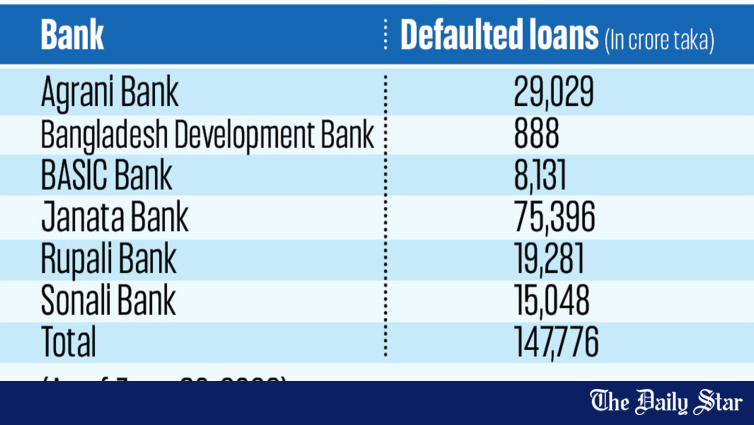
🏦 Dhaka, Bangladesh — Janata Bank had the highest amount of non-performing loans (NPLs) among the country’s six state-owned banks, accounting for more than half of the Tk 147,776 crore in non-performing loans held by Agrani Bank, Bangladesh Development Bank, BASIC Bank, Janata Bank, Rupali Bank and Sonali Bank as of 30 June 2026.
📊 Finance Minister Amir Khosru Mahmud Chowdhury disclosed the figures while replying to a query from MP Abdul Alim during the question-and-answer session in Parliament yesterday.
💰 Tk 75,397 Crore in Bad Loans Concentrated in Top 20 Defaulters
📊 Officials of Janata Bank told The Daily Star, seeking anonymity, that a major portion of the bank’s Tk 75,396.67 crore in bad loans is concentrated among a small number of powerful business groups. About 80 percent of its bad loans are stuck with its top 20 defaulters, including:
- 🏢 Beximco Group — alone accounting for about Tk 25,000 crore
- 🏢 S Alam Group
- 🏢 AnonTex Group
- 🏢 Crescent Group
- 🏢 Thermex Group
⚠ The concentration of NPLs in a handful of large conglomerates underscores the structural vulnerability of Bangladesh’s banking sector — where a small number of politically connected business groups account for a disproportionate share of defaulted loans across multiple banks.
📊 Banking Sector: Tk 6.07 Lakh Crore in Total NPLs
💰 At the end of June 2026, bad loans in the entire banking sector stood at Tk 6,06,555 crore, accounting for 32.78 percent of total disbursed loans, according to the latest data from Bangladesh Bank. Defaulted loans increased by Tk 17,851 crore in the three months to June, with the bad-loan ratio standing at 32.26 percent at the end of March.
📊 Earlier, defaulted loans in the banking sector stood at Tk 6.44 lakh crore, or nearly 36 percent of disbursed loans, at the end of September 2025.
📈 Political Transition Triggered NPL Surge
🌏 After the fall of the Awami League-led government in August 2024, bad loans in the banking sector jumped sharply as businesses affiliated with the previous government — including S Alam Group, Nassa Group, Beximco and Sikder Group — defaulted heavily.
📊 The fragile state of the banking sector was reflected in December 2024, when bad loans jumped to Tk 3,45,764 crore from Tk 2,11,391 crore six months earlier, Bangladesh Bank data showed.
🏛 62 Banks in Bangladesh, Including 7 Public
📊 Replying to another query from Lutfor Rahman MP, Amir Khosru said the government usually takes necessary steps in accordance with the rules after receiving applications to set up new banks. Between 2010 and June 2024, 13 private banks were allowed to operate, he said. There are currently 62 public and private banks in the country, of which seven are public banks, said the minister.
⚠ Strategic Context: Concentration Risk in Bangladesh Banking
📊 The Janata Bank disclosure highlights the deep structural challenge facing Bangladesh’s banking sector — concentration risk. When 80 percent of a single bank’s NPLs are tied to just 20 defaulters, the entire banking system becomes hostage to the financial health of a small number of business groups.
💰 For Janata Bank specifically, the Tk 75,397 crore NPL position translates into:
- 💲 Significant provisioning requirements that erode capital
- 📉 Reduced capacity to extend fresh credit to productive sectors
- 🛡 Weakened depositor confidence
- 💪 Increased reliance on Bangladesh Bank refinancing facilities
🌏 For Bangladesh’s broader economy, the concentration of bad loans in conglomerates like Beximco, S Alam, AnonTex, Crescent and Thermex has several cascading effects:
- 👥 Employment risk — these groups collectively employ hundreds of thousands of workers across textiles, pharmaceuticals, ceramics, steel and consumer goods
- 💰 Fiscal cost — eventual recapitalisation of state banks falls on taxpayers
- 🤝 Credit squeeze — capital locked in NPLs is unavailable for new lending
- 🌏 Investor sentiment — persistent NPL issues weigh on foreign investor confidence
🤝 Government Strategy: Separate Companies from Owners
⚖ As disclosed by Finance Minister Amir Khosru in a separate exchange in Parliament, the government’s strategy for resolving the legacy NPL problem involves separating the legal personality of operating companies from the personal liability of their owners. Under this approach:
- ✅ Operating companies continue running to preserve employment and operational cash flow
- ⚖ Owners face criminal prosecution for personal corruption and fraud
- 💰 Rescheduling permitted under law for companies that qualify
- 📋 Those that don’t qualify face auction or restructuring
📊 For Janata Bank specifically, with Beximco alone accounting for Tk 25,000 crore of its NPLs, the resolution strategy will need to be carefully calibrated. Aggressive enforcement could trigger wider economic disruption if Beximco’s operating companies — which span pharmaceuticals, textiles, ceramics and steel — are forced to shut down. However, continued forbearance without firm action would only entrench moral hazard.
✅ For Bangladesh’s banking sector reform agenda, the Janata Bank disclosure provides a stark reminder of the work that remains. While the political transition has created space for accountability, the underlying NPL stock — particularly the concentration in a few large defaulters — will require sustained, multi-year resolution efforts spanning legal reform, asset recovery, recapitalisation and tighter credit discipline in fresh lending. The Tk 6.07 lakh crore total banking sector NPL figure, equivalent to nearly a third of all disbursed loans, underscores the magnitude of the challenge ahead.
This news was originally published by The Daily Star. For the full original report, please visit: https://www.thedailystar.net/business/economy/news/janata-bank-carries-bulk-state-banks-bad-loans-4266546
Related on BangladeshExport
📬 Get Bangladesh Trade News in your inbox
Weekly digest of export industry news, policy updates, and market analysis.
📰 Related Stories