IMF Reviews Bangladesh External Debt Risks Amid Slow Loan Disbursements
Saifuddin Saif 15 July, 2026, 12:20 am Last modified: 15 July, 2026, 09:48 am Representational image.
Photo: Collected The visiting International Monetary Fund mission yesterday (14 July) held a meeting with the Economic Relations Division (ERD) to assess the country's external debt risks.
Highlights: TBS During the meeting at the Secretariat, the IMF sought detailed information on Bangladesh's cost of debt, availability of concessional financing, growing reliance on market-based floating-rate loans, average borrowing costs, and external debt-servicing obligations.
According to ERD officials who attended the meeting, the multilateral lender also sought an explanation for the recent decline in external loan disbursements to Bangladesh.
In addition, the mission asked why budget support from development partners has fallen in recent years.
Bilateral lenders, particularly Japan, are shifting towards less concessional loans, while the share of market-based floating-rate borrowing from multilateral lenders such as the World Bank and the ADB continues to rise.
Floating-rate loans accounted for about 30% of Bangladesh's external debt portfolio in FY25, and officials expect that share to increase further in the recently concluded fiscal year.
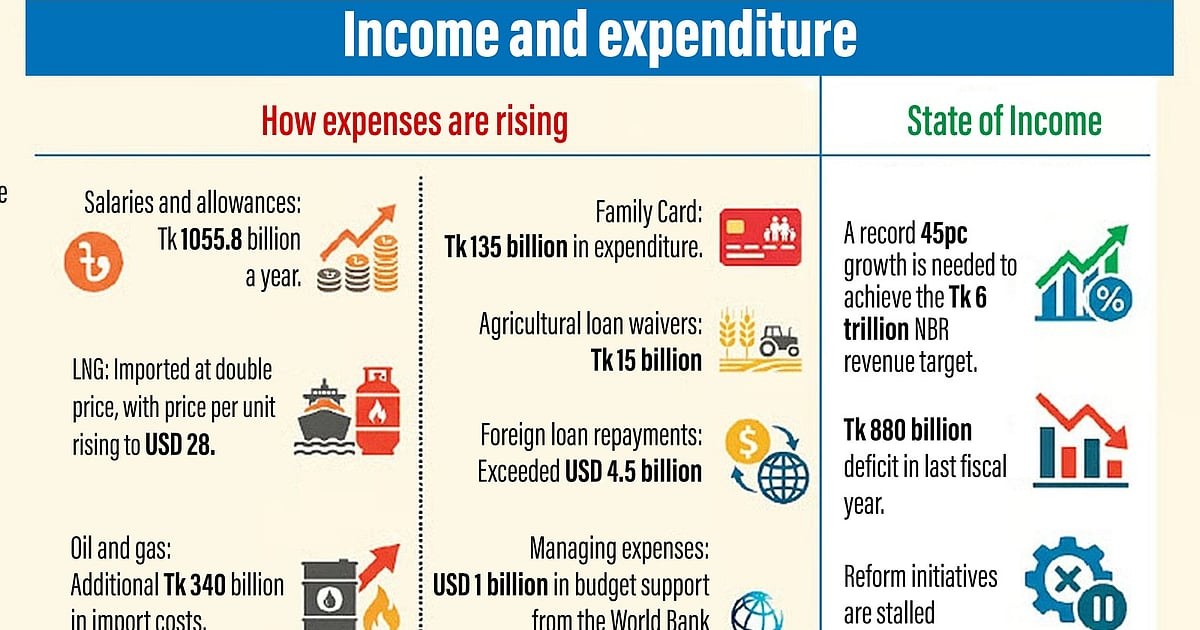
Bangladesh is entering a period of intense fiscal pressure, with external debt servicing set to surge sharply over the next five years, exposing the limits of its already weak revenue base, officials told the IMF.
According to an ERD report, the country will need to pay nearly $26 billion in external debt servicing between the current fiscal year and FY30.
📊 Key Details
In the 54 years since independence in 1971, Bangladesh has paid around $40 billion in debt servicing.
Now, nearly two-thirds of that amount will be repaid within just five years.
Review part of broader macroeconomic assessment ERD officials said the IMF's review forms part of its broader assessment of Bangladesh's macroeconomic conditions and external debt sustainability.
As part of the exercise, the mission sought an update on the country's external borrowing position and asked what steps the government is taking to accelerate the disbursement of committed foreign loans that remain stuck in the pipeline.
Officials said they informed the IMF mission that the government is reviewing many ongoing projects inherited from the previous administration and is taking a cautious approach to approving new externally financed projects.
💡 Analysis & Context
They added that development activities slowed during the interim government's tenure, contributing to weaker foreign loan disbursements.
According to ERD data, Bangladesh currently has $41.73 billion in undisbursed foreign loans in the pipeline.
External loan disbursements totalled $4.577 billion in July-May, down 18.3% from $5.488 billion in the corresponding period a year earlier.
For FY25, total external loan disbursements stood at $9.26 billion, compared with $10.25 billion in the previous fiscal year, ERD data shows.
Budget support Officials said the IMF also sought an explanation for recent trends in budget support.
🎯 What This Means for Bangladesh
According to the ERD, Bangladesh received a record $3.44 billion in budget support in FY25, but the amount fell sharply to $1.56 billion in FY26.
Officials expect budget support to decline further in the current fiscal year.
They said budget support increased in the aftermath of the Covid-19 pandemic and the Russia-Ukraine war to help Bangladesh cope with mounting economic pressures.
More recently, heightened geopolitical tensions stemming from the Israel-US conflict with Iran have further increased the need for external financing.
Bangladesh exited an existing $5.5 billion IMF loan programme, agreed in 2023 under the previous government, and is now seeking a new three-year package worth $4-4.5 billion with revised reform conditions.
📈 Looking Ahead
The high-level IMF delegation arrived in Dhaka on 12 July for a five-day fact-finding mission to assess the feasibility of the fresh loan package.
This news was originally published by The Business Standard. For the full original report, please visit: https://www.tbsnews.net/economy/imf-reviews-bangladeshs-external-debt-risks-slow-loan-disbursements-1488601
📬 Get Bangladesh Trade News in your inbox
Weekly digest of export industry news, policy updates, and market analysis.
📰 Related Stories