Chittagong Stock Exchange Pushes for Commodity Exchange to Diversify Bangladesh Capital Market
CSE MD M Shaifur Rahman Mazumdar says preparations for commodity market are nearing completion, with regulatory, technological and ecosystem frameworks almost ready. Former CSE president Mirza Salman Ispahani attended as chief guest.
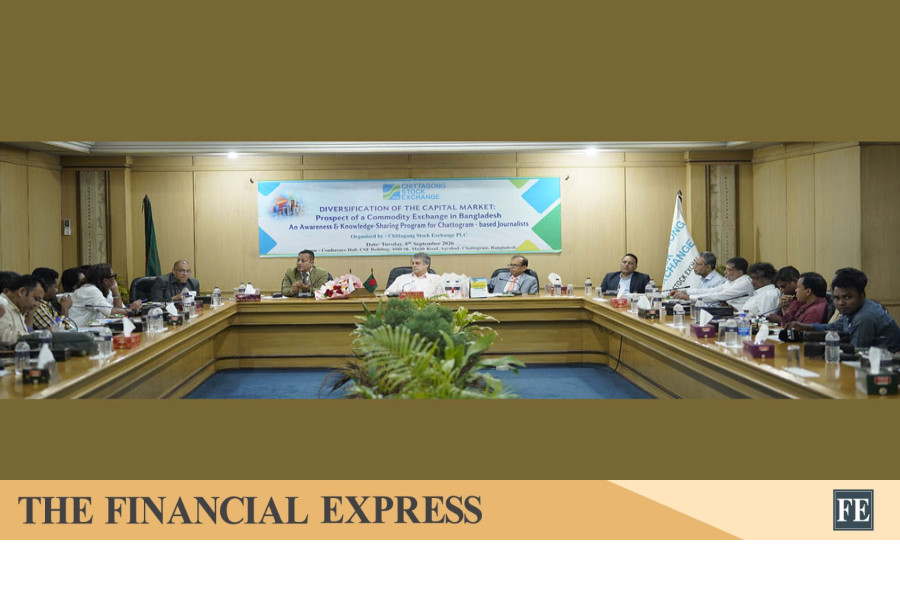
📊 Chattogram, Bangladesh — The Chittagong Stock Exchange (CSE) is pushing to diversify Bangladesh’s capital market by introducing a commodity exchange, aiming to expand investment opportunities and bring the country’s financial market closer to international standards.
📊> The exchange shared this at an awareness and knowledge-sharing programme titled “Diversification of Bangladesh Capital Market: Prospect of Commodity Exchange” held at its head office in Chattogram on Tuesday. Former CSE president Mirza Salman Ispahani was present as the chief guest at the event.
💬 CSE MD: Essential for Capital Market Diversification
💬> CSE Managing Director M Shaifur Rahman Mazumdar said establishing a commodity exchange is essential for diversifying Bangladesh’s capital market, improving commodity price discovery and managing price risks.
💬> He said preparations for establishing the commodity market had advanced significantly, with work on its regulatory, technological and ecosystem frameworks nearing completion.
💬> “Establishing a commodity market is essential for making the capital market more vibrant,” he said.
💻 Trading System Upgraded
💬> Mr Mazumdar said the CSE had also upgraded its trading system as part of the technological preparations, incorporating the existing:
- 📊 Equity market
- 📊 Derivatives market
- 📊 Equity-derivatives market
💬 He said the development of the commodity-market ecosystem would require cooperation from all relevant stakeholders.
💬 CSE Director: Bangladesh's Commodity Market Is Incomplete
💬> CSE Director and former major (retd) Emdadul Islam said Bangladesh’s commodity market remains incomplete and a commodity exchange could help address weaknesses in:
- 📊 Price discovery
- 📊 Commodity price-risk management
💬> “Bangladesh’s commodity market is incomplete. If commodity price risks can be managed properly and appropriate prices can be determined, the commodity market can be transformed into a well-structured market,” he said.
💬> He said experience of countries with established commodity markets showed that such markets could play an important role in the broader economic ecosystem.
📊> Benefits for Producers, Consumers and Supply Chain
💬> The commodity exchange could benefit producers, consumers and other participants in the commodity supply chain by providing a more organised mechanism for:
- 📊 Trading — organized trading platform
- 📊 Price discovery — transparent market-determined prices
- 📊 Risk management — hedging against price volatility
🌏> Strategic Context: Bangladesh Capital Market Evolution
📊> For Bangladesh’s capital market, a commodity exchange would represent a significant evolution:
- 📊 Current markets: Equity (DSE + CSE), government bonds, treasury bills
- 📊 Derivatives launch: DSE planning derivatives trading by January 2028
- 📊 Commodity exchange: Would add commodities (jute, rice, wheat, cotton, gold) to tradable instruments
- 📊 International benchmarks: India (MCX, NCDEX), China (SHFE), Vietnam (MXV)
- 📊 Market depth: Would attract institutional investors and hedgers
- 📊 Price transparency: Reduce information asymmetry in commodity markets
💰> Bangladesh Commodity Trading Context
📊> Bangladesh has significant commodity production and trade that could benefit from a commodity exchange:
- 🌾 Rice — major producer, aromatic rice exports
- 🌾 Jute — world’s largest raw jute producer
- 🌾 Potato — significant exports to Middle East
- 🧴 Gold — Tk 235,146 per bhori, active domestic market
- 🛢 LNG — major importer, price volatility affects economy
- 🌾 Cotton/yarn — Tk 30,000cr annual imports from India
📋> Implications for Bangladesh Economy
📊> A commodity exchange in Bangladesh would have several economic implications:
- 📊 Farmer price protection — hedging against price crashes (e.g., paddy price drops)
- 📊 Import cost management — hedging against LNG, cotton, edible oil price volatility
- 📊 Export revenue stability — jute, rice, potato exporters can lock in prices
- 📊 Investment diversification — new asset class for domestic investors
- 📊 Financial market deepening — broader range of instruments
- 📊 Inflation management — transparent commodity prices inform monetary policy
- 📊 International integration — linkages with regional commodity exchanges
📈> Outlook: Nearing Completion
✅> For Bangladesh’s broader capital market strategy, the CSE’s commodity exchange initiative represents an important step toward financial market diversification. With regulatory, technological and ecosystem frameworks nearing completion, Bangladesh could soon join the ranks of emerging economies with commodity exchanges — providing farmers, traders, investors and policymakers with a transparent, organized platform for commodity price discovery and risk management.
🌏> For the export community — particularly jute, rice, potato and leather exporters who face significant price volatility — a commodity exchange could provide hedging tools that reduce revenue uncertainty and improve export planning. Combined with the DSE’s planned derivatives trading launch by January 2028, Bangladesh’s capital market is poised for a transformation that could attract new investors, deepen market liquidity and support the broader economic diversification agenda as the country prepares for LDC graduation.
This news was originally published by The Financial Express. For the full original report, please visit: https://thefinancialexpress.com.bd/stock/commodity-exchange-key-to-capital-market-diversification-cse
📬 Get Bangladesh Trade News in your inbox
Weekly digest of export industry news, policy updates, and market analysis.
📰 Related Stories