China Now Largest Trading Partner of 151 Countries: Implications for Bangladesh Trade Strategy
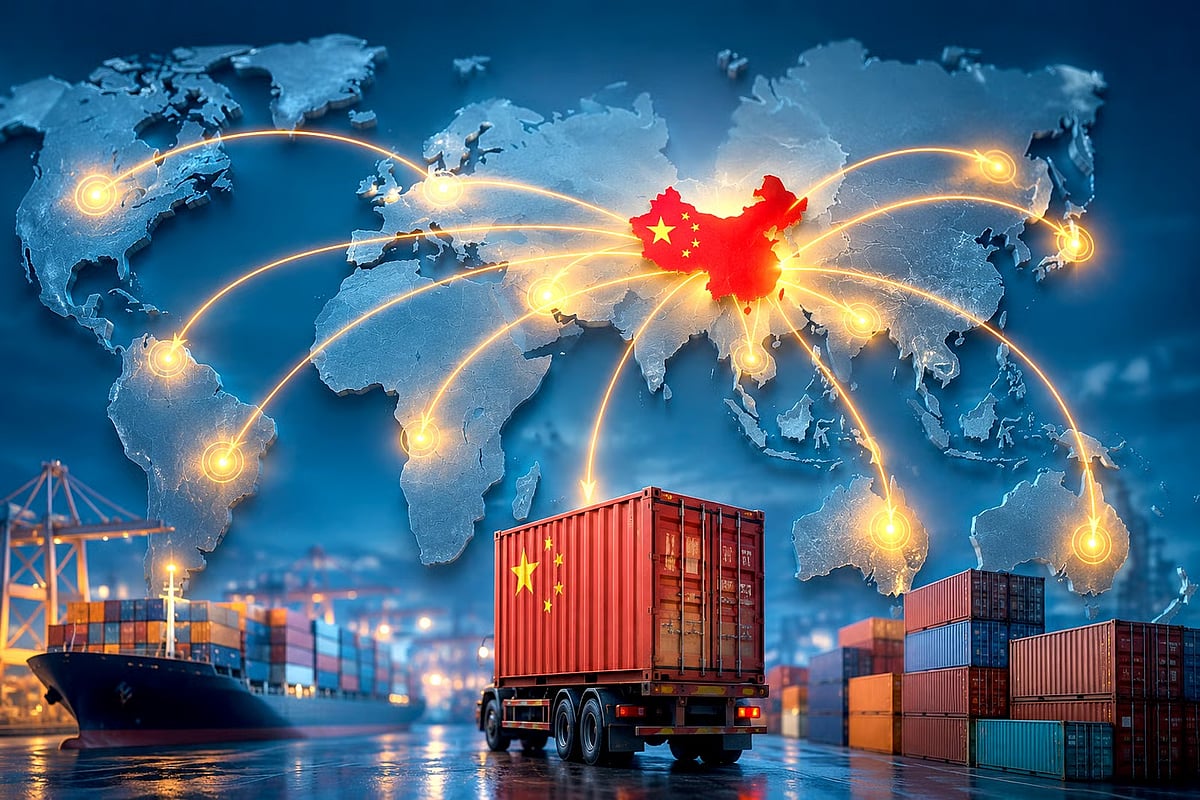
Dhaka, August 18, 2026 — China has emerged as the world's largest trading partner for 151 countries — surpassing the United States in trade prominence across much of the developing world — according to a Visual Capitalist analysis of 2025 bilateral trade data from the International Monetary Fund's (IMF) Direction of Trade Statistics. The shift carries profound implications for global supply chain architecture, geopolitical alignment, and trade strategy for countries like Bangladesh that maintain significant commercial relationships with both China and the United States.
📊 The Numbers at a Glance
- 🌐 151 countries — for which China is now the largest trading partner
- 🌐 ~80% of UN member states — roughly the share where China is the largest partner
- 🌐 2001 — year China joined WTO (major turning point)
- 🌐 1949 — People's Republic of China established
- 🌐 1978 — Deng Xiaoping's market-oriented reforms launched
- 🌐 1939 — Shanghai described in Auden/Isherwood's "Journey to a War" (poor, addicted to opium)
- 🌐 World's 2nd largest economy — current China status
- 📊 Visual Capitalist 2025 analysis — data source
- 📊 IMF Direction of Trade Statistics — underlying data
🏛 Historical Context: From Poverty to Global Trade Dominance
The transformation of China from a poverty-stricken, opium-addicted country dominated by foreign powers in the early 20th century to the world's largest trading partner is one of the most remarkable economic transformations in modern history. The article traces several key milestones:
- 📜 1939 — WH Auden and Christopher Isherwood's "Journey to a War" described Shanghai as looking impressive from the river but not on the inside
- 📜 1949 — People's Republic of China established; country predominantly agricultural and poor
- 📜 1949-1978 — Mao era: planned economic model based on Soviet approach; emphasis on industrialisation
- 📜 1978 — Deng Xiaoping's market-oriented reforms launched
- 📜 1978 onwards — agricultural production system changes, SEZ establishment, FDI attraction, export-oriented industrialisation
- 📜 2001 — China joined WTO; major turning point in global trade integration
- 📜 2001-2025 — rapid industrialisation, export growth, supply chain integration; China became one of world's major manufacturing hubs
- 📜 2025 — China is now largest trading partner of 151 countries
The 1978 reforms were built on the foundations of industrial capacity, state capability, and infrastructure developed during Mao's era — demonstrating how state-led industrialisation (even when inefficient) can create the physical and institutional infrastructure that enables subsequent market-oriented growth. This historical pattern has direct relevance for Bangladesh's own development trajectory, where state investment in industrial capacity, infrastructure, and human capital forms the foundation for private-sector-led growth.
🌐 Global Supply Chain Dependence on China
The reality that the industries and supply chains of many countries are heavily dependent on raw materials, intermediate goods, machinery, and components from China creates a structural interdependence that goes well beyond consumer goods trade. Without the necessary supplies from China, production in many countries could come to a standstill. The dependency varies by country:
- 🛒 Consumer goods importers — some countries mainly import finished consumer goods from China (clothing, electronics, household items)
- 🏭 Intermediate goods importers — large share of intermediate goods and machinery for industrial production comes from China
- 🧵 Raw material importers — some countries import raw materials (rare earths, chemicals) that are difficult to source elsewhere
- 💰 Capital goods importers — machinery and equipment for industrial production
- 🧴 Pharmaceutical inputs — APIs and intermediates (relevant for Bangladesh's pharma sector)
- 👕 Textile inputs — fabric, yarn, dyes, accessories (relevant for Bangladesh's RMG sector)
The breadth of China's supply chain role means that any significant disruption to Chinese exports — whether from geopolitical tensions, pandemics, natural disasters, or industrial action — would have cascading effects on industrial production globally. This vulnerability has been a major driver of the "China Plus One" strategy pursued by many multinationals — seeking to diversify supply chains across multiple countries rather than depending solely on China.
🧱 The iPhone Example: China's Manufacturing Ecosystem
The article uses the iPhone example to illustrate China's manufacturing ecosystem advantage:
- 📱 Large-scale production in China — enables economies of scale
- 👥 Skilled labour — massive workforce with technical skills and manufacturing experience
- 🧵 Vast network of suppliers — component manufacturers clustered in industrial zones
- 🛣 Advanced infrastructure — ports, roads, power, logistics optimised for export manufacturing
- 💰 Low production costs — despite rising wages, China remains cost-competitive
- 🌐 Result — technology products like iPhone can be manufactured at relatively low costs
- 👥 Middle-class access — such products have reached middle class in developing countries, not just wealthy in developed
The iPhone example is directly relevant to Bangladesh's export strategy. Bangladesh's RMG sector has built a similar ecosystem advantage for apparel manufacturing — with skilled labour, supplier networks, infrastructure, and scale enabling cost-efficient production of garments for global markets. The challenge for Bangladesh's export diversification agenda is to extend this ecosystem advantage beyond RMG into other sectors where the country has or can develop competitive capacity.
🌐 Implications for Bangladesh's Trade Strategy
For Bangladesh — which maintains significant commercial relationships with both China and the United States — the Visual Capitalist analysis carries several strategic implications:
- 👕 RMG fabric and accessories imports — Bangladesh's RMG sector imports significant volumes of fabric, yarn, dyes, and accessories from China
- 💊 Pharmaceutical APIs — Bangladesh's pharma sector imports roughly 90% of APIs and intermediates, primarily from China and India
- 💰 Capital machinery — industrial equipment imports, including textile machinery, pharma production lines
- 🌐 Consumer goods — electronics, household items, and consumer durables from China
- 🚢 Infrastructure construction — Chinese contractors and financiers involved in major Bangladeshi infrastructure projects
- 💰 Chinese FDI — potential for significant Chinese investment in BEZA economic zones
- 🤝 Belt and Road Initiative — Bangladesh's participation in China's BRI framework
Bangladesh's challenge is to balance its commercial relationship with China against:
- 🇺🇸 US trade relationship — US is the largest single-country export market for Bangladeshi RMG
- 🇪🇺 EU trade relationship — EU is the largest regional export market for Bangladeshi RMG under GSP
- 🇮🇳 India trade relationship — growing bilateral engagement under BNP government
- 🇶🇦 Qatar energy relationship — LNG imports for energy security
- 🇦🇪 UAE bilateral relationship — migrant workers, remittance, trade
- 🇰🇵 South Korea CEPA — signed, awaiting ratification
- 🇲🇾 Malaysia bilateral relationship — tourism, labour, aviation cooperation
🌐 Geopolitical Alignment Considerations
The fact that China is now the largest trading partner of 151 countries — many of which are also US allies or significant US trade partners — creates a complex geopolitical landscape where economic relationships do not always align with political alignment. For Bangladesh:
- 🇨🇳 China relationship — major supplier of RMG inputs, capital machinery, infrastructure investment
- 🇺🇸 US relationship — largest single-country export market; GSP considerations, trade policy alignment
- 🌐 Balancing act — Bangladesh must navigate competing US-China interests in South Asia
- 🤝 Non-alignment — Bangladesh's traditional non-aligned foreign policy stance
- 🌐 Multi-alignment — engaging both powers without picking sides
- 💰 Tariff and trade policy — navigating US-China trade tensions and their spillover effects
- 💼 Supply chain diversification — "China Plus One" strategy could benefit Bangladesh as alternative manufacturing base
🌐 The "China Plus One" Opportunity for Bangladesh
The growing recognition of supply chain dependence on China has led many multinational companies to pursue a "China Plus One" strategy — seeking to diversify manufacturing across multiple countries to reduce China concentration risk. For Bangladesh, this represents a significant opportunity:
- 👕 RMG sector — already a major alternative to Chinese apparel manufacturing
- 🧴 Plastics and chemicals — potential for growth with EPR-compliant production
- 💊 Pharmaceuticals — growing exports to regulated markets, particularly post-LDC
- 🧵 Textile backward linkage — yarn and fabric production as alternative to Chinese imports
- 🌾 Agro-processing — food processing for global supply chains
- 🔌 Light engineering — potential for components and assemblies
- 🌐 IT/ITeS — software development, BPO, semiconductor design (per Ulkasemi)
To capture the "China Plus One" opportunity, Bangladesh needs to address several structural constraints identified across the August 2026 economic reviews: energy supply reliability (LNG shortage, gas rationing), banking sector health (NPLs at 30.6% of loans), capital machinery imports recovery, tax net expansion, and ease of doing business. The BNP government's broader reform agenda — including the Tk 60,000 crore stimulus, the five-year banking sector strategic framework, the NBR separation, and the energy sector reform programme — is designed in part to address these constraints and position Bangladesh as a credible "China Plus One" manufacturing alternative.
🌐 The Bigger Picture: Bangladesh's Trade Strategy in a Multipolar World
The Visual Capitalist analysis of China's emergence as the largest trading partner of 151 countries underscores that the global trade landscape is becoming increasingly multipolar — with no single country able to dominate all bilateral trade relationships. For Bangladesh — a small, export-oriented economy seeking to grow from a $450 billion GDP to a $1 trillion economy by 2034 — this multipolarity offers both opportunities and challenges:
- 🤝 Trade partner diversification — engage both China and US, plus India, EU, ASEAN, Gulf, and others
- 💰 Supply chain positioning — become a "China Plus One" alternative for multinationals
- 🌐 Geopolitical balancing — maintain non-aligned posture; engage all major powers commercially
- 💼 Sectoral specialisation — build competitive advantage in specific export sectors (RMG, pharma, agro, IT)
- 💰 FDI attraction — from both Chinese and Western investors, in different sectors
- 🤝 Bilateral trade agreements — including South Korea CEPA, future FTAs with ASEAN, EU, US
- 🌐 Regional integration — through SAARC, BIMSTEC, BBIN, and ASEAN connectivity
For the BNP government under Prime Minister Tarique Rahman and Foreign Minister Khalilur Rahman (whose UNGA 81st presidency role gives Bangladesh a global diplomatic platform), the China trading partner milestone reinforces the importance of the broader trade diversification strategy. The recent series of bilateral engagements — South Korea CEPA, Qatar energy assurance, Malaysia tourism cooperation, India B2B task forces, UAE bilateral engagement — collectively represent an effort to build a balanced portfolio of trade relationships that captures opportunities across all major markets while managing the risks of dependence on any single partner. For Bangladesh's export economy — which depends on imported Chinese inputs (fabric, APIs, machinery) for its export production (RMG, pharmaceuticals, agro-processing) — the China relationship is not optional but structural. The strategic question is not whether to engage with China, but how to engage in ways that maximise Bangladesh's commercial benefit while managing the geopolitical risks of an increasingly complex multipolar world. The next decade will reveal whether Bangladesh can successfully navigate this complexity to achieve its ambition of becoming a $1 trillion economy by 2034 — with both China and the United States as significant trade partners, and with a diversified, resilient export base that captures the "China Plus One" opportunity that the global supply chain restructuring is creating.
This news was originally published by Prothom Alo English. For the full original report, please visit: https://en.prothomalo.com/business/local/oxuu9dy5i3
📬 Get Bangladesh Trade News in your inbox
Weekly digest of export industry news, policy updates, and market analysis.
📰 Related Stories