Bangladesh Eyes Equally Beneficial Economic Partnership With India: State Minister Shama Obaed
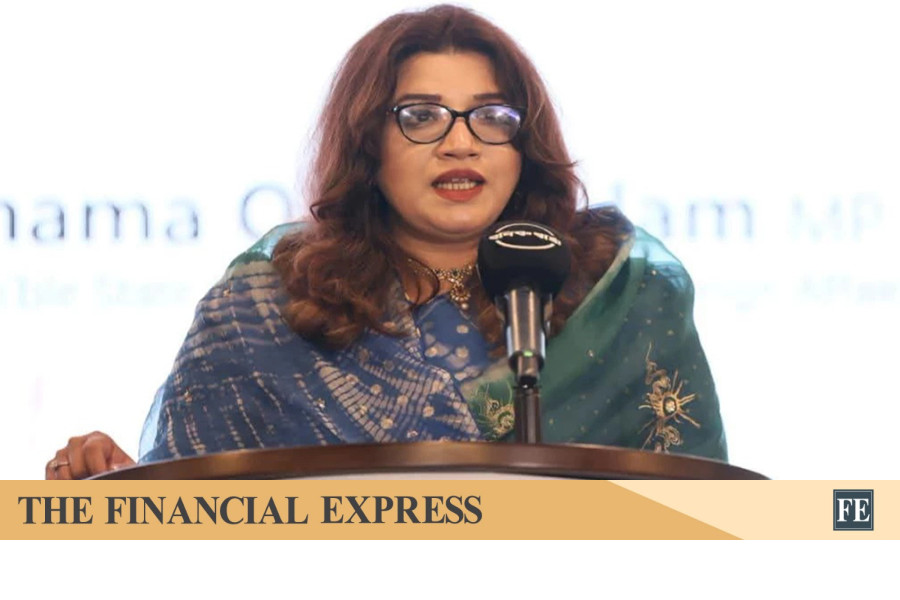
Dhaka, August 19, 2026 — Bangladesh wants to see an economic partnership with India that is "equally beneficial and brings tangible changes" to the lives of people — articulated by State Minister for Foreign Affairs Shama Obaed Islam during a reception hosted by Indian High Commissioner to Bangladesh Dinesh Trivedi on Tuesday night (19 August 2026). The reception, held in honour of leading Bangladeshi business leaders and a delegation from the Confederation of Indian Industry (CII), underscored the BNP government's intent to rebalance the bilateral relationship toward more symmetric commercial engagement — building on the FBCCI-CII B2B task forces announced the previous day.
📊 Key Participants and Engagement
- 🤝 Shama Obaed Islam — Bangladesh State Minister for Foreign Affairs (keynote speaker)
- 🤝 Dinesh Trivedi — Indian High Commissioner to Bangladesh (host)
- 🤝 Chandrajit Banerjee — CII Director General (Indian delegation leader)
- 🤝 Pawan Badhe — Indian Deputy High Commissioner (speaker)
- 👥 Leading Bangladeshi business leaders — in attendance
- 👥 CII delegation — visiting from India
- 📅 19 August 2026 (Tuesday) — reception date
🤝 "Equally Beneficial and Tangible Changes"
Shama Obaed's framing of the partnership as needing to be "equally beneficial and brings tangible changes" is significant — reflecting a deliberate departure from the previous administration's approach to India, which was widely criticised within Bangladesh for being asymmetrically tilted in India's favour on issues including trade, water sharing, border management, and security cooperation. The State Minister's language signals that the BNP government under Prime Minister Tarique Rahman intends to pursue a more balanced bilateral relationship — one where Bangladesh's commercial interests are explicitly protected and advanced.
"I am confident that the business communities of our two countries have both the vision and the capacity to make this happen. We can collectively identify practical solutions to the challenges," she said, noting that greater predictability and ease of doing business will benefit businesses in both countries. The reference to "practical solutions to the challenges" implicitly acknowledges the persistent bilateral trade frictions — including non-tariff barriers on Bangladeshi exports to India, port restrictions on specific products, and uneven market access.
💼 Business Visa Facilitation
The State Minister specifically called for faster business visa issuance for Bangladeshis travelling to India — highlighting one of the most persistent operational bottlenecks in the bilateral commercial relationship:
- 📜 Business visa processing delays — Bangladeshi business travellers often face long wait times
- 📜 Visa documentation requirements — sometimes perceived as disproportionate to the nature of travel
- 📜 Multiple-entry visa availability — limited for some Bangladeshi applicants
- 💼 Frequency of business travel — needs to be increased for effective commercial engagement
- 🤝 Communication frequency — between private sectors of both countries
"We want our businesses and private sectors to communicate with their counterparts in India more frequently," she said — underscoring that the BNP government views private-sector-led commercial engagement as the foundation of a stronger bilateral relationship, rather than the government-to-government-led model that has historically dominated India-Bangladesh cooperation.
💰 Investment: An Important Pillar
Shama Obaed identified investment as "an equally important pillar of the future economic relationship" — signalling Bangladesh's interest in attracting Indian FDI into specific sectors. Bangladesh has offered Indian companies several specific advantages:
- 👥 Large and growing domestic market — Bangladesh's 170 million population with rising middle class
- 👥 Substantial industrial workforce — skilled and semi-skilled labour across RMG, textiles, pharmaceuticals, agro-processing, IT
- 🏭 Competitive production capabilities — established manufacturing infrastructure
- 📍 Geographical proximity — shared border enabling integrated supply chains
- 🌐 Connectivity to markets beyond Bangladesh — including ASEAN through India's Northeast
- 🏭 Economic zones — providing dedicated manufacturing and export facilities for Indian companies
- 💼 Technology transfer — investments that bring technology are particularly welcome
- 🤝 Local supplier integration — Indian investments expected to integrate local suppliers
- 💼 Employment creation — for Bangladeshi workers
- 🌐 Value chain integration — connecting Bangladeshi products to regional and global value chains
"Our economic zones provide Indian companies with opportunities to establish dedicated manufacturing and export facilities. We would particularly welcome investments that bring technology, integrate local suppliers, and create employment. And, in the process, connect Bangladeshi products to regional and global value chains," Shama Obaed said — articulating a clear FDI attraction strategy that aligns with the broader Invest Bangladesh Authority framework and the BNP government's economic diversification agenda.
📊 Bilateral Trade Imbalance Acknowledged
In a notably candid acknowledgment, the State Minister recognised the structural trade imbalance that has long characterised Bangladesh-India commercial relations:
- 📊 India remains a major trading partner — in the region
- 📈 Bilateral trade has grown significantly — over the years
- ⚠ Trade "structurally imbalanced" — in Bangladesh's disfavour
- ⚠ "Much lower than its actual potential" — suggesting scope for significant expansion
The State Minister's framing of the trade relationship as both imbalanced AND below potential reflects the BNP government's two-track approach: addressing the imbalance (through non-tariff barrier removal, market access expansion, and export promotion) while also growing the overall trade volume (through investment, infrastructure, and connectivity improvements). The objective, she said, should be to "expand the overall economic partnership, overcome challenges, and create greater opportunities for trade, business, and investment on both sides."
🤝 Geographical Proximity, Historical Connection, Economic Complementarity
Shama Obaed articulated the three foundations of the Bangladesh-India economic partnership:
- 📍 Geographically proximate — shared 4,096 km border, enabling overland trade and people movement
- 📜 Historically connected — shared cultural, linguistic, and familial ties predating partition
- 💰 Economically complementary — Bangladesh's manufacturing base complements India's technology and capital
"These advantages provide us with a strong foundation to build a more balanced, interdependent and mutually beneficial economic partnership, a partnership that may generate greater trade, investment, technology cooperation and integration of value chains, and expansion of markets," she said — outlining a comprehensive vision for bilateral commercial engagement that goes well beyond traditional trade in goods to include services, technology, investment, and value chain integration.
💼 Private Sector as the Driver
A distinctive theme in Shama Obaed's remarks is the role of the private sector — with the State Minister explicitly stating that the strength of the economic relationship will be measured "not only by government-to-government engagements and bilateral mechanisms but also by the contacts and partnerships that businesses establish with each other." This framing signals a deliberate shift from the state-led engagement model of the previous administration toward a private-sector-led commercial relationship — consistent with:
- 🤝 FBCCI-CII B2B task forces — announced on 18 August 2026
- 💼 CII delegation visit — to Dhaka for trade and investment talks
- 💼 India-Bangladesh business chambers — strengthened engagement
- 💼 Private investment promotion — through Invest Bangladesh Authority
- 🤝 Joint business councils — sector-specific engagement mechanisms
🤝 Indian Business Community's Role
The State Minister identified an important role for the Indian business community — suggesting that Indian companies' active engagement with Bangladesh will be critical for the partnership's success. This framing implicitly acknowledges that Indian business has sometimes been cautious about Bangladesh investment — despite the obvious geographic, cultural, and economic complementarities — due to concerns about political stability, regulatory predictability, and energy supply reliability. The BNP government's broader macro stabilisation and reform agenda is designed in part to address these concerns and unlock greater Indian private investment.
For Indian companies evaluating Bangladesh investment opportunities, the State Minister's remarks create a clear policy framework — with specific advantages articulated (large market, workforce, proximity, value chain access) and specific expectations set (technology transfer, local supplier integration, employment creation, value chain connectivity). Indian conglomerates with potential Bangladesh investment interests include:
- 🏭 Tata Group — automotive, steel, consumer goods
- 🏭 Reliance Industries — energy, petrochemicals, retail
- 🏭 Adani Group — energy, infrastructure, ports (already invested in Bangladesh power sector)
- 🏭 Mahindra Group — automotive, agricultural equipment, IT
- 🏭 Bharti Enterprises — telecommunications, retail
- 🏭 Infosys/TCS/Wipro — IT services, BPO
- 🏭 Sun Pharma/Dr Reddy's/Cipla — pharmaceuticals
🌐 Strategic Significance for Bangladesh's Foreign Policy
Shama Obaed's remarks represent the most explicit articulation yet of the BNP government's India policy — combining:
- 🤝 Engagement — commitment to stronger commercial relationship
- ⚠ Rebalancing — emphasis on "equally beneficial" outcomes
- 💰 Investment attraction — clear policy framework for Indian FDI
- 📜 Practical solutions — to non-tariff barriers and trade frictions
- 💼 Private sector leadership — shifting from state-led to private-led engagement
- 🌐 Regional integration — connecting Bangladesh to broader value chains
For Prime Minister Tarique Rahman's broader foreign policy agenda, the India engagement complements other bilateral initiatives announced during the BNP government's first six months:
- 🇰🇵 South Korea CEPA — signed, awaiting ratification
- 🇶🇦 Qatar energy security engagement — FM Khalilur Rahman's Doha visit
- 🇲🇾 Malaysia tourism cooperation — aviation and tourism engagement
- 🇦🇪 UAE bilateral engagement — including potential FDI
- 🇨🇳 China engagement — strengthening trade ties
- 🌐 Australia/New Zealand — RCEP accession support
The India engagement fits into this broader strategy of diversifying Bangladesh's international partnerships while also strengthening engagement with traditional partners on more balanced terms. For State Minister Shama Obaed, the reception speech marks her emergence as a key articulator of the BNP government's foreign economic policy — combining diplomatic engagement with commercial clarity in a way that positions Bangladesh for more symmetric and productive relationships with all its major partners. The next 12–18 months will reveal whether this articulated vision translates into concrete outcomes: Indian FDI commitments, non-tariff barrier removal, increased bilateral trade volumes, and tangible improvements in the ease of doing business across the Bangladesh-India corridor. For the millions of Bangladeshis whose livelihoods depend directly or indirectly on India-Bangladesh commercial relations — as exporters, importers, migrant workers, or participants in integrated value chains — the stakes of this bilateral re-engagement extend well beyond diplomatic ceremony, into the daily economic reality of cross-border commerce and cooperation.
This news was originally published by The Financial Express. For the full original report, please visit: https://thefinancialexpress.com.bd/economy/dhaka-eyes-equally-beneficial-economic-partnership-with-new-delhi-shama-obaed
Related on BangladeshExport
📬 Get Bangladesh Trade News in your inbox
Weekly digest of export industry news, policy updates, and market analysis.
📰 Related Stories