Bangladesh Launches First Grid-Connected Agrivoltaics Pilot in Chuadanga
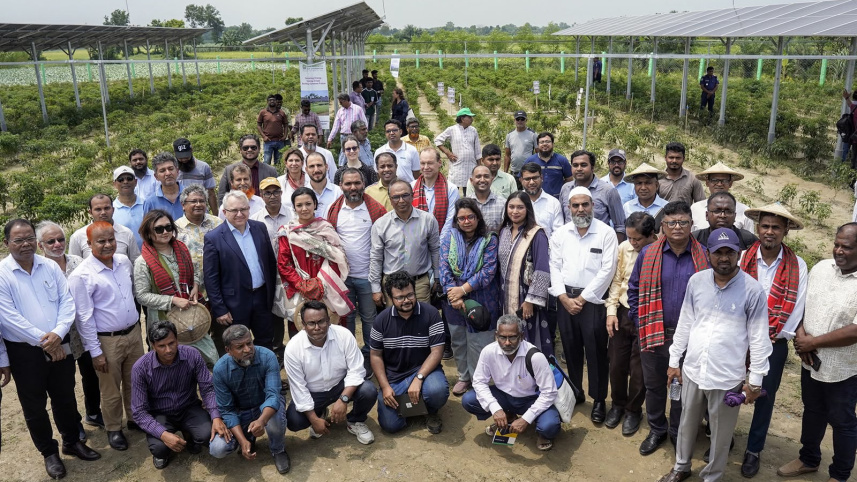
Chuadanga, August 20, 2026 — Bangladesh has launched its first scientifically designed grid-connected agrivoltaics pilot project in Chuadanga — integrating solar power generation with agricultural production on the same land, allowing renewable energy generation without sacrificing valuable farmland. The 49.6 kWp pilot is co-funded by the European Union (EU) and the German Federal Ministry for Economic Cooperation and Development (BMZ), implemented by GIZ Bangladesh in partnership with the Power Division, with technical expertise provided by the Fraunhofer Institute for Solar Energy Systems — one of Europe's leading solar research institutions.
📊 The Project at a Glance
- ☀ 49.6 kWp — pilot agrivoltaics capacity
- 📍 Chuadanga — pilot site location (south-western Bangladesh)
- 🤝 EU + BMZ — co-funding partners
- 🏢 GIZ Bangladesh — implementing agency (in partnership with Power Division)
- 🧵 Fraunhofer ISE — technical expertise (30+ years solar experience)
- 🌾 Green chillies — currently being cultivated
- 🌾 Seasonal vegetables + rice — planned for upcoming seasons
- 📜 GET-PAP — pilot under Green Energy Transition – Policy Advisory Partnership project
🌾 What Is Agrivoltaics?
Agrivoltaics is the dual use of agricultural land for both crop production and solar power generation — achieved by installing solar panels above or between crop rows at a height and spacing that allows sufficient sunlight to reach the crops below. The technology addresses one of the most fundamental constraints on solar energy scale-up in densely populated countries like Bangladesh: the competition between renewable energy generation and agricultural production for limited arable land.
Bangladesh has roughly 8.5 million hectares of arable land — one of the lowest per-capita arable land endowments in the world (roughly 0.05 hectares per person). Any large-scale solar deployment that consumes agricultural land would directly threaten food security — creating a tension between clean energy and agricultural self-sufficiency. Agrivoltaics resolves this tension by allowing both uses on the same land, with the solar panels providing additional benefits to crops including:
- ☀ Partial shade — reducing heat stress on crops during peak summer months
- 💧 Reduced water evaporation — conserving soil moisture and reducing irrigation demand
- 🌾 Crop protection — panels provide physical protection from heavy rain and hail
- 💰 Dual income streams — farmers earn from both crop sales and solar electricity generation
- 💼 Rural employment — solar maintenance and operation jobs in rural areas
🧵 The Pilot Design
The 49.6 kWp pilot is being implemented under the Green Energy Transition – Policy Advisory Partnership (GET-PAP) project, a framework designed to support Bangladesh's transition to renewable energy through policy advisory, technical assistance, and pilot project implementation. The Chuadanga pilot will:
- 📊 Generate renewable electricity — fed into the national grid through grid-connection
- 🌾 Cultivate crops — green chillies currently being grown at the pilot site, with seasonal vegetables and rice planned for upcoming seasons
- 📜 Gather operational data — on crop yields, electricity generation, and land-use efficiency
- 🌐 Inform national policy — data from the site will shape national agrivoltaics policies aimed at balancing food security with the green energy transition
- 🤝 Build local capacity — training farmers, technicians, and government officials on agrivoltaics design, installation, and operation
- 🌐 Create a scalable framework — the pilot is designed as a model that can be replicated across Bangladesh if successful
🤝 The Partnership Structure
The Chuadanga pilot brings together a multi-stakeholder partnership:
- 🇪 European Union (EU) — co-funder; broader EU-Bangladesh development cooperation framework
- 🇩🇪 German Federal Ministry for Economic Cooperation and Development (BMZ) — co-funder; German development cooperation
- 🏢 GIZ Bangladesh — implementing agency (Deutsche Gesellschaft für Internationale Zusammenarbeit, Germany's development agency)
- 🏛 Power Division, Government of Bangladesh — national implementing partner
- 🧵 Fraunhofer ISE — technical expertise (Fraunhofer Institute for Solar Energy Systems, Germany)
The partnership structure reflects the strong German and EU engagement with Bangladesh on energy transition issues — building on earlier cooperation including the Bangladesh-Germany Energy Partnership, EU-Bangladesh cooperation on climate change, and broader development partner support for the country's renewable energy ambitions.
🧵 Fraunhofer ISE: World-Class Technical Expertise
Fraunhofer ISE, the technical partner providing expertise for the Chuadanda pilot, is one of Europe's leading research and development institutes for solar energy — with more than 30 years of experience in the sector. The institute, based in Freiburg, Germany, is part of the Fraunhofer Society — Europe's largest applied research organisation — and has been instrumental in developing solar technology innovations including high-efficiency PV cells, bifacial modules, and agrivoltaics design standards.
Fraunhofer ISE's involvement in the Bangladesh pilot is significant for several reasons:
- 🧬 Scientific rigour — the pilot will follow Fraunhofer's rigorous agrivoltaics design standards, ensuring credible data collection
- 💼 Technology transfer — Bangladesh gains access to state-of-the-art agrivoltaics design expertise
- 🌐 International credibility — Fraunhofer involvement signals the pilot's quality to international investors and policymakers
- 🤝 Capacity building — Fraunhofer typically trains local partners as part of its project engagements
- 📊 Replication framework — Fraunhofer's design methodology can be replicated at scale across Bangladesh
🌾 Crop Selection: Green Chillies, Vegetables, Rice
The choice of crops for the Chuadanga pilot — green chillies (currently being cultivated), seasonal vegetables, and rice — reflects a deliberate strategy to test agrivoltaics across crop types that are economically and nutritionally important to Bangladesh:
- 🧅 Green chillies — high-value cash crop; sensitive to extreme heat; benefits from partial shade; subject to sharp seasonal price volatility that agrivoltaics could help stabilise
- 🌾 Seasonal vegetables — diverse crop group; tests how different vegetables perform under agrivoltaics conditions
- 🌾 Rice — Bangladesh's staple food; most important food security crop; testing agrivoltaics with rice is critical for scaling the technology across the country's 11+ million hectares of rice-cultivated land
The decision to test agrivoltaics with rice is particularly significant. Rice cultivation in Bangladesh typically requires significant water and is sensitive to temperature. Agrivoltaics could reduce water evaporation from rice paddies while providing shade that reduces heat stress — potentially improving rice yields while generating electricity on the same land. If rice cultivation proves successful under the Chuadanga pilot, the model could be replicated across Bangladesh's vast rice-growing areas, unlocking gigawatts of distributed solar capacity without sacrificing food security.
🌐 Strategic Significance for Bangladesh's Renewable Energy Strategy
Bangladesh has set ambitious renewable energy targets as part of its Nationally Determined Contribution (NDC) under the Paris Agreement — including a commitment to generate 40 percent of electricity from renewable sources by 2041. However, the country's progress on renewable energy has been slow, with renewable sources (excluding hydro) accounting for less than 5 percent of installed capacity. The slow pace has been driven by several challenges:
- 🌾 Land scarcity — utility-scale solar requires large land areas that compete with agriculture
- 🌐 Grid integration — limited grid capacity in rural areas where solar potential is greatest
- 💰 Financing — high cost of capital for utility-scale solar projects
- 📜 Policy framework — limited net metering, feed-in tariff, and corporate PPA support
- 🏢 Institutional capacity — limited experience with large-scale renewable procurement
Agrivoltaics addresses the most binding of these constraints — land scarcity — by allowing solar generation to coexist with agricultural production. If the Chuadanga pilot proves successful and the model is scaled across even 1 percent of Bangladesh's arable land (85,000 hectares), the country could install several gigawatts of additional solar capacity without sacrificing food security — a structural contribution to both renewable energy targets and climate commitments.
🌐 The Bigger Picture: Climate-Smart Agriculture
The Chuadanga pilot also has significant implications for Bangladesh's broader climate-smart agriculture strategy. As climate change accelerates — with rising temperatures, more frequent extreme weather events, and shifting rainfall patterns — the country's agriculture sector faces growing productivity risks. Agrivoltaics offers a structural adaptation response, providing shade that protects crops from heat stress, reducing water demand, and creating additional income streams that improve farmer resilience to climate shocks.
For the European Union and Germany, the project represents a concrete contribution to Bangladesh's climate adaptation and mitigation agenda — demonstrating how development partner financing can be channelled into practical, scalable climate solutions. The pilot's success could position Bangladesh as a leader in agrivoltaics deployment among climate-vulnerable developing countries — creating a model that other Asian and African nations could replicate as they seek to balance food security, energy security, and climate commitments. The data gathered at Chuadanga over the coming months will inform the design of a national agrivoltaics policy framework — and the capacity built through the project will help Bangladesh accelerate its renewable energy transition while protecting the agricultural foundation of its rural economy. For the Power Division, GIZ Bangladesh, Fraunhofer ISE, and the farmers of Chuadanga, the pilot is both a technical experiment and a strategic test of whether Bangladesh can lead the world in deploying agrivoltaics at scale.
This news was originally published by The Daily Star. For the full original report, please visit: https://www.thedailystar.net/business/economy/news/bangladesh-launches-first-grid-connected-agrivoltaics-pilot-4251921
📬 Get Bangladesh Trade News in your inbox
Weekly digest of export industry news, policy updates, and market analysis.
📰 Related Stories