Bangladesh Tax Target Hikes 60% For Large Taxpayers As Base Narrows
VAT LTU target raised 60% and income tax LTU target 53% above FY26 collection, even as VAT LTU taxpayer count drops from 162 in 2005 to 106 today
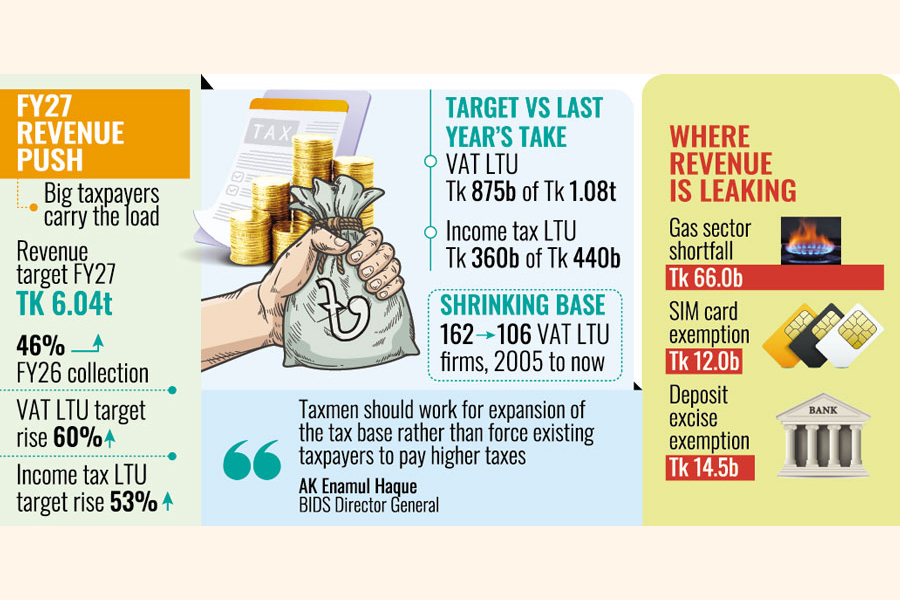
📊 Government's greater reliance on large taxpayers — both individuals and corporates — to achieve its higher revenue target in the current fiscal year is putting additional pressure on the existing taxpayer base. The Large Taxpayers Unit (LTU) under the VAT wing of the National Board of Revenue (NBR) has been assigned a revenue target 60-percent higher than its collection last fiscal year. And the income-tax LTU's target is nearly 53-percent higher than its collection in FY26.
🏛 The government has set an overall revenue-collection target at Tk 6.04 trillion for FY27, which is 46-percent higher than the amount collected in the past fiscal year. The targets of the income tax and VAT LTUs have increased more than 14-fold over the past two decades. In FY08, the government had set revenue targets at Tk 38 billion for the income-tax LTU and Tk 101.44 billion for the VAT LTU. For FY27, the targets have been raised to Tk 550 billion and Tk 1.40 trillion respectively.
💰 FY26 Performance Vs FY27 Targets
The VAT LTU collected Tk 875 billion last fiscal year against a target of Tk 1.08 trillion, while the income-tax LTU collected Tk 360 billion against a target of Tk 440 billion. Both LTUs missed their FY26 targets — the VAT LTU by Tk 205 billion (19% shortfall) and the income-tax LTU by Tk 80 billion (18% shortfall). Despite these misses, FY27 targets have been set substantially higher — creating an even larger gap between historical collection capacity and the new collection expectations.
- 💰 FY27 overall revenue target: Tk 6.04 trillion (+46% vs FY26 collection)
- 💰 VAT LTU FY27 target: Tk 1.40 trillion (+60% vs FY26 collection of Tk 875 billion)
- 💰 Income-tax LTU FY27 target: Tk 550 billion (+53% vs FY26 collection of Tk 360 billion)
- 💰 VAT LTU FY26 target: Tk 1.08 trillion; collected: Tk 875 billion (19% shortfall)
- 💰 Income-tax LTU FY26 target: Tk 440 billion; collected: Tk 360 billion (18% shortfall)
- 📊 VAT LTU taxpayer count: 162 (2005) → 106 (2026) - 35% decline
- 📊 LTU targets growth since FY08: 14-fold+
⚠ Narrow Tax Base: Taxpayer Count Declining
Economists and tax officials have aired concerns over the ambitious targets, citing Bangladesh's narrow tax base and sluggish business environment. The number of large taxpayers has not increased significantly in Bangladesh. Rather, several large companies, including multinationals, have exited the country over the past decade. The number of VAT LTU taxpayers has fallen to 106 companies from 162 in 2005 — a 35% decline that reflects the broader contraction of Bangladesh's large corporate base.
The income-tax LTU is also heavily dependent on corporate taxes paid by private commercial banks. Tax officials say the banking sector is facing multiple challenges, including high non-performing loans, while troubled banks are struggling to repay depositors, leaving limited scope for tax officials to collect additional revenue from them. With NPLs exceeding Tk 6 lakh crore by June 2026 and 21 banks reporting capital shortfalls, the banking sector — historically the largest contributor to income-tax LTU revenue — is in no position to absorb a 53% increase in tax obligations.
📜 Experts Call For Base Expansion Over Burden Increase
Bangladesh Institute of Development Studies (BIDS) Director-General AK Enamul Haque says Bangladesh's low tax-to-GDP ratio is not acceptable given the size of its economy. "Taxmen should work for expansion of the tax base rather than force existing taxpayers to pay higher taxes," he told The Financial Express.
Business Initiative Leading Development (BUILD) Chairperson Abul Kasem has said taxpayers recognised as top taxpayers for paying high taxes and maintaining compliance should not face "arbitrary harassment". Tax officials should categorise compliant taxpayers separately to protect them from unnecessary scrutiny while pursuing the revenue target, he added. The compliance-based categorisation proposal reflects growing concern that aggressive tax enforcement is driving compliant taxpayers toward informal channels or outright tax avoidance — undermining long-term revenue collection capacity.
Apurba Kanti Das, former tax member at the National Board of Revenue (NBR), says revenue collection depends on an ecosystem linked to the broader economic conditions of a country. "Banks are among the largest taxpayers, but many are now under immense financial pressure." He has suggested accelerating automation in tax administration as he thinks a shift away from manual systems could help increase revenue collection significantly.
💵 Major VAT Sources: Tobacco, Telecom, Gas, Power
Meanwhile, major sources of VAT collection include tobacco, telecommunications, gas and power. The concentration of VAT revenue in four sectors — tobacco, telecom, gas and power — illustrates the structural narrowness of Bangladesh's VAT base. Tobacco alone contributes an estimated 20-25% of total VAT collection, despite being a sector with significant public health externalities and limited long-term growth potential. Telecom is a maturing sector facing regulatory uncertainty. Gas and power are under pressure from energy supply disruptions and rising cross-subsidisation burdens.
The reliance on these four sectors for VAT revenue creates a structural vulnerability: if any one of them experiences a downturn — whether due to regulatory action, demand contraction or supply disruption — overall VAT collection misses its target. The FY27 target assumes all four sectors will deliver double-digit growth simultaneously, an assumption that historical patterns suggest is unrealistic.
⚠ Demoralised Tax Officials
VAT officials have said achieving the "unprecedented" target, which requires a quantum jump in collection, would be nearly impossible. Such targets demoralise officials and discourage them from intensifying efforts when they know they are unlikely to come close to meeting them, they said. The demoralisation effect is particularly damaging — when tax officials perceive targets as unachievable, they often shift from active revenue mobilisation toward defensive compliance, focusing on routine collections rather than pursuing new revenue opportunities.
The pattern of setting ambitious targets that are then systematically missed — a recurring feature of Bangladesh's revenue budgeting process — undermines the credibility of the entire fiscal framework. When businesses, taxpayers and international financial institutions observe consistent target misses, confidence in the government's fiscal management erodes, complicating future borrowing, tax policy reform and donor engagement.
🌏 Strategic Implications For Bangladesh's Fiscal Position
For Bangladesh's broader fiscal position, the ambitious revenue target carries strategic weight. The FY27 budget assumes that revenue collection will grow by 46% in a single fiscal year — a target that, if missed by 15-20% as in FY26, would translate into a Tk 90,000-120,000 crore revenue shortfall. Such a shortfall would force the government to either cut development spending (undermining infrastructure investment needed for LDC graduation) or increase borrowing (worsening the debt servicing burden that already consumes nearly half of revenue).
The alternative path — base expansion through structural tax reform — would yield slower but more sustainable revenue growth. Bringing informal sector businesses into the tax net, modernising property tax collection, implementing digital VAT enforcement, and broadening income tax compliance through simplified filing would collectively generate more durable revenue gains than hiking targets on an already narrow base. The coming fiscal year will reveal whether the government pursues this structural path or continues to rely on target hikes that the existing tax base cannot deliver.
This news was originally published by The Financial Express. For the full original report, please visit: https://thefinancialexpress.com.bd/economy/greater-revenue-burden-falls-on-large-taxpayers
Related on BangladeshExport
📬 Get Bangladesh Trade News in your inbox
Weekly digest of export industry news, policy updates, and market analysis.
📰 Related Stories