Bangladesh Ranks High Among LDCs in Remittance Transfer Costs: UNCTAD
UNCTAD report shows Bangladesh has 7-8% average remittance transfer cost, well above the SDG target of 3%, even as mobile money and digital platforms reshape global remittance markets.
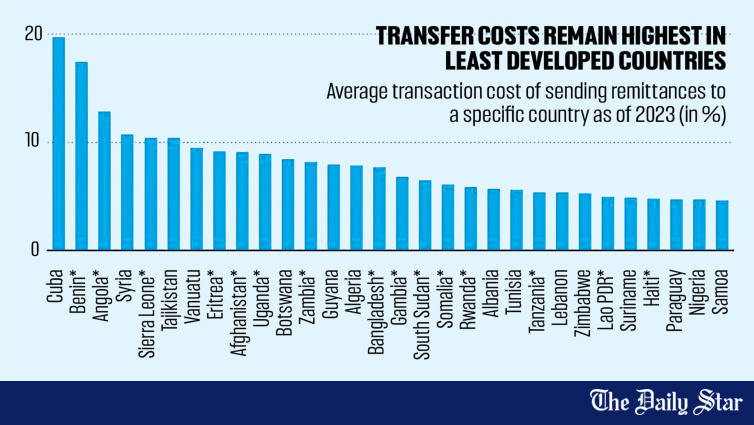
💰 Dhaka, Bangladesh — Bangladesh has one of the highest costs for remittance transfers among the least developed countries (LDCs), with the average transaction cost of sending remittances to the country standing at 7-8 percent — well above the Sustainable Development Goal (SDG) target of 3 percent.
📊 According to the latest global trade update by the United Nations Conference on Trade and Development (UNCTAD), released on 4 September 2026, Bangladesh was featured in a 2023 remittance transfer benchmark by the World Bank. Bangladesh is one of the top 10 remittance-receiving countries in the world, thanks to millions of migrant workers, mainly in the Middle East, who send money home, helping the country meet much of its external payment needs.
🌏 The UNCTAD report said LDCs account for half of the countries with the highest remittance costs globally. Benin and Angola have the highest remittance transfer costs, while Lao PDR and Haiti have the lowest among LDCs.
💬 “However, real progress has been made, particularly in Africa,” said the UNCTAD report. The report said mobile money use among adults in sub-Saharan Africa rose from around 27 percent in 2021 to about 40 percent in 2024. The Pan-African Payment and Settlement System (PAPSS) is also helping to lower cross-border transaction costs and reduce reliance on offshore clearing.
📊 Digitally Deliverable Services Gap
💻 UNCTAD said trade in digitally deliverable services (DDS) is growing rapidly, but LDCs are not keeping pace. Over the past decade, global services exports expanded by about 6.7 percent annually, outpacing goods exports, and increased by 8.3 percent in 2025.
📊 Key findings from the report:
- 📈 DDS trade grew 7.1% annually — faster than total services
- 📊 DDS now represents 56% of global services exports
- 📊 LDCs services exports grew only 3% annually
- 💲 LDCs’ share of global services exports declined from below 1% in 2010 to 0.6% in 2025
- 📊 DDS accounts for 61% in developed economies, only 16% in LDCs
⚠ After 2020, LDC DDS exports showed very little progress, widening the gap with the rest of the world, said the report.
🛠 Servicification: Services as Critical Inputs
🔧 The UNCTAD report also highlighted “servicification” — the growing use of services as inputs across all sectors, such as logistics, finance, design and data management.
💬 “Servicification has emerged as a key driver of economic diversification, structural transformation and participation in global value chains,” it said.
📊 By 2022, services accounted for:
- 🌏 71% of global intermediate inputs
- 🌏 78% in developed economies
- 🌏 61% in developing economies
- 🌏 58% in LDCs
📊 UNCTAD said services represent 33 percent of intermediate inputs in industrial goods exports globally, but this drops to just 13 percent in LDCs, including Bangladesh.
💬 “Services should be viewed not only as a sector in their own right but also as critical inputs into the production and export of goods. The quality, cost and availability of services directly affect competitiveness and participation in global value chains across all sectors,” it said.
⚠ The role of services in developing countries’ trade is often underestimated because the services embedded in goods exports are not adequately measured, it added.
📊 Unlocking Servicification Benefits
🔐 “Unlocking the benefits of servicification requires targeted action to strengthen:
- 📊 Data governance
- 💻 Digital infrastructure
- 🏛 Regulatory frameworks
- 🤝 Participation in trade negotiations
⚠ Particularly for developing and least developed economies,” the report said.
🧠 AI May Widen the Gap
🤖 The UNCTAD report flagged that artificial intelligence may widen the gap because computing capacity, data, finance and expertise remain concentrated in a few economies. The report also flagged sluggish progress in multilateral rules on digital trade — divergent provisions in regional and bilateral agreements have increased regulatory complexity.
💬 “Developing countries need better data, stronger digital infrastructure and greater capacity to shape emerging rules,” UNCTAD concluded.
🌏 Strategic Context for Bangladesh Remittance Economy
💰 For Bangladesh, the high remittance cost is a significant economic issue. With remittances contributing over $35 billion annually to the country’s external account — second only to ready-made garment exports in foreign exchange inflows — even a 1 percentage point reduction in transfer costs would translate into hundreds of millions of dollars in additional household income for migrant families.
📊 The 7-8 percent average cost for Bangladesh remittances reflects several structural factors:
- 💰 Banking correspondent networks — limited competition in formal remittance corridors
- 📱 Mobile financial services — while bKash and Nagad have expanded access, cross-border integration remains limited
- 🏛 Regulatory friction — compliance requirements add cost to formal channels
- 🤝 Hundi/informal channels — competing informal operators offer lower cost but bypass formal financial system
✅ For Bangladesh’s policymakers, the UNCTAD report offers several actionable directions:
- 📞 Negotiate lower corridor fees with major remittance source countries
- 📱 Expand mobile money cross-border integration — particularly with Gulf states
- 💰 Incentivise formal channels — through tax breaks or subsidy on transfer fees
- 📊 Develop DDS export capacity — investing in IT skills and digital infrastructure to capture share of growing global digitally deliverable services trade
- 🧠 AI strategy — building domestic AI capability to avoid being left behind in the next wave of digital transformation
🌏 For Bangladesh’s broader trade strategy, the UNCTAD report underscores that competing in the next phase of global trade requires more than just goods exports. Building competitive services exports — in IT, professional consulting, design and digital content — will be essential to capture a meaningful share of the global services trade that is increasingly driving economic growth. The 0.6% LDC share of global services exports is a sobering reminder of how far Bangladesh and its LDC peers have to travel to compete in this rapidly expanding segment of the world economy.
This news was originally published by The Daily Star. For the full original report, please visit: https://www.thedailystar.net/business/economy/news/bangladesh-ranks-high-among-ldcs-remittance-costs-4266516
📬 Get Bangladesh Trade News in your inbox
Weekly digest of export industry news, policy updates, and market analysis.
📰 Related Stories