Bangladesh Public Debt Nears IMF Threshold: A Debt Trap Looming?
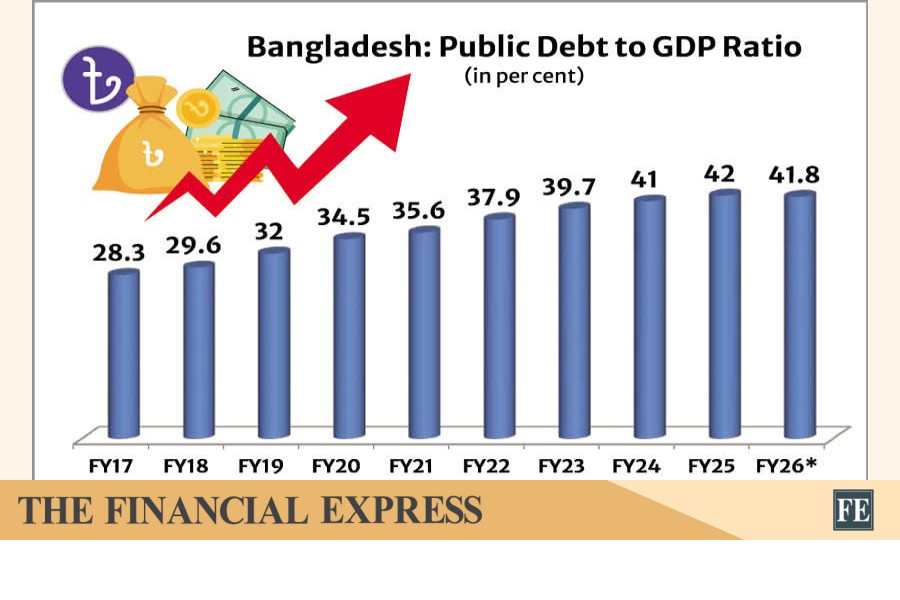
Bangladesh's debt-to-GDP ratio climbs to 41 per cent in FY25 from 36.9 per cent in FY23, edging close to the IMF-World Bank medium capacity threshold of 55 per cent and raising concerns about debt sustainability
📊 Of late, sections of the Bangladeshi print media have been sounding the alarm on public debt, painting Cassandra-like scenarios with dark portents about the country's fiscal trajectory. Their concern is well-intentioned and rooted in the broader public interest, but a careful examination of borrowing patterns, debt-to-GDP dynamics and repayment capacity is needed before declaring the country trapped in a debt cycle. The picture is uncomfortable, but not yet catastrophic.
💵 Borrowing Pattern Across Five Fiscal Years
The composition of government borrowing across bank, non-bank and foreign sources has shifted markedly since FY21. In fiscal year 2020-21, borrowing was distributed evenly across the three channels, with bank borrowing at Tk 44.28 billion, non-bank at Tk 442.81 billion and foreign financing at Tk 474.03 billion. The relatively balanced distribution reflected the pandemic-era strategy of diversifying funding sources to avoid crowding out private credit.
In FY22, the corresponding figures were Tk 619.41 billion from banks, Tk 269.25 billion from non-bank sources and Tk 731.97 billion from foreign financing, signalling a sharp rise in external borrowing as multilateral lenders stepped up concessional support. By FY23, however, the government became heavily dependent on banks, borrowing Tk 1,020.17 billion, while non-bank borrowing collapsed to just Tk 76.52 billion as savings instruments lost appeal amid falling coupon rates.
Over these five years, bank borrowing has been substantial but volatile, without a linear upward trajectory. Non-bank borrowing also exhibits volatility, declining over the years until FY24, when it levelled up with the FY21 figure. Foreign financing, by contrast, has increased steadily, from Tk 474.03 billion in FY21 to Tk 920.22 billion in FY24 and Tk 726.15 billion the following year, reflecting sustained engagement with multilateral and bilateral development partners.
📜 Debt-To-GDP Ratio: The Critical Metric
What matters in government borrowing is not the absolute volume of debt but whether it is within permissible limits relative to the size of the economy. The debt-to-GDP ratio is the standard benchmark used by multilateral lending institutions to assess sustainability. There is no single universal ratio at which a government automatically becomes unsafe; the threshold depends on the country's growth rate, interest rate, revenue earnings capacity, currency composition of debt, and access to financing.
According to recent IMF series reports, Bangladesh reached a debt-to-GDP ratio of 36.9 per cent in FY23, 38.5 per cent in FY24 and 41 per cent in FY25. The IMF-World Bank medium capacity threshold for Bangladesh is 55 per cent, meaning the country is not yet at the threshold but very near to it, with a headroom of only 14 per cent of GDP. More than the proximity, it is the direction of travel that is concerning. The ratio has shown a sharp increase over a short period of time, suggesting that without corrective action, the threshold could be breached within the next few fiscal cycles.
- 📈 Debt-to-GDP ratio: 36.9% (FY23) → 38.5% (FY24) → 41% (FY25)
- 🚩 IMF-World Bank threshold for Bangladesh: 55% of GDP
- 📏 Headroom remaining: only 14% of GDP
- 💰 Domestic debt servicing: 4.1% of GDP annually
- 💸 Tax-to-GDP ratio: around 8-9% (one of South Asia's lowest)
⚠ The Vicious Cycle Of Domestic Debt Servicing
Debt distress essentially means weak repaying capacity. Taking the present volume of domestic debt, the Bangladesh government has to pay 4.1 per cent of GDP annually in servicing costs. With the tax-to-GDP ratio stuck at around 8-9 per cent, repayment of domestic debt has become precarious. The result is a vicious cycle: greater volume of domestic borrowing leads to increasing debt-servicing burdens that exceed the revenue capacity of the government, which in turn forces greater borrowing from bank, non-bank and foreign sources to meet the fiscal deficit.
This dynamic is particularly worrying because domestic borrowing tends to be more expensive than concessional external financing. The yield on long-term Bangladesh Government Treasury Bonds (BGTBs) has hovered above 9 per cent in recent auctions, while foreign loans from multilateral institutions carry effective interest rates of 1-2 per cent with long grace periods. The rising share of high-cost domestic debt in the total mix is structurally pressuring the debt servicing bill.
🏛 Revenue Mobilisation: The Way Out
Bangladesh is caught in a debt conundrum largely because of the increasing volume of domestic borrowing that consumes almost half of revenue earnings, leading to more borrowing to meet the fiscal deficit. If the present trend continues, the threshold determined by the debt-to-GDP ratio (55 per cent) will be reached soon, causing a fiscal crisis that would force sharp cuts in development spending and social safety net allocations.
The way out of this economic catastrophe is threefold:
- ✅ Increase revenue earnings by broadening the tax base, digitising NBR collections and bringing untaxed economic sectors into the formal net
- ✅ Reduce non-productive public expenditures, including rationalisation of loss-making state-owned enterprises and untargeted subsidy programmes
- ✅ Avail more foreign loans at concessionary rates, particularly for infrastructure projects that generate returns over the long term
🌏 Broader Implications For The Economy
For an economy preparing to graduate from the Least Developed Country (LDC) category by November 2026, the timing of this debt build-up is uncomfortable. LDC graduation will mean the loss of concessional financing windows that have traditionally supported Bangladesh's development budget. As interest rates on external debt rise post-graduation, the debt-servicing burden will compound unless revenue mobilisation is dramatically improved.
The current account dynamics also matter. A larger share of external debt means more foreign currency outflows for servicing, putting pressure on the taka and Bangladesh Bank's foreign exchange reserves. With reserves having seen volatility in recent quarters, the composition of future borrowing — domestic versus external, concessionary versus commercial — will determine whether the country stays safely below the IMF threshold or drifts into debt distress territory.
Bangladesh is not yet in a debt trap, but it is uncomfortably close to the threshold beyond which debt sustainability becomes structurally difficult to restore. The next two fiscal years will be decisive. Without a credible fiscal consolidation plan anchored on revenue mobilisation, expenditure rationalisation and a strategic shift towards concessionary external financing, the country risks sleepwalking into a debt trap that could undermine decades of development gains.
This news was originally published by The Financial Express. For the full original report, please visit: https://thefinancialexpress.com.bd/columns/is-bangladesh-in-a-debt-trap
Related on BangladeshExport
📬 Get Bangladesh Trade News in your inbox
Weekly digest of export industry news, policy updates, and market analysis.
📰 Related Stories