Bangladesh Pauses Borrowing From Japan As JICA Interest Rate Hiked To 3.05%
JICA lending rate raised from below 1% to 3.05%, poised to reach 3.55% from October; Dhaka's request for reconsideration went unheeded as country pauses new loan signings
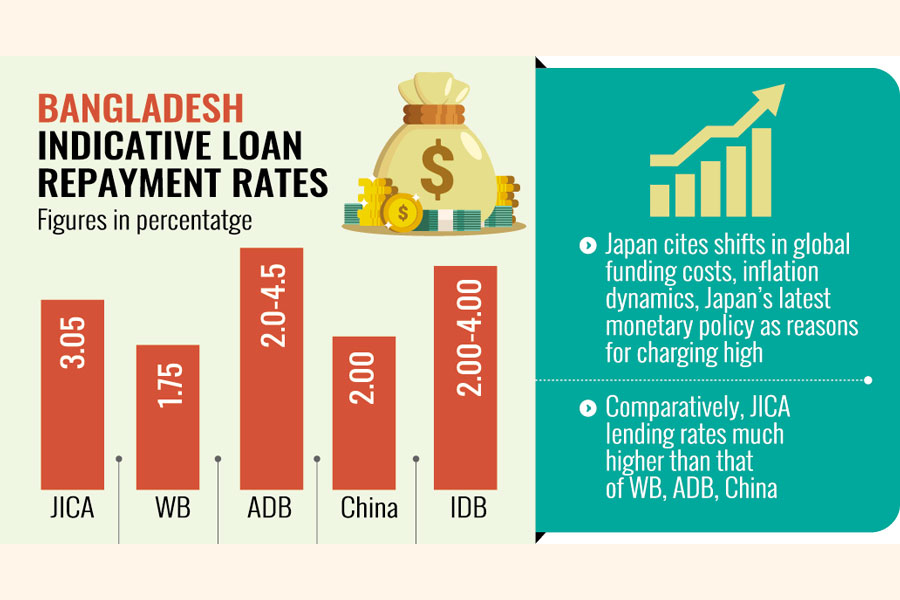
💰 Bangladesh has paused in borrowing from Japan as its interest rate on development finance has been steeply hiked and Dhaka's request for reconsidering the tightened terms went unheeded, officials say. The rate of interest on Japanese development assistance has been raised for a six-month spell to 3.05 per cent, and it could go up to 3.55 per cent from next month, they have said.
📊 Bangladesh used to enjoy an interest rate as low as 1.0 per cent in borrowing from the Japanese development-financing agency — the Japan International Cooperation Agency (JICA) — until a few years ago. In response to the steeper borrowing costs, Bangladesh has refrained from signing any new loan packages with its largest bilateral lender, they have said.
📜 JICA Rate Hike: Global Funding Dynamics
"Japan has recently informed us that the new rate is revised on global funding dynamics. This is not only for Bangladesh. This is for all borrowing countries of the Japanese ODA," a senior Ministry of Finance (MoF) official told The Financial Express. "After the interest-rate hike in April, we requested Japanese lender — the Japan International Cooperation Agency — to reduce the rate for Bangladesh in view of global and local shocks."
For the current six-month window spanning from April to September, Tokyo ramped up interest rates for funding Bangladesh to a steep 3.05 per cent in April. The rate rise marks a drastic shift from historical agreements. Even as recently as 2022, Japanese Official Development Assistance (ODA) carried highly concessional rates below 1.0 per cent. Once-most-concessional loan has become costlier as Japan has proposed to raise its interest rate by 30 percentage points to 3.05 per cent for lending to Bangladesh. Earlier, the JICA used to charge 2.35 per cent on its loans against different development projects in Bangladesh.
- 💰 Previous JICA rate: Below 1.0% (until 2022)
- 💰 Previous rate (pre-hike): 2.35%
- 💰 Current rate (April-September): 3.05%
- 💰 Projected rate (October): 3.55%
- 📊 Rate increase: 30 percentage points
- 👥 Lender: JICA (Japan International Cooperation Agency)
- 👥> Bangladesh position: Paused new loan signings
🌏 Strategic Context: Concessional Financing Erosion
For Bangladesh, the JICA rate hike represents a structural shift in the country's external financing landscape. Japan has historically been Bangladesh's largest bilateral development partner, providing concessional financing for major infrastructure projects including metro rail, bridges, power plants and urban transport systems. The shift from sub-1% concessional rates to 3.05% (potentially 3.55%) fundamentally changes the economics of Japanese-financed projects — making them significantly more expensive to service over their loan tenures.
The rate hike also reflects a broader global trend: as the US Federal Reserve raises interest rates and global benchmark rates rise, multilateral and bilateral lenders are adjusting their own lending rates to reflect higher funding costs. The World Bank, ADB and other multilateral institutions have similarly adjusted their lending terms, though typically with smaller increases than JICA's 30-percentage-point jump.
Bangladesh's decision to pause new borrowings — rather than accepting the higher rates — signals the government's assessment that the current JICA rates are not economically viable for the projects under consideration. The pause creates a financing gap that will need to be filled through alternative sources: domestic borrowing (which carries its own fiscal costs), other bilateral lenders (China, India, South Korea), or multilateral institutions (World Bank, ADB) that may offer more competitive terms.
For an economy preparing to graduate from LDC status in November 2026, the erosion of concessional financing is a structural challenge that will intensify post-graduation. The government's recently announced plan to issue a sovereign dollar bond — targeting $500 million to $1 billion by December — represents one response to the financing diversification imperative. The JICA rate pause underscores the urgency of this diversification: as traditional concessional lenders raise rates, Bangladesh must build the institutional capacity to access international capital markets on commercial terms.
The coming months will reveal whether Japan responds to Bangladesh's request for rate reconsideration, or whether the pause in Japanese borrowing becomes a sustained shift in Bangladesh's external financing strategy. For the infrastructure projects that depend on JICA financing — including ongoing metro rail extensions and planned transport corridors — the financing uncertainty creates implementation risk that could delay project timelines and increase overall costs.
This news was originally published by The Financial Express. For the full original report, please visit: https://thefinancialexpress.com.bd/economy/bangladesh-pauses-in-borrowing-from-japan-over-interest-hike
Related on BangladeshExport
📬 Get Bangladesh Trade News in your inbox
Weekly digest of export industry news, policy updates, and market analysis.
📰 Related Stories