Bangladesh Macroeconomic Stability Returns But Business Woes Persist: TBS Review
Dhaka, August 18, 2026 — Bangladesh's macroeconomic stability has visibly improved in the first six months of the new government, with foreign exchange reserve erosion halted, exports and remittances rising, a current account surplus emerging, and banking sector stress easing — but the micro-level business environment has barely moved, with corruption, extortion and bureaucratic delays continuing to throttle day-to-day commerce, according to a sweeping TBS economic review published 18 August 2026.
✅ What Has Stabilised
- 💰 Forex reserves — decline halted; stable at $20–22 billion under IMF BPM6 methodology
- 📨 Exports — increased
- 💵 Remittances — increased (21.6% YoY in first 48 days of FY27)
- 📊 Current account — surplus generated on the back of higher export earnings and remittance inflows
- 🏢 Banking sector — some stability has returned
- 💹 Macro signals — improved across reserve, FX, current account, and banking indicators
⚠ What Has NOT Improved
The TBS review is sharply critical of the gap between macro improvements and micro-level business reality:
- 🚧 Micro-level business reform — "no meaningful reform at the micro level of business and trade"
- 👥 Day-to-day operations — businesses report little improvement in routine operations
- 🕵 Land mutation — corruption and extortion persist
- 🏛 Deputy commissioners' offices — corrupt dealings continue
- 🚢 Import clearance — supposed to take one day, often takes a month or 1.5 months
- 💲 Inflation — high prices of essentials remain a major concern for ordinary people
- 💼 Employment — has not improved
- 📈 Investment climate — concerns have intensified
- 📜 Fiscal position — government cannot meet expenditure from revenue earnings, forced to borrow more
- 🤝 IMF reforms — many recommendations adopted, but implementation remains inadequate
⏳ The Import Clearance Bottleneck
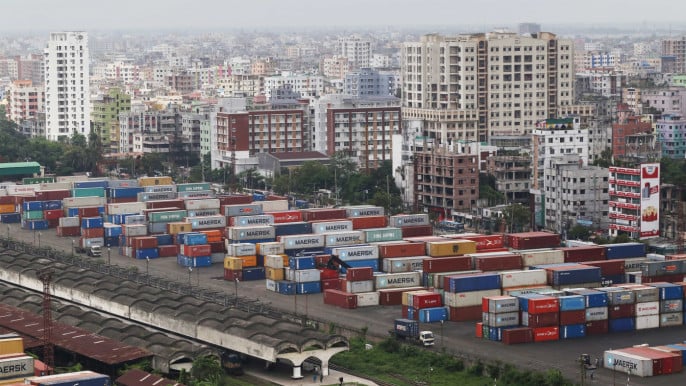
One of the most damaging findings in the review concerns the import clearance process. Under existing regulations, imported goods are supposed to be cleared within a day — a standard designed to keep working capital cycles tight for exporters dependent on imported raw materials, especially RMG fabric and accessories, pharmaceutical APIs, capital machinery and energy commodities. In practice, the process often takes a month or even a month and a half — a 30-to-45x delay over the regulatory standard.
For Bangladesh's export economy, this is a profound structural drag. RMG exporters importing fabric and accessories under back-to-back LCs face a 90-day cycle that begins with the LC opening and ends with shipment of finished garments. If the import clearance alone consumes 30–45 days of that window, the entire back-to-back LC mechanism — designed to let exporters settle raw-material imports out of export proceeds — is destabilised. Banks become reluctant to confirm back-to-back LCs, suppliers demand pre-payment, and exporters are forced into more expensive informal financing arrangements. The cumulative cost is billions of taka a year in extra interest, demurrage and lost orders — a deadweight loss borne entirely by the export sector.
👥 Corruption and Extortion: A Daily Reality
The review's account of corruption and extortion at every stage of routine business operations — from land mutation and dealings with deputy commissioners' offices to the clearance of imported goods — is perhaps its most damning finding. These are not isolated incidents but systemic practices that impose a daily tax on commerce that does not appear in any official statistics but is felt by every business operating in Bangladesh.
For exporters, the cost of this corruption is multiplied because it compounds across the value chain. A garment exporter importing fabric pays extortion at the port, at the land mutation office when expanding a factory, at the deputy commissioner's office when registering equipment, and at the customs bond commissionerate when renewing bonded warehouse licenses. Each payment is small relative to the value of the underlying transaction — but cumulatively, they represent a meaningful drag on profitability that competitors in Vietnam, Cambodia or Indonesia do not face. The result is a structural cost disadvantage that no amount of macroeconomic stabilisation can offset — and a major reason why Bangladeshi exporters consistently report that they cannot match regional rivals on landed cost despite enjoying lower labour costs.
💰 Fiscal Stress and Government Borrowing
The review notes that the government itself faces financial constraints and cannot meet its expenditure from revenue earnings — forcing it to borrow more from the financial sector. This is a critical signal: the macroeconomic stabilisation gains of the past six months have not been matched by a corresponding improvement in fiscal capacity. The government's revenue effort — NBR tax collection — remains well below the level needed to fund both its operating expenditure and the public investment programme laid out in the Annual Development Programme (ADP).
For the export economy, this fiscal stress has two direct implications. First, the government's reliance on domestic borrowing crowds out private-sector credit — making it harder for exporters to access the working capital they need to expand production. Second, the government's fiscal weakness limits its capacity to invest in trade-enabling infrastructure — including port modernisation, customs automation, single-window implementation, and the road and rail connectivity projects that determine how quickly goods move from Bangladeshi factories to global markets. Without these investments, the structural bottlenecks identified in the review will persist regardless of how many trade agreements Bangladesh signs.
🏛 IMF Reform Implementation Gap
The review notes that many IMF recommendations have been adopted by the government — but implementation remains inadequate. This is a recurring theme in assessments of Bangladesh's engagement with the IMF's $4.7 billion loan programme: legislative and policy commitments are made, but the operational follow-through often lags far behind. The risk is that the macroeconomic stabilisation gains of the past six months — themselves partly the product of IMF-conditioned reforms — could be reversed if the implementation gap widens.
- 📜 Bangladesh Bank autonomy — commitment made, but governor appointment process undermined the principle
- 🏢 Banking sector governance — reforms announced, but NPLs continue to climb
- 🌐 National Single Window — commitment made, but operationalisation still pending
- 📜 Insolvency and bankruptcy reform — legislation passed, but operational capacity limited
- 📊 Statistics and data quality — BBS has not published employment data since 2024
📊 The Macro-Micro Disconnect
The fundamental message of the TBS review is that macroeconomic stability without micro-level reform is not sustainable. The reserve stability, current account surplus, export growth and remittance surge of the past six months are real and important gains — but they reflect the natural bounce of an economy that had been artificially constrained by the previous administration's mismanagement, not the structural reform needed for long-term competitiveness.
For Bangladesh's export economy, this disconnect is particularly dangerous. The macro gains can mask the micro-level dysfunction for a quarter or two — but eventually, the cost of corruption, the import clearance delays, the bureaucratic hurdles and the fiscal stress will erode the competitiveness of Bangladeshi exports and undermine the macro stability that has been achieved. The review's call to "reduce bureaucratic hurdles, eliminate corruption and adopt business-friendly policies" is not a generic recommendation — it is a precise diagnosis of what stands between Bangladesh's current macro stabilisation and a sustainable, export-led growth trajectory.
The next six months will be decisive. If the government can translate the macro gains into micro-level reform — specifically by fixing the import clearance process, rooting out corruption at land mutation and deputy commissioners' offices, operationalising the National Single Window, restoring Bangladesh Bank's genuine autonomy, and rebuilding the fiscal position through revenue reform rather than domestic borrowing — the country can convert its current stabilisation into the structural transformation the GED's five-year plan envisions. If it cannot, the macro gains will prove temporary, and the structural bottlenecks that have held back Bangladeshi exporters for decades will continue to extract their daily tax on commerce, even as the headline numbers tell a story of recovery that the micro-level reality contradicts.
This news was originally published by The Business Standard. For the full original report, please visit: https://www.tbsnews.net/economy/economy-stabilises-business-woes-persist-1518001
Related on BangladeshExport
📬 Get Bangladesh Trade News in your inbox
Weekly digest of export industry news, policy updates, and market analysis.
📰 Related Stories