$8 Billion of World Bank Finance Stuck in Bangladesh Project Delays and Design Flaws
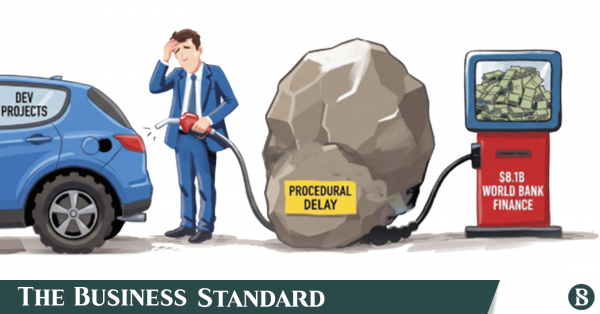
Dhaka, August 19, 2026 — Of the roughly $12 billion in project aid pledged by the World Bank, more than $8 billion remained undisbursed as of June 2026 — for reasons including procedural delays at various stages that consume nearly a year before the first disbursement. An Economic Relations Division (ERD) analysis has identified chronic project delays and implementation failures as the root cause, with 15 of 37 ongoing World Bank-financed projects facing serious implementation challenges.
📊 The Undisbursed Amount
- 💰 $12 billion — total World Bank project aid pledged
- 💰 $8 billion+ — undisbursed as of June 2026
- 📊 15 of 37 projects — facing serious implementation challenges
- ⏳ 11.8 months — average time from board approval to first disbursement
⏳ The Procedural Delay Timeline
According to the ERD analysis, the journey from project approval to first disbursement takes nearly a year:
- 📜 4.4 months — from board approval to signing the financing agreement
- 📜 2.1 months — from signing to making the agreement effective
- 📜 5.3 months — from effectiveness to first disbursement
- ⏳ Total: 11.8 months — nearly a year lost before any money flows
By the time the first instalment is released, almost a year — sometimes even more — of the grace period is already gone. World Bank financing typically comes with three to five years' grace period.
🚧 Root Causes of Project Delays
The ERD analysis identified several recurring problems:
- 🔍 Flawed feasibility studies — incomplete or faulty project designs
- 📜 Discrepancies — between development project proposals and appraisal documents
- 👥 Frequent project director changes — disrupt continuity and progress
- 🏢 Land acquisition delays — difficulties in securing project sites
- 📜 Tendering delays — slow procurement processes
- 🤝 Poor coordination — between government agencies and implementing partners
- 💼 Rushed negotiations — creating costly project problems
👥 Accountability Question
Analysts say the ERD has rightly identified many operational bottlenecks, but the assessment falls short of addressing a crucial question: who is responsible? The reasons behind frequent changes of project directors, poor feasibility studies, and rushed negotiations point to systemic governance failures that require accountability mechanisms — not just procedural reforms.
🌐 Strategic Context: Foreign Aid and Economic Development
The $8 billion stuck in World Bank project procedures represents a significant lost opportunity for Bangladesh's economic development:
- 💰 Infrastructure investment delayed — roads, bridges, power projects on hold
- 💼 Employment generation delayed — construction and operational jobs not created
- 🏭 Export infrastructure gaps — port, transport, energy projects delayed
- 💵 Grace period erosion — repayment obligations begin before project benefits
- 📊 Investor confidence — project delays undermine development partner trust
For Bangladesh's export economy, the delayed World Bank projects include critical infrastructure that directly supports export competitiveness — including transport corridors, energy projects, and trade facilitation initiatives. The 11.8-month average delay from approval to first disbursement means that even well-designed projects lose significant implementation time before construction begins — extending the timeline for infrastructure that exporters urgently need.
The ERD's identification of these systemic problems is an important first step — but without accountability for the officials responsible for flawed feasibility studies, frequent director changes, and rushed negotiations, the same problems will continue to plague future World Bank-financed projects. The government's broader governance reform agenda must include project implementation reform as a priority — ensuring that the $8 billion currently stuck in procedures can flow to the infrastructure and development projects that Bangladesh urgently needs for its post-LDC economic transformation.
The scale of the problem becomes even more significant when viewed in the context of Bangladesh's overall development financing needs. The GED's five-year transformation plan envisions significant infrastructure investment to support 8.5 percent GDP growth by 2031 — but with $8 billion of already-pledged World Bank financing stuck in procedural delays, the country is effectively operating with one hand tied behind its back. The 15 projects facing serious implementation challenges likely include critical infrastructure in transport, energy, water management, and social sectors that directly support economic growth and export competitiveness.
The analysis also highlights the broader institutional capacity gap in Bangladesh's project implementation system. The fact that it takes 4.4 months just to sign a financing agreement after board approval — and another 2.1 months to make it effective — suggests that the government's project preparation and negotiation processes are not keeping pace with the needs of large-scale development financing. This institutional bottleneck affects not only World Bank projects but likely also ADB, JICA, AIIB, and other multilateral development partner financed projects — cumulatively representing billions of dollars in delayed development investment.
The frequent changes of project directors identified in the analysis represent a particularly damaging practice. Project directors are the key officials responsible for day-to-day implementation — managing contractors, coordinating with stakeholders, overseeing financial management, and ensuring compliance with development partner requirements. When project directors are changed frequently, institutional memory is lost, relationships with contractors and stakeholders must be rebuilt, and implementation momentum is disrupted. The practice of frequent director changes often reflects political interference in project management rather than merit-based administrative decisions — and addressing this root cause will require strong political commitment to professionalising project management in Bangladesh's public sector.
This news was originally published by The Business Standard. For the full original report, please visit: https://www.tbsnews.net/economy/8b-world-bank-finance-stuck-long-project-procedures-design-flaws-1518896
📬 Get Bangladesh Trade News in your inbox
Weekly digest of export industry news, policy updates, and market analysis.
📰 Related Stories