Bangladesh Spends Nearly 43 Percent of Annual LNG Subsidy in Just 1.5 Months: FE Report
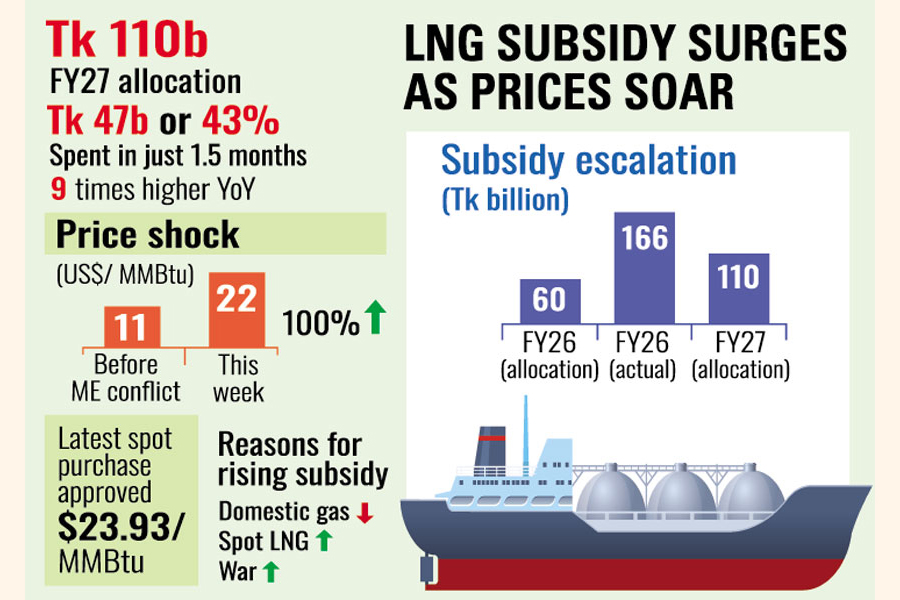
Dhaka, August 19, 2026 — Bangladesh has disbursed nearly 43 percent of its annual liquefied natural gas (LNG) subsidy allocation within just one and a half months of fiscal year 2027 — spending Tk 47 billion out of the FY27 allocation of Tk 110 billion by mid-August, as global LNG prices spike amid Middle East war-driven supply chain disruptions. The disbursement is over nine times higher than the Tk 5.0 billion spent during the same period in the previous fiscal year — an extraordinary escalation that signals the FY27 LNG subsidy budget will be exhausted well before year-end, requiring either supplementary allocations or significant subsidy rationalisation.
📊 The Numbers at a Glance
- 💰 Tk 110 billion — FY27 annual LNG subsidy allocation
- 💰 Tk 47 billion — disbursed by mid-August (1.5 months)
- 📈 42.73% — of annual allocation spent in 1.5 months
- 📈 9x increase — vs Tk 5.0 billion in same period of FY26
- 💰 Tk 60 billion — FY26 budget allocation (original)
- 💰 Tk 166 billion — FY26 actual spending (2.77x over budget)
- 💰 $22/MMBtu — spot LNG price this week
- 💰 $23.93/MMBtu — cabinet-approved LNG cargo price
- 📈 ~2x increase — spot LNG price vs pre-war levels
🚢 FY26 as a Warning Precedent
The FY27 LNG subsidy trajectory is even more alarming when viewed against the FY26 actuals — which themselves were a sharp overshoot from the original budget:
- 💰 FY26 original budget: Tk 60 billion
- 💰 FY26 actual spending: Tk 166 billion (2.77x over budget)
- 💰 FY27 original budget: Tk 110 billion (raised from FY26's Tk 60bn)
- 💰 FY27 actual projection: "will surpass significantly last year's spending" (per senior Energy Division official)
If FY27 follows FY26's 2.77x overshoot pattern, total LNG subsidy spending could reach Tk 305 billion — roughly equivalent to 5 percent of the government's entire FY27 revenue target. Even at a more modest overshoot, the LNG subsidy alone could consume Tk 200+ billion of the FY27 budget — creating a fiscal hole that would need to be filled either through additional borrowing, supplementary budget allocations, or sharp cuts to other development expenditure.
🌐 The Geopolitical Driver: Middle East Conflict
The LNG price spike that has driven the subsidy overshoot is directly tied to the US-Israel war on Iran, which has disrupted key Middle East LNG shipping routes and forced suspension of some gas production. The specific impacts include:
- 🚢 Blockade of Middle-East LNG routes — particularly through the Strait of Hormuz, which handles roughly 20 percent of global LNG shipments
- 🚢 Suspension of gas production — at some Iranian facilities affected by the conflict
- 💰 Spot LNG price near $22/MMBtu — almost double pre-war levels
- 💰 Cabinet-approved cargo at $23.93/MMBtu — approved on 19 August 2026 by Cabinet Committee on Government Purchase
- 🌐 Long-term contractor supply dried up — forcing Bangladesh to procure more cargoes from spot market at elevated prices
The war-driven price spike is particularly damaging for Bangladesh because the country has structured its LNG import portfolio around a combination of long-term contracts (with Qatar, Oman, and others) and spot market purchases. When long-term contractors default on supply commitments — as has been happening in recent months — Bangladesh is forced into the spot market, where prices are currently at multi-year highs. The $23.93/MMBtu price approved by the Cabinet Committee for a single spot cargo represents roughly 9 percent above the already-elevated $22/MMBtu spot benchmark — a premium that reflects both the urgency of Bangladesh's procurement and the bargaining power of suppliers dealing with a buyer in distress.
🏭 Cabinet Committee Approval: One Cargo at $23.93/MMBtu
On Wednesday, 19 August 2026, the Cabinet Committee on Government Purchase — chaired by Finance Minister Amir Khosru Mahmud Chowdhury — approved a proposal for buying one cargo of LNG from the spot market at $23.93 per MMBtu, amid severe supply shortage. The approval reflects:
- 🚧 Severe supply shortage — forcing Bangladesh to accept premium prices for spot cargoes
- 💰 $23.93/MMBtu — roughly 9% above the $22 spot benchmark, indicating supplier premium
- 🤝 Finance Minister oversight — Cabinet Committee chaired by FM Khosru himself, signalling political attention
- 📜 Spot market reliance — long-term contractor supply has dried up, forcing spot procurement
The fact that the Cabinet Committee approved the cargo at $23.93/MMBtu — despite the obviously elevated price — signals that the government has no choice but to pay prevailing market rates if it wants to keep factories running, power plants generating, and household gas supply available. The alternative — refusing to pay premium prices and accepting gas supply disruptions — would have even more damaging economic consequences, as the Narsingdi textile factory closures have demonstrated.
📜 Power Sector Subsidy: A Different Story
Interestingly, disbursement of subsidy for the power sector remained almost the same during the one-and-a-half-month period of FY27 compared to the same period in FY26 — suggesting that the LNG subsidy overshoot is not driven by increased power generation but rather by elevated LNG prices for the same volume of imports. This distinction matters because it identifies the root cause as price exposure, not volume growth — meaning the only sustainable solutions are either to reduce LNG import dependency or to rationalise the subsidy framework so that price volatility is absorbed more efficiently.
⚠ CAB Energy Adviser: LNG Is "Terrifying and Self-Destructive"
Professor M Shamsul Alam, Energy Adviser at the Consumers Association of Bangladesh (CAB), offered a scathing assessment of the country's energy strategy in his comments to The Financial Express:
- 🚢 "Economy under immense pressure" — while energy security is on its "deathbed"
- 💵 LNG is "not a supportive energy source for long-term energy security" — in a country like Bangladesh
- 🚧 Importing LNG while domestic gas extraction stagnates is "terrifying and self-destructive"
- 💰 Recommended solution — go for extraction of domestic coal and gas to ensure energy security
Alam's characterisation of LNG imports as "terrifying and self-destructive" is a striking critique from a respected consumer advocate — and reflects a growing view among Bangladeshi energy analysts that the country's growing LNG dependence has created structural vulnerability to global price volatility and supply disruption. His call for domestic coal and gas extraction echoes similar recommendations from the Bangladesh Energy Prosperity Forum and other domestic energy policy voices, though these recommendations face significant environmental and political opposition.
🌐 Strategic Implications for Bangladesh's Energy and Fiscal Policy
The 43 percent LNG subsidy disbursement in 1.5 months carries several strategic implications for Bangladesh's energy and fiscal policy:
- 💰 Fiscal stress — the LNG subsidy alone could consume Tk 200+ billion of FY27 budget, creating a fiscal hole
- 💰 Subsidy rationalisation — the government may need to raise gas tariffs for industrial and commercial consumers, passing through some of the price increase
- 💼 Industrial impact — higher gas tariffs would further squeeze industrial margins already under pressure from energy shortages
- 🚢 LNG import portfolio review — Bangladesh needs to diversify its LNG supplier base and renegotiate long-term contract terms
- 🌞 Domestic gas field investment — accelerated domestic exploration and production is the only long-term structural solution
- 🔌 Renewable energy acceleration — rooftop solar (1,768 MWp RMG potential per CPD) and agrivoltaics (Chuadanga pilot) must scale rapidly
- 🛡 Hedging instruments — Bangladesh could explore LNG price hedging through futures contracts to manage volatility
For Finance Minister Amir Khosru Mahmud Chowdhury, the LNG subsidy overshoot creates a direct fiscal policy challenge — the government must either find supplementary financing for the subsidy gap or accept gas supply disruptions that would damage industrial production. Both options carry significant economic costs, and both will likely require political backing from the Prime Minister's office. The Cabinet Committee approval of the $23.93/MMBtu cargo suggests the political leadership has accepted the price-passthrough logic for now — but as the subsidy continues to overshoot, the calculus may shift toward tariff rationalisation or demand suppression.
🌐 The Bigger Picture: Bangladesh's Energy Strategy Crossroads
The LNG subsidy crisis brings Bangladesh to a fundamental crossroads in its energy strategy. The country has spent the past decade building LNG import infrastructure (FSRUs, onshore regasification, pipeline networks) on the assumption that LNG would provide a reliable, affordable bridge fuel as domestic gas production declined. The Middle East war-driven price spike has exposed the fragility of that assumption — LNG is no longer affordable, no longer reliably supplied, and no longer a sustainable basis for the country's industrial and power generation strategy.
The alternative pathways are well-known but politically and financially challenging:
- 🔌 Renewable energy at scale — rooftop solar, agrivoltaics, utility-scale solar, offshore wind — requiring massive investment but offering long-term price stability
- 🛢 Domestic coal extraction — the Phulbari and Barapukuria coal reserves could support domestic coal-fired power generation, but face significant environmental opposition
- 🛢 Domestic gas exploration — accelerated onshore and offshore exploration to reverse the production decline
- 🤝 Regional energy cooperation — including potential pipeline gas imports from Myanmar, Nepal, or Bhutan
- 🛡 Energy efficiency — industrial efficiency improvements that reduce overall energy demand
- 💰 LNG portfolio diversification — more long-term contracts with diversified suppliers to reduce spot market exposure
For the BNP government under Prime Minister Tarique Rahman, the LNG subsidy crisis is both a fiscal challenge and a strategic opportunity — an opportunity to fundamentally reshape the country's energy strategy away from import dependency toward domestic resource mobilisation and renewable energy scale-up. Whether the government can seize this opportunity — despite the political and financial costs of transitioning away from LNG — will be one of the defining tests of its energy and economic policy in the coming years. The Tk 47 billion already spent in 1.5 months of FY27 is a stark reminder of what is at stake — and a clear warning that without structural change, the fiscal drain will only intensify as global LNG prices remain elevated and Bangladesh's domestic gas production continues its slow decline.
This news was originally published by The Financial Express. For the full original report, please visit: https://thefinancialexpress.com.bd/economy/nearly-43pc-of-annual-lng-subsidy-spent-in-just-15-months
Related on BangladeshExport
📬 Get Bangladesh Trade News in your inbox
Weekly digest of export industry news, policy updates, and market analysis.
📰 Related Stories