Bangladesh Large-Scale Manufacturing Rebounds 14.5% in June on Garment Strength
Bangladesh's large-scale manufacturing sector rebounded sharply with 14.5% growth in June 2026, but the recovery is concentrated in the clothing industry, raising questions about its breadth.
📊 Dhaka, Bangladesh — Bangladesh’s large-scale manufacturing sector rebounded sharply with a 14.5 percent expansion in June 2026, the final month of fiscal year 2025-26, according to official statistics. The figure provides a stronger-than-expected end to a volatile fiscal year marked by repeated contractions amid economic uncertainty.
👕 The June spike in the Index of Industrial Production (IIP) of large-scale manufacturing suggests that the country’s industrial sector may be regaining momentum after a prolonged period of weakness. Large-scale manufacturing accounts for more than 11 percent of gross domestic product (GDP), making its performance an important indicator of broader economic activity.
💰 Growth Concentrated in Clothing
📊 Much of the June growth came from the clothing industry, which carries a dominant 61 percent weight in the manufacturing index. The textile sector, the second-largest component with an 11 percent weight, remained almost stagnant during the month.
⚠ The concentration of growth in garments raises questions about the strength of the wider industrial recovery. While the performance of the clothing industry provided a substantial liftoff to the overall index, several other manufacturing segments continued to struggle, suggesting that the recovery remains uneven.
💬 Expert View: A Difficult Fiscal Year
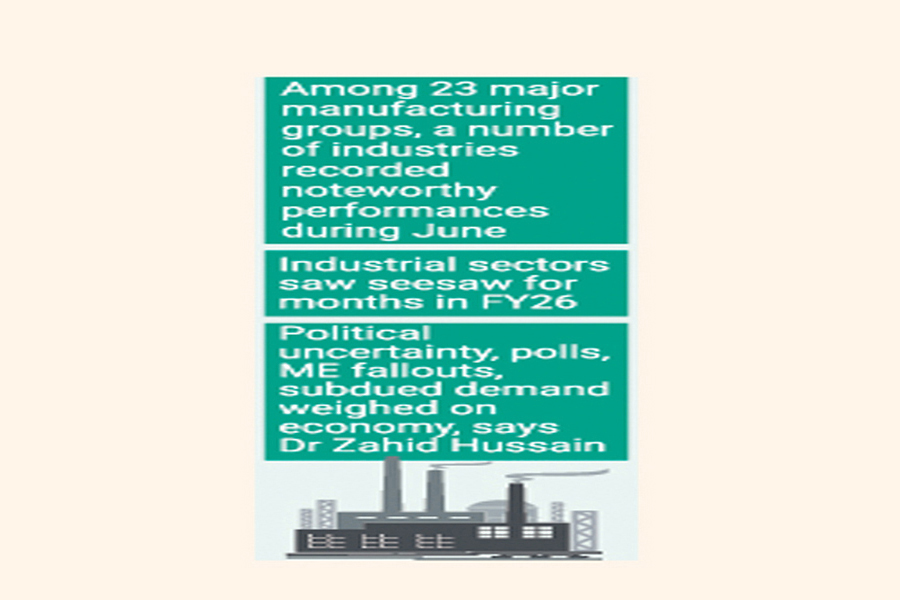
💬 “The manufacturing sector had a difficult fiscal year,” says Dr. Zahid Hussain, an independent economist. He goes on to say that industrial activity contracted in several months amid political uncertainty, the national elections and the fallout from geopolitical tensions, including the crisis in the Middle East centred on Iran.
👥 Some industries are benefiting from stronger demand and export opportunities, while others continue to face subdued consumption, high production costs, financing constraints or weak investment. The sharp rise in June, therefore, needs to be viewed in the context of the sector’s performance over the entire fiscal year rather than as evidence of a fully established recovery.
📈 Volatile Year: Negative Growth in Six Months
📊 The sector recorded negative growth in October, November, December, February, March and May. January and another month recorded virtually flat performance. As a result, the strong June expansion came after months in which manufacturers faced weak demand, uncertainty over investment and disruptions to business activity.
✅ Against this backdrop, the June increase of 14.5 percent is significant. It marks a sharp turnaround from the contractionary trend seen during much of the fiscal year and could indicate that manufacturers are responding to improving business conditions and stronger external demand, particularly for export-oriented products.
👥 Mixed Picture Across 23 Manufacturing Groups
✅ Among the 23 major manufacturing groups, a number of industries recorded noteworthy performances during June. The gainers include:
- 🍚 Food products
- 👕 Leather
- 🧪 Chemicals
- 💊 Pharmaceuticals
- 🔹 Rubber and plastics
- ⚙ Basic metals
- 🔌 Electrical equipment
- 🔧 Machinery
- 🚗 Motor vehicles
- 🚆 Other transport equipment
- 🛋 Furniture and other manufacturing
❌ Several industries, meanwhile, continued to perform poorly. The losers include:
- 🍹 Beverages
- 🚭 Tobacco
- 🪵 Wood products
- 📄 Paper and paper products
- 🔨 Fabricated metal products
- 💻 Computers and electronics
- 🖨 Printing
📊 The performance of these industries points to some degree of breadth in the June recovery, although the dominant contribution from garments means the overall picture remains heavily influenced by one sector.
🌏 Strategic Context for Bangladesh Industry
📈 The June rebound provides a measure of relief for Bangladesh’s industrial policymakers after a difficult year. However, the concentration of growth in the clothing sector underscores both the strength and vulnerability of the country’s industrial base.
👕 With garment exports accounting for over 80 percent of Bangladesh’s total merchandise exports, the clothing industry’s dominance in the manufacturing index is structural — but it also means that any slowdown in global apparel demand could rapidly translate into weaker industrial growth.
🤝 For the broader economy, the June data suggests that the worst of the FY2025-26 industrial slowdown may be over. But sustained recovery will require addressing the persistent headwinds facing non-garment industries — including financing constraints, high production costs, weak domestic consumption and limited investment.
✅ For investors and policymakers, the takeaway is that Bangladesh’s industrial diversification agenda remains a work in progress. While the country’s garment export machine continues to power industrial output, building a more balanced manufacturing base across pharmaceuticals, light engineering, electronics and agro-processing will be essential to sustain long-term industrial growth and reduce dependence on a single sector.
This news was originally published by The Financial Express. For the full original report, please visit: https://thefinancialexpress.com.bd/economy/large-scale-manufacturing-sector-rebounds-with-145pc-growth-in-june
Related on BangladeshExport
📬 Get Bangladesh Trade News in your inbox
Weekly digest of export industry news, policy updates, and market analysis.
📰 Related Stories