Bangladesh Handset Industry Squeezed On Multiple Fronts: Surging Memory Costs, Grey Market, Weak Production
Daily Star's Mahmudul Hasan documents how Bangladesh's local mobile handset industry faces surging memory component prices (70% rise since January), declining production (9.9% YoY drop in smartphones), grey market competition, and regulatory uncertainty under the National Equipment Identity Register (NEIR).
Dhaka, September 29, 2026 — Bangladesh's local mobile handset industry is under fresh pressure from rising prices of memory components, adding to longstanding problems such as grey-market competition, weak factory utilisation, and uncertainty over regulatory enforcement. Prices of key smartphone components, particularly RAM and ROM, have risen sharply this year, raising production costs for local manufacturers and threatening to make budget smartphones more expensive.
💰 Surging Memory Component Costs
Key data on the memory price surge:
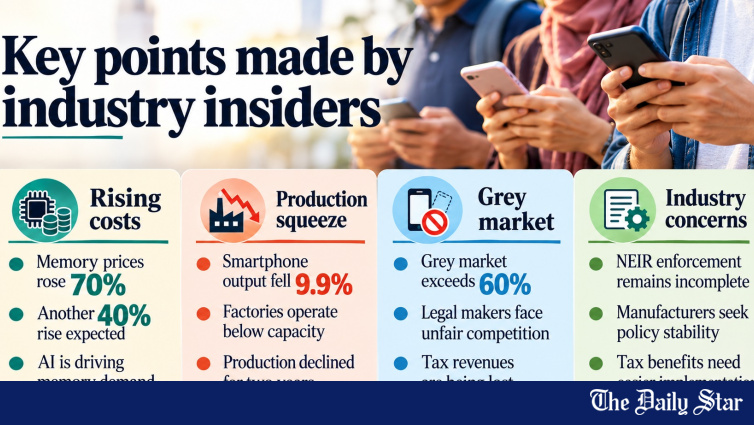
- 💰 Memory price rise since January 2026: approximately 70 per cent — per Rezwanul Hoque, CEO of Ismartu Technology BD Ltd
- 💰 Expected additional rise (next 3 months): another 40 per cent
- 💰 Gartner estimate: combined DRAM and solid-state drive prices could rise 130 per cent by end of 2026 from 2025 levels
- 💰 Potential smartphone price impact: up to 13 per cent increase
💬 Ziauddin Chowdhury, country general manager of Xiaomi Technologies Bangladesh, said rising memory-chip prices, driven partly by the rapid expansion of artificial intelligence technologies, were putting “significant pressure on the affordability of entry-level and budget segments.”
📱 Declining Local Production
BTRC data shows declining handset production:
- 📱 Smartphone production (Jan-Aug 2026): 53.76 lakh units (down 9.9% YoY from 59.66 lakh)
- 📱 Feature-phone production (Jan-Aug 2026): 85.66 lakh units (down 9.6% YoY from 94.73 lakh)
- 📱 Total production (2025): ~2.44 crore handsets (down from ~2.73 crore in 2024)
The Daily Star spoke to half a dozen manufacturers' officials, who said their factories were operating at less than full capacity due to competition from unofficial (grey market) imports.
💬 Industry Voices
💬 Rezwanul Hoque, CEO of Ismartu Technology BD Ltd: “Memory prices had risen 70 per cent since January and could climb another 40 per cent over the next three months.”
💬 Jakaria Shahid, president at the Mobile Phone Industry Owners' Association of Bangladesh (MIOB): “Global memory supplies were very tight, pushing up prices in the unofficial market as well.”
🚧 Grey Market Competition
Local manufacturers face significant competition from grey market (unofficial) imports:
- 🚧 Unofficial imports — handsets brought in without proper customs declaration
- 🚧 Price undercutting — grey market sellers can offer lower prices by avoiding duties
- 🚧 Quality concerns — grey market handsets may not meet safety or quality standards
- 🚧 Revenue loss — grey market deprives the government of import duties and taxes
🏛 NEIR And Regulatory Enforcement
Industry players say effective enforcement of the National Equipment Identity Register (NEIR) is crucial:
- 🏛 NEIR purpose: register and verify the IMEI numbers of all mobile handsets sold in Bangladesh
- 🏛 Anti-grey market: NEIR can block unofficial handsets from accessing mobile networks
- 🏛 Consumer protection: NEIR helps track stolen handsets and prevents counterfeit devices
- 🏛 Implementation challenges: NEIR enforcement has been inconsistent
💼 Bangladesh's Handset Manufacturing Ecosystem
Bangladesh has developed a local handset manufacturing ecosystem:
- 📱 Major brands manufacturing locally: Samsung, Xiaomi, Oppo, Vivo, Walton, Symphony
- 📱 Manufacturing facilities: located primarily in Dhaka and surrounding areas
- 📱 Employment: thousands of workers in assembly, testing, and quality control
- 📱 Government support: tax incentives for local manufacturing to reduce import dependence
📊 The AI Connection
The memory price surge is partly driven by the global AI investment boom:
- 🧠 AI demand for memory — AI training and inference require massive amounts of high-bandwidth memory
- 🧠 Supply reallocation — memory manufacturers are prioritising AI-grade chips over consumer-grade chips
- 🧠 Price transmission — the AI-driven demand pushes up prices across all memory segments
📜 Looking Ahead
For Bangladesh's handset industry, the combination of surging memory costs, grey market competition, and regulatory uncertainty creates a perfect storm. Key priorities include:
- 🔹 NEIR enforcement — to curb grey market imports and protect local manufacturers
- 🔹 Stable tax policy — to provide predictability for manufacturers
- 🔹 Component cost mitigation — exploring bulk procurement, local component manufacturing, or trade agreements
- 🔹 Export market development — utilising local manufacturing capacity for regional exports
- 🔹 Technology upgrades — moving up the value chain from assembly to design and engineering
The coming months will be critical for Bangladesh's handset manufacturing sector — with the memory price surge showing no signs of abating and the grey market continuing to undercut local producers. Without effective policy intervention, Bangladesh risks losing the manufacturing capacity it has built over the past decade.
This news was originally published by The Daily Star. For the full original report, please visit: https://www.thedailystar.net/business/news/handset-industry-squeezed-multiple-fronts-4283546
📬 Get Bangladesh Trade News in your inbox
Weekly digest of export industry news, policy updates, and market analysis.
📰 Related Stories




✍️ More from System Administrator