Banglalink Gets BTRC Approval For Limited Starlink Direct-To-Cell Service: Bangladesh First In South Asia
Banglalink becomes the first operator in South Asia to introduce Starlink Direct-to-Cell service, allowing 4G handset users to access SMS, data messaging, and WhatsApp calls in areas beyond conventional mobile network coverage, including at sea and remote islands.
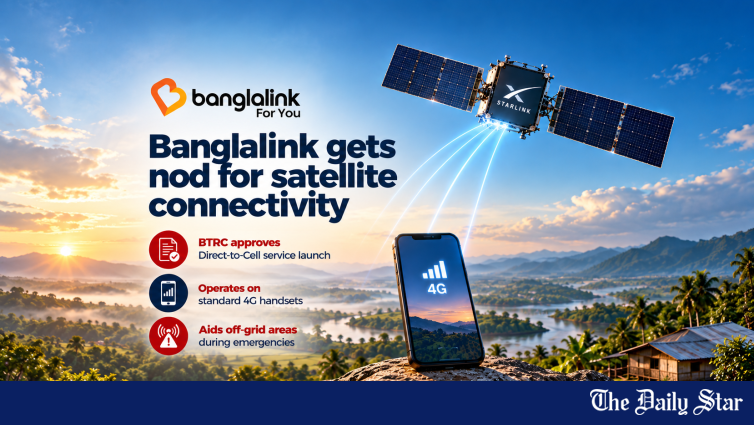
Dhaka, September 25, 2026 — Banglalink has received approval from the Bangladesh Telecommunication Regulatory Commission (BTRC) to launch a limited Starlink Direct-to-Cell service, which it says makes Bangladesh the first country in South Asia to introduce the technology. The approval marks a significant milestone in Bangladesh's telecom sector modernisation — bringing satellite-to-mobile connectivity closer to commercial reality.
🛰 Initially, Banglalink subscribers with 4G-enabled handsets will be able to access SMS, data messaging, and WhatsApp calls through the connection in areas with Direct-to-Cell coverage, the operator said in a statement today.
📱 How Direct-To-Cell Works
The satellite technology lets standard 4G LTE mobile phones connect directly to Starlink satellites in orbit without requiring:
- 📱 A special handset
- 📱 A satellite dish
- 📱 Extra hardware
- 📱 Custom apps
This is a significant breakthrough compared to traditional satellite phone services that require bulky dedicated handsets and expensive service plans. Direct-to-Cell technology integrates Starlink satellites as supplementary cell towers in orbit, allowing standard 4G LTE devices to connect seamlessly.
🌏 Coverage Expansion Beyond Traditional Networks
By combining Banglalink's mobile network with Starlink's satellite system, the service will extend connectivity to areas beyond conventional networks, including:
- 🌊 The sea — allowing fishermen and maritime workers to stay connected.
- 🌴 Remote islands — including Bangladesh's coastal islands.
- 🏖 Coastal communities — particularly those vulnerable to cyclones.
- ⛰ Hill tracts — the Chittagong Hill Tracts and other remote areas.
- 🏔 Other coverage gap areas — where traditional mobile towers are not economically viable.
💼 Target Beneficiaries
The service could prove particularly useful for:
- 🐟 Fishermen — who venture far out into the Bay of Bengal and currently lack any communication means in case of emergencies.
- 👥 Remote communities — including island dwellers and populations in remote rural areas.
- 🚶 People travelling through locations without mobile coverage — including highways, rivers, and remote routes.
🌚 Disaster Resilience Applications
The service could also provide an alternative means of communication during:
- 🌪 Cyclones — when traditional network infrastructure may be damaged.
- 🌊 Floods — particularly in flood-prone regions.
- 🌏 Other natural disasters — including earthquakes and landslides.
- ⚡ Power outages — when mobile towers and other network infrastructure are unavailable.
- 🚧 Infrastructure damage scenarios — when mobile towers are damaged or destroyed.
This disaster resilience application is particularly significant for Bangladesh — one of the world's most climate-vulnerable countries — where cyclones and floods regularly disrupt communication infrastructure.
💬 Banglalink CEO's Statement
💬 Johan Buse, Chief Executive Officer of Banglalink, said: “This is ultimately about people, not technology. A fisherman far out at sea, a family in a remote area, or someone caught in a natural disaster should not have to worry about being beyond the reach of mobile services.”
💬 “With Starlink, Banglalink is taking mobile connectivity beyond the boundaries of traditional networks and bringing it to more people, in more places, across Bangladesh,” he added.
The CEO's framing is significant — positioning the service as a humanitarian connectivity initiative rather than a purely commercial offering.
🌏 Starlink: Elon Musk's Satellite Internet Venture
Starlink is the satellite internet constellation operated by SpaceX, the aerospace company founded by Elon Musk. Key facts about Starlink:
- 🛰 Constellation size: Over 6,000 satellites in low Earth orbit (LEO).
- 🛰 Service coverage: Available in over 70 countries globally.
- 🛰 Direct-to-Cell technology: Launched in 2024, allowing standard LTE phones to connect to Starlink satellites.
- 🛰 Service types: SMS, data messaging, and (eventually) voice calls.
- 🛰 Speed: Currently limited for Direct-to-Cell, but with plans for significant upgrades.
🏢 Banglalink: Company Profile
Banglalink is Bangladesh's third-largest mobile operator, with key facts:
- 📱 Subscribers: approximately 40+ million.
- 📱 Parent company: VEON (Netherlands-based international telecom operator).
- 📱 Network technology: 4G LTE nationwide, with 5G trials planned.
- 📱 Market position: Third largest after Grameenphone and Robi.
Banglalink's parent company VEON has also been approved to launch Nova Digital Bank in Bangladesh — making Banglalink a key player in both telecom and digital financial services.
🏛 BTRC's Regulatory Role
The Bangladesh Telecommunication Regulatory Commission (BTRC) is the regulatory authority for the telecommunications sector in Bangladesh. BTRC's approval of the Starlink Direct-to-Cell service reflects:
- ⚖ Regulatory innovation — adapting to new satellite-to-mobile technologies.
- ⚖ Spectrum management — authorising satellite spectrum use for the service.
- ⚖ Consumer protection — ensuring service quality and customer rights.
- ⚖ National security considerations — reviewing satellite connectivity from a security perspective.
🌏 Regional Context: First In South Asia
Bangladesh's position as the first South Asian country to introduce Starlink Direct-to-Cell technology is strategically significant:
- 🇧🇩 Bangladesh — first to introduce Direct-to-Cell, through Banglalink.
- 🇮🇳 India — Starlink's broader satellite internet service has been pending regulatory approval.
- 🇵🇰 Pakistan — Starlink has not yet received regulatory approval.
- 🇱🇰 Sri Lanka — Starlink has received approval for satellite internet services but not yet Direct-to-Cell.
- 🇳🇵 Nepal — Starlink not yet available.
💼 Implications For Bangladesh's Telecom Sector
The Starlink Direct-to-Cell service has several strategic implications for Bangladesh's telecom sector:
- 📱 Universal service obligation (USO) — supports the goal of universal connectivity, particularly for remote and underserved populations.
- 📱 Competitive differentiation — Banglalink gains a unique selling proposition against Grameenphone and Robi.
- 📱 Disaster management capability — provides backup communication during natural disasters.
- 📱 Maritime economy support — enables digital services for Bangladesh's fishing fleet and maritime workers.
- 📱 Tourism potential — extends connectivity to remote tourist destinations like St. Martin's Island.
💼 Other Telecom Operators' Likely Response
Banglalink's Starlink partnership is likely to trigger competitive responses from other Bangladeshi telecom operators:
- 📱 Grameenphone — may seek partnerships with other satellite operators (e.g., Iridium, OneWeb) or pursue its own Direct-to-Cell agreements.
- 📱 Robi Axiata — may pursue similar satellite partnerships through its parent Axiata's regional network.
- 📱 Teletalk — the state-owned operator may seek government support for satellite connectivity.
📜 What's Next?
The limited Starlink Direct-to-Cell service is now in the launch preparation phase. Key next steps include:
- 📝 Network integration — between Banglalink's core network and Starlink's satellite system.
- 📝 Testing and quality assurance — ensuring service reliability before commercial launch.
- 📝 Customer onboarding — enabling 4G handset users to access the service.
- 📝 Service rollout — phased expansion across coverage areas.
- 📝 Pricing announcement — with details on service plans and consumer pricing.
Industry observers expect the commercial launch within the next 3-6 months — though the exact timeline will depend on technical integration progress and regulatory approvals for commercial operations.
💼 Wider Strategic Implications
For Bangladesh's broader digital transformation agenda, the Starlink Direct-to-Cell service represents an important milestone — demonstrating that the country is at the forefront of adopting cutting-edge telecom technologies. This positioning supports:
- 🌏 Digital Bangladesh vision — extending connectivity to all citizens.
- 🌏 Smart Bangladesh 2041 — supporting the goal of universal digital services.
- 🌏 Climate resilience — providing communication backup during climate-induced disasters.
- 🌏 Blue economy development — enabling digital services for Bangladesh's maritime economy.
- 🌏 International reputation — positioning Bangladesh as a regional telecom innovation leader.
The approval of the Starlink Direct-to-Cell service is therefore not just a telecom sector development — it is a strategic milestone that reinforces Bangladesh's commitment to leveraging technology for inclusive and resilient development.
This news was originally published by The Daily Star. For the full original report, please visit: https://www.thedailystar.net/business/news/banglalink-gets-approval-limited-starlink-service-4281921
📬 Get Bangladesh Trade News in your inbox
Weekly digest of export industry news, policy updates, and market analysis.
📰 Related Stories

✍️ More from System Administrator