Bangladesh Must Build Stronger Chemical Industry to Cut $6.2 Billion Import Bill, DCCI Urges
Domestic chemical market estimated at $6-8 billion growing 10-15% annually; textile/RMG alone uses 2,500+ chemicals; pharma imports 90% of APIs
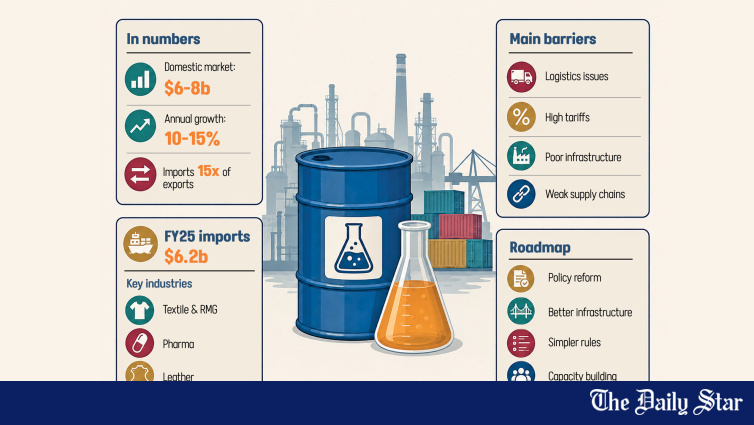
Dhaka, July 25, 2026 — Bangladesh's major export sectors rely heavily on chemicals, but the country still imports most of its chemical needs despite having a domestic market estimated at $6 to $8 billion that is growing by 10 to 15 percent annually. Developing a strong domestic chemical industry is essential to reduce import dependence and improve the competitiveness of export sectors, stakeholders said at a seminar yesterday. 🏭
📋 The seminar, titled "Backward Linkage Development of Chemical-Dependent Key Export-Oriented Industries: Current State & Issues", was organised by the Dhaka Chamber of Commerce and Industry (DCCI) at its auditorium in the capital.
📊 Chemical Import Bill — $6.2 Billion and Rising
Bangladesh imported $6.2 billion worth of chemicals in FY25, up 17.8 percent from the previous year. 💰
📦 Chemicals are a key input for multiple export sectors:
- 👕 Textiles and RMG — Uses more than 2,500 chemicals including dyes, auxiliaries, and finishing agents
- 💊 Pharmaceuticals — Requires active pharmaceutical ingredients (APIs), excipients, and solvents; imports ~90% of APIs despite exporting to 150+ countries
- 👞 Leather — Depends on tanning chemicals and dyes
- 🏗️ Construction — Uses chemical additives and materials
- 🌾 Agriculture — Requires fertilizers, pesticides, and agrochemicals
- ♻️ Plastics — Depends on polymer chemicals and additives
💊 Pharmaceutical Sector — 90% API Import Dependence
Although the pharmaceutical industry exports products to more than 150 countries, it still imports around 90 percent of its APIs. This heavy import dependence creates vulnerability in one of Bangladesh's most promising export sectors. 🌍
⚠️ The API import dependence means:
- 💰 High foreign exchange outflow for raw materials
- 📅 Supply chain vulnerability — dependent on foreign API suppliers
- 📊 Limited margin control — API prices set by international markets
- 🏭 Constrained domestic value addition
👕 Textile and RMG — 2,500+ Chemicals Used
The textile and RMG sector alone uses more than 2,500 chemicals, including dyes, auxiliaries, and finishing agents. This massive chemical requirement represents both a challenge (import dependence) and an opportunity (potential for domestic production). 🧪
📋 Key chemical categories for textiles:
- 🎨 Dyes — Reactive, disperse, vat, and acid dyes for coloring
- 🔧 Auxiliaries — Wetting agents, leveling agents, softeners
- ✨ Finishing agents — Wrinkle-resistant, water-repellent, flame-retardant finishes
- 🧴 Sizing chemicals — For yarn preparation and weaving
- 🧹 Bleaching agents — For fabric preparation
🎯 DCCI Recommendations — Building Domestic Capacity
The DCCI seminar highlighted the need for strategic development of the domestic chemical industry:
- 🏗️ Investment in chemical manufacturing — Both domestic and FDI
- 📚 Technology transfer — From established chemical-producing countries
- 🎓 Workforce development — Chemical engineering and specialized training
- 📋 Policy support — Tax incentives, bonded warehouse facilities for chemical manufacturers
- 🔬 R&D investment — Domestic research into chemical processes and products
- 🌍 Strategic partnerships — With international chemical companies for technology and knowledge
💰 Economic Impact of Import Substitution
Developing a domestic chemical industry could have significant economic benefits:
- 💵 Foreign exchange savings — Reduce the $6.2 billion chemical import bill
- 🏭 Export competitiveness — Lower input costs for textile, pharma, and leather sectors
- 💼 Job creation — Chemical manufacturing is capital and labor intensive
- 🔗 Backward linkage — Strengthens the entire export supply chain
- 🛡️ Supply chain resilience — Reduces vulnerability to global supply disruptions
For Bangladesh to achieve its export targets — including the government's ambition of a $1 trillion economy by 2034 — building a robust domestic chemical industry is not optional but essential. The current $6.2 billion import bill represents both a vulnerability and an opportunity: the question is whether Bangladesh can capture even a fraction of this market domestically. 🚀
This news was originally published by The Daily Star. For the full original report, please visit: https://www.thedailystar.net/business/economy/news/stronger-chemical-industry-needed-cut-import-dependence-4232296
📬 Get Bangladesh Trade News in your inbox
Weekly digest of export industry news, policy updates, and market analysis.
📰 Related Stories