Adani Power Plant Unit Trips, Deepening Bangladesh Power Crisis
Technical fault at 1,600 MW Adani Godda plant cuts supply to 736 MW as Bangladesh faces gas, coal and liquid-fuel shortages with peak demand exceeding 16,000 MW
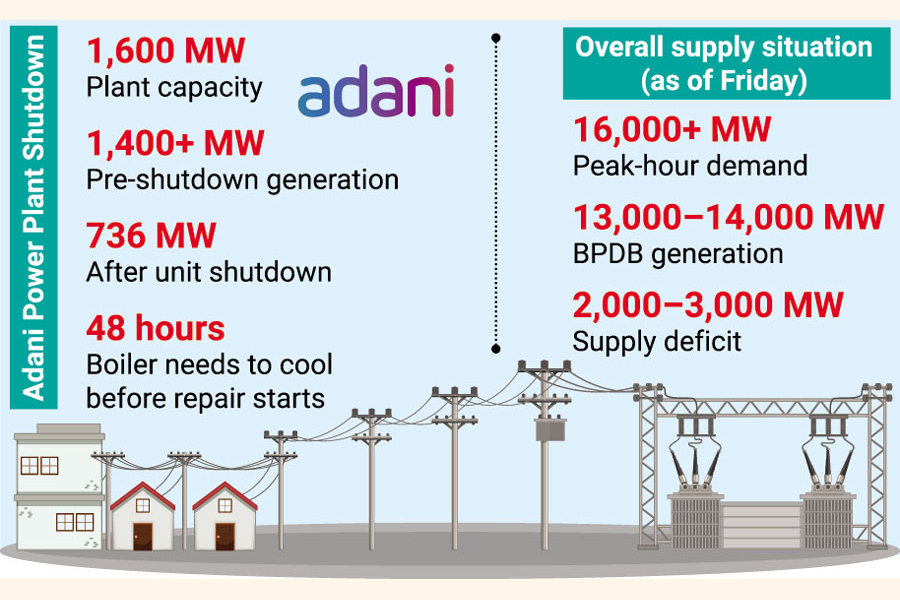
⚠ A unit of the 1,600-megawatt Adani power plant in India's Jharkhand has shut down following "technical fault" that further tightened Bangladesh's power-supply situation amid ongoing gas, coal and liquid-fuel shortages. Sources say the shutdown has cut down the plant's generation by more than half — dealing a fresh blow to a power system already under sustained pressure from domestic fuel supply constraints.
📊 The plant was generating more than 1,400 megawatts on Thursday night before one of its units went offline around midnight. By Friday noon, its generation had fallen to 736 MW, according to sources at Bangladesh Power Development Board (BPDB) and Power Grid Company of Bangladesh (PGCB). The 48% reduction in supply from the Adani plant translates into approximately 700 MW of lost generating capacity for Bangladesh's grid at a time when peak-hour demand exceeds 16,000 MW.
At 3:00 am on Thursday, grid supply came down to 12,907 megawatts against 15,776 MW in demand, leaving a 2,869 MW shortfall. Officials familiar with the plant said a technical glitch had developed in the boiler of one of its units. "The boiler may take around 48 hours to cool before repair can begin, meaning it could take several days for generation to return to normal."
💰 Adani Power Purchase Agreement Context
The BPDB signed a power-purchase agreement with the plant authority in 2017. The plant has supplied more than 1,500 megawatts at times, based on Bangladesh's demand. The Adani Godda plant — owned by Indian conglomerate Adani Power — was commissioned specifically to supply electricity to Bangladesh via a dedicated cross-border transmission line. The 25-year power purchase agreement has been politically contentious in Bangladesh, with critics arguing that the pricing terms (linked to imported coal with a capital cost component) made the electricity more expensive than domestic generation alternatives.
Despite the controversy, the Adani plant has become a critical component of Bangladesh's power supply mix, particularly during peak summer demand when domestic gas-fired capacity falls short. The current shutdown underscores the supply concentration risk of relying on a single cross-border plant for a significant share of peak generation capacity.
- ⚠ Adani Godda plant total capacity: 1,600 MW
- 📊 Generation before shutdown: 1,400+ MW (Thursday night)
- 📊 Generation after shutdown: 736 MW (Friday noon)
- 💰 Lost supply: ~700 MW (48% reduction)
- 📅 Power purchase agreement signed: 2017
- ⏳ Repair timeline: ~48 hours to cool boiler + several days for repairs
- 📈 Peak demand: 16,000+ MW
- 📈 Current generation: 13,000-14,000 MW
- ⚠ Friday morning load shedding: 2,500+ MW
🔥 Broader Power Crisis: Gas, Coal And Liquid-Fuel Shortages
Meanwhile, the country's power generation has come under increasing pressure for worsening energy shortage and technical glitches at some power plants. According to BPDB sources, the gas shortage has persisted for more than two months, reducing generation from gas-fired power plants by up to 1,500 MW. Several coal-fired plants are also operating below capacity due to fuel shortages and technical problems.
Latest generation data show that BPDB generates 13,000-14,000 MW against peak-hour demand exceeding 16,000 MW, leaving a significant supply deficit. Current production relies primarily on gas-fired plants (5,000 MW), coal-fired units (4,500 MW), and liquid-fuel plants (2,000-3,000 MW). The domestic gas supply shortage has been the most persistent constraint — Bangladesh's natural gas reserves have been declining for several years, and LNG import infrastructure has not been able to fully bridge the gap between demand and domestic supply.
Generation at the Payra power plant in Patuakhali has also been affected, with one unit remaining offline for several days due to coal shortages and a technical fault. Another power plant in Patuakhali is also facing a coal shortage. The Payra plant — a 1,320 MW Bangladesh-China joint venture — has been plagued by coal supply disruptions, foreign exchange constraints on coal imports, and technical issues that have repeatedly forced one or both of its units offline.
💵 Coping Strategy: Oil-Fired Generation
Sources said authorities were trying to offset the shortfall by increasing generation from oil-fired power plants to make do with. However, the additional generation has not been sufficient to fully ease the pressure on the power-supply system. Load shedding has also increased as electricity demand rises with higher temperatures even at the fag-end of the outgoing summer.
Despite Friday being a weekly holiday, load shedding exceeded 2,500 MW in the morning. It later fell to 414 MW at about 2:00 pm as generation increased. The reliance on oil-fired generation is economically expensive — diesel and furnace oil-based power plants cost approximately 3-4 times as much per kWh as gas-fired generation. Sustained reliance on oil-fired capacity to bridge the supply gap will significantly increase BPDB's operating costs and widen the subsidy burden on the national budget.
🏛 Implications For Bangladesh's Export Economy
For Bangladesh's export-oriented economy, the power crisis carries direct operational consequences. Ready-made garment (RMG) factories — which account for over 84% of merchandise exports — depend on reliable grid electricity to operate sewing machines, knitting machines, washing plants and other production equipment. Power interruptions force factories to either shut down production lines or switch to expensive diesel generator backup power, raising production costs and reducing competitiveness against regional rivals including Vietnam and Cambodia.
The crisis is particularly damaging for the broader manufacturing sector at a time when private-sector credit growth is stuck at just 4.47% and industrial output contracted by 0.28% in the most recent reporting period. Without reliable electricity supply, industrial capacity utilisation falls, fixed costs spread over lower production volumes, and unit costs rise — squeezing margins for exporters already under pressure from US tariffs and global demand softness.
🌏 Strategic Context: Bangladesh-India Power Trade
The Adani plant shutdown also has strategic implications for Bangladesh-India power trade relations. Bangladesh imports approximately 1,500-2,000 MW of electricity from India through multiple cross-border interconnections, with the Adani Godda plant being the largest single source. The current disruption exposes the vulnerability of depending on cross-border generation capacity that is outside Bangladesh's regulatory and operational control.
For the interim government, the crisis adds to the urgency of resolving Bangladesh's structural energy supply challenges. Options include: accelerating domestic gas exploration and LNG import infrastructure expansion; diversifying coal supply sources to reduce dependence on any single origin country; scaling renewable energy capacity faster to reduce reliance on fossil-fuel imports; and renegotiating power purchase agreements with cross-border suppliers to ensure more favourable terms and reliability guarantees.
🤝 What Comes Next
The coming days will reveal how quickly the Adani plant's affected unit can be brought back online, and whether the broader gas and coal supply shortages show any sign of easing. The 48-hour boiler cooling period is the minimum technical timeline — actual repair and restart could take several days depending on the nature of the technical fault and the availability of spare parts and skilled technicians.
In the interim, Bangladesh will continue to rely on oil-fired generation to bridge the supply gap — accepting the higher operating costs as the price of keeping industrial production running. The episode underscores the structural fragility of Bangladesh's power supply system and reinforces the case for accelerated investment in domestic energy infrastructure, including renewable energy capacity that does not depend on imported fuel inputs.
For an economy preparing to graduate from LDC status in November 2026, reliable and affordable electricity supply is a strategic prerequisite for sustaining export competitiveness and attracting foreign investment. The Adani plant shutdown is a tactical supply disruption — but it exposes a strategic vulnerability that will need to be addressed if Bangladesh is to sustain its export-led growth trajectory in the post-LDC era.
This news was originally published by The Financial Express. For the full original report, please visit: https://thefinancialexpress.com.bd/economy/adani-plants-one-unit-trips-amid-bangladesh-power-crunch
📬 Get Bangladesh Trade News in your inbox
Weekly digest of export industry news, policy updates, and market analysis.
📰 Related Stories