38 Bangladeshi Banks Seek Tk 28,000 Crore in Stimulus Funds for Struggling Businesses
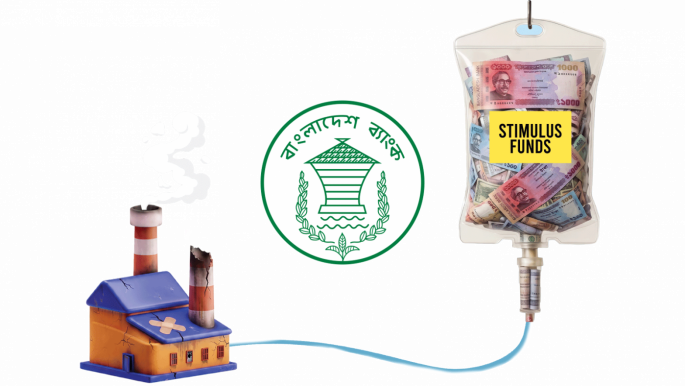
Dhaka, August 18, 2026 — Thirty-eight commercial banks have signed agreements with Bangladesh Bank seeking over Tk 28,000 crore under the central bank's stimulus scheme to lend to struggling businesses, with loan disbursements set to begin on 1 September 2026 after the central bank resolved an interest-rate dispute with commercial lenders. The disbursement is part of a wider Tk 60,000 crore stimulus package announced in May 2026 to reopen closed and struggling mills and factories — with the broader package expected to revive industries and create 25 lakh (2.5 million) jobs.
📊 The Numbers at a Glance
- 🏢 38 banks — have signed stimulus agreements with Bangladesh Bank
- 💰 Tk 28,000+ crore — sought under the stimulus scheme
- 💰 Tk 41,000 crore — total size of the refinancing facility (part of wider Tk 60,000cr package)
- 📅 1 September 2026 — loan disbursements begin
- 📈 10.0% — current facility interest rate (policy rate 9.5% + 50 bps)
- ⏳ 3 years — gradual drawdown period (not disbursed all at once)
- 👥 25 lakh jobs — target of the wider Tk 60,000 crore stimulus
- 📈 50 bps cut — on 30 July 2026 (first policy rate cut in nearly two years)
- 💰 9.5% — current Bangladesh Bank policy rate
💰 Interest Rate Dispute Resolved
Bangladesh Bank has cleared the path for loan disbursements to begin on 1 September after resolving an interest rate dispute with commercial banks over funding for the Tk 41,000 crore refinancing facility. Under the agreed terms, Bangladesh Bank will pay fund-providing banks a rate tied to its policy rate plus 50 basis points — up from the 9% originally proposed.
Treasury officials at several banks confirmed the earlier 9% flat rate had been a key sticking point. By pegging the rate to the policy rate plus 50 bps, the central bank can automatically adjust borrowing costs alongside future policy changes — a structure that gives commercial banks comfort that their funding cost will track monetary policy decisions over the three-year drawdown period. Following a 50-bps cut on 30 July 2026 — the first policy rate cut in nearly two years — the policy rate now stands at 9.5%, putting the facility's current rate at 10%.
📜 Previous Failed Attempts and Treasury Concerns
Previous attempts to resolve the rate dispute, including two meetings chaired by Deputy Governor Dr. Kabir Ahmed with treasury heads split over advance-deposit ratios of 60–70% and 70–80%, ended without consensus. Beyond the interest rate, treasury officials raised concerns on two additional fronts:
- 🛡 No liquidity backstop — funds lent under the scheme will carry no liquidity support, as Bangladesh Bank has confirmed that holdings under the package cannot be used as collateral for repo financing during cash shortages.
- 📊 Accounting treatment unclear — bankers are unsure how to record the funds on their balance sheets, raising questions about regulatory capital treatment and reporting requirements.
🏢 Structural Design: Gradual Drawdown
Funds will be drawn down gradually over three years rather than disbursed all at once, a senior central banker said. For instance, if a bank requests Tk 100 crore for a client, Bangladesh Bank will pair the request with a surplus-liquidity lender able to meet that timeframe — a structure officials say refutes claims that bank funds will remain tied up for prolonged periods. The matched-maturity design is intended to address commercial bank concerns about liquidity being locked up for the full three-year horizon.
This structural innovation reflects Bangladesh Bank's effort to balance two competing objectives: providing long-term affordable financing to struggling businesses, while not undermining commercial bank liquidity management. By matching each borrower request with a specific surplus-liquidity lender willing to commit for the same timeframe, the central bank aims to create a peer-to-peer intermediation model within the banking system — with the central bank providing the credit risk backstop and the rate-settling mechanism.
🏭 Wider Stimulus Package: Tk 60,000 Crore
The Tk 41,000 crore refinancing facility is part of a wider Tk 60,000 crore stimulus package unveiled in May 2026 by the Finance Ministry under Finance Minister Amir Khosru Mahmud Chowdhury. The package was designed to:
- 🏭 Reopen closed mills and factories — particularly in the textile, jute, and sugar sectors that have seen significant closures over the past decade
- 👥 Create 25 lakh jobs — through revival of industrial capacity and new investment in productive sectors
- 🌾 Support struggling businesses — with affordable long-term financing at a time when commercial bank lending rates remain elevated
- 💼 Stimulate private-sector credit growth — which has been slowing despite earlier monetary easing
- 📊 Targeted sectors — including RMG and textiles, jute, leather, pharmaceuticals, agro-processing, light engineering, and plastics
👥 Why 38 Banks Signed Up
The fact that 38 of Bangladesh's roughly 60 scheduled banks have signed up for the stimulus scheme — collectively seeking over Tk 28,000 crore — reflects the depth of stress in the corporate loan book. Many businesses that borrowed during the post-COVID recovery of 2021–2022 have been unable to service their loans as inflation, energy shortages, weak export demand, and import clearance delays have eroded profitability over the past 18 months. The stimulus offers these businesses a path to refinance existing obligations at lower rates with longer tenors — buying them time to return to viability.
For banks, the scheme serves a different but equally important purpose: it allows them to clean up their balance sheets by moving stressed exposures into a long-term refinancing vehicle, freeing up capital for fresh lending. This is particularly important for the weaker banks — including several that have been under Bangladesh Bank's special supervision — for whom NPL ratios have climbed to uncomfortable levels. By transferring stressed loans to the stimulus facility, these banks can report healthier balance sheets, attract fresh capital, and resume normal lending operations.
⚠ Risks and Open Questions
Despite the apparent resolution of the interest rate dispute, several risks remain:
- ⚠ No liquidity backstop — if a surplus-liquidity lender faces its own cash shortage, it cannot use the stimulus holdings as repo collateral, potentially creating funding stress during liquidity tight periods.
- 📊 Accounting treatment unclear — banks may need additional regulatory guidance on capital treatment of stimulus exposures, particularly for risk-weighted assets calculations.
- 📜 Selection of beneficiaries — the scheme's success depends on banks selecting genuinely viable businesses for refinancing, rather than politically connected borrowers with little chance of recovery.
- 👥 Governance of closed factory re-openings — reopening closed mills and factories is politically popular but commercially risky; many of these factories closed because they were no longer competitive, not just because of working capital stress.
- 💰 Job creation target — the 25 lakh jobs target is ambitious; similar stimulus packages in Bangladesh's history have typically delivered 30–50% of their stated employment targets.
- 🌐 Currency risk — the stimulus supports taka-denominated lending, but many of the beneficiary businesses have dollar-denominated obligations (LCs, foreign currency loans), creating a currency mismatch.
🌐 Strategic Context: Banking Sector Reform
The stimulus scheme operates alongside the government's broader five-year banking sector clean-up plan — which aims to address the structural governance issues that have driven the NPL build-up over the past decade. Without genuine governance reform — including accountability for bank owners and directors responsible for related-party lending, stronger Bangladesh Bank supervision, and the resolution or merger of systematically weak banks — the stimulus risks being absorbed by the same governance failures that created the NPL crisis in the first place.
For Bangladesh's export economy, the stakes are particularly high. Many of the businesses seeking stimulus support are export-oriented — RMG factories, textile mills, leather processors, pharmaceutical manufacturers — whose survival is directly tied to the country's export competitiveness. If the stimulus succeeds in returning these businesses to viability, Bangladesh can preserve the productive capacity it needs to navigate the post-LDC transition. If it fails — by supporting non-viable businesses or being captured by politically connected borrowers — the country will face a deeper structural adjustment when the stimulus funds are exhausted, with even weaker banks and even fewer viable exporters.
The next six months will be critical. The disbursements beginning on 1 September will provide the first concrete evidence of whether the matched-maturity intermediation model can work at scale, whether commercial banks can manage without the repo backstop for stimulus holdings, and whether the selected beneficiaries can translate affordable long-term financing into operational recovery. For Finance Minister Amir Khosru Mahmud Chowdhury and Bangladesh Bank Governor Md. Mostaqur Rahman, the stimulus is both an opportunity and a test — an opportunity to revive industrial capacity and create jobs, and a test of whether the government can deliver complex financial reforms with the operational rigour needed to convert policy ambition into measurable outcomes.
This news was originally published by The Business Standard. For the full original report, please visit: https://www.tbsnews.net/economy/banking/38-banks-seek-tk28000cr-stimulus-funds-struggling-businesses-1517961
Related on BangladeshExport
📬 Get Bangladesh Trade News in your inbox
Weekly digest of export industry news, policy updates, and market analysis.
📰 Related Stories