14 Industrial Groups Submit 86 Investment Proposals for Closed Bangladesh State-Owned Factories
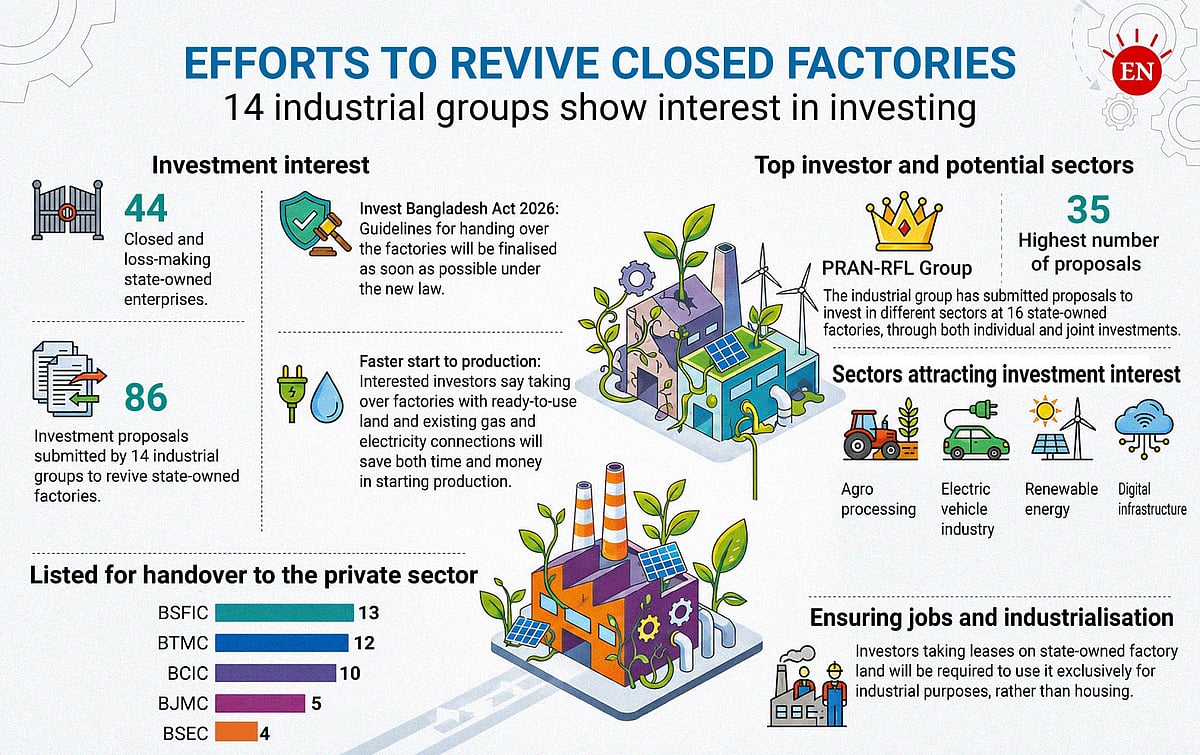
Dhaka, August 14, 2026 — Fourteen local companies and industrial groups have submitted 86 investment proposals to the government to take over closed and loss-making state-owned factories — marking one of the most significant private sector responses to the government's push to revive dormant industrial assets. The Bangladesh Investment Development Authority (BIDA) is now reviewing the proposals, which span agriculture, electric vehicles, data centres, food processing, light engineering, and renewable energy.
📊 The Investment Response
The private sector response to the government's factory revival initiative has been substantial:
- 👥 14 companies and industrial groups — submitted investment proposals
- 📜 86 investment proposals — total submissions to BIDA
- 🏭 44 closed/loss-making factories — identified for potential handover
- 📅 June 2026 initiative launch — BIDA listed factories for private sector
- 🌐 Multiple sectors covered — agriculture, EVs, data centres, food, light engineering, renewable energy
The 44 factories identified for potential handover are spread across five state-owned corporations:
- 🌾 BSFIC — 13 enterprises (sugar and food industries)
- 🧵 BTMC — 12 enterprises (textile mills)
- 🧪 BCIC — 10 enterprises (chemical industries)
- 🧵 BJMC — 5 enterprises (jute mills)
- 🔧 BSEC — 4 enterprises (steel and engineering)
💼 The 14 Industrial Groups and Their Proposals
The investment proposals reveal strong interest from Bangladesh's leading conglomerates:
- 🏭 PRAN-RFL Group — 35 investment proposals (largest single submitter)
- 🏭 Akij Resource Group — 12 proposals (via Akij Agro & Livestock + Akij Electric and Electronics)
- 🏭 TK Group — 10 proposals
- 🏭 Kazi Farms Group — 4 proposals
- 🏭 Transcom Group — 3 proposals
- 🏭 Paragon Group — multiple proposals (agro-processing and solar)
- 🏭 Square Food and Beverage — agro-processing interest
- 🏭 Nabil Group — interest in Setabganj Sugar Mills
- 🏭 BRAC Seed and Agro Enterprise — interest in Setabganj Sugar Mills
- 🏭 Milk Vita — interest in Setabganj Sugar Mills
- 👥 Plus 4 additional groups — with various proposals
📈 PRAN-RFL's Aggressive Play: 35 Proposals
PRAN-RFL Group has emerged as the most aggressive suitor — submitting 35 investment proposals for 16 state-owned factories. The group's interest spans:
- 🌾 Agriculture and agro-processing — leveraging PRAN's core strength
- 🚗 Electric vehicle and motorcycle manufacturing — new sector entry
- 💻 Data centres and digital infrastructure — tech sector diversification
- 🍚 Food and water processing — aligned with PRAN's food business
- 🔧 Light engineering — manufacturing capacity expansion
- ☀️ Renewable energy — solar power investments
The breadth of PRAN-RFL's proposals reflects the group's ambition to become a diversified industrial conglomerate — moving beyond its traditional food and consumer goods base into technology, mobility, and green energy.
🏭 Akij Group's Two-Pronged Strategy
Akij Venture Group has submitted 12 proposals through two subsidiaries:
- 🌾 Akij Agro and Livestock — 3 proposals covering agriculture, agro-processing, solar power, and cold storage at 3 sugar mills
- 🔌 Akij Electric and Electronics — 9 proposals in light engineering, furniture, rubber, electric vehicles, power, and IT
The two-pronged approach allows Akij to pursue both agro-industrial and technology/manufacturing opportunities simultaneously — maximising its chances of securing multiple factory allocations.
🏛️ Competitive Interest: Same Factories, Multiple Bidders
A review of the investment proposals shows that several industrial groups have expressed interest in investing in the same factories — creating competitive tension:
- 🌾 Thakurgaon Sugar Mills — Paragon Group AND Kazi Farms Group interested
- 🌾 Setabganj Sugar Mills — Nabil Group, BRAC Seed and Agro Enterprise, AND Milk Vita interested
- 📊 Multiple bidders for prime assets — suggests strong private sector demand
- 🤝 BIDA review process — will determine allocation methodology
- 🏛️ Investment structure committee — formed to scrutinise proposals
🏛️ Government Process and Timeline
The government has moved quickly to process the investment proposals:
- 📅 June 2026 — BIDA listed 44 factories for potential private sector handover
- 📅 July 4, 2026 — PM Office meeting on reopening closed factories
- 📅 July 8, 2026 — Ministry of Industries meeting chaired by Minister Khandaker Abdul Muktadir
- 📅 July 2026 — Invest Bangladesh Bill 2026 passed by parliament
- ⏳ Rules formulation underway — handover model to be decided after rules finalised
- 🚧 Committee formed — to scrutinise proposals and determine investment structure
Industries Secretary Abdun Naser Khan told Prothom Alo: “We have received investment proposals from various business organisations. The Invest Bangladesh Bill 2026 was passed last month. Once the rules are formulated under the law, it will be decided under which model the closed and unprofitable state-owned factories will be handed over to the private sector.” He said the entire process would be completed within a short period.
👥 PM Tarique Rahman's Directive
At the July 4 meeting at the Prime Minister's Office, PM Tarique Rahman directed officials to expedite the process of reopening unprofitable and closed state-owned factories through domestic and foreign investment. The PM's directive reflects the government's broader industrial revival strategy:
- 🏭 No factory to remain closed — PM's directive is to revive all viable assets
- 💰 Domestic and foreign investment — both sources welcome
- ⏳ Expedited process — avoid bureaucratic delays
- 👥 Employment generation — revive jobs in industrial areas
- 🏛️ Asset utilisation — put dormant public assets to productive use
🧑💼 Expert View: Maintain Industrial Character
Mustafizur Rahman, Distinguished Fellow at the Centre for Policy Dialogue (CPD), endorsed the initiative while cautioning on implementation: “The issue of closed state-owned factories had been left unresolved for a long time. The decision to hand them over to the private sector is a good one. However, it must be ensured that they remain industrial units even after being handed over to the private sector. If that happens, many people will find employment.”
The concern is that private investors might convert factory land to real estate or other non-industrial uses — losing the industrial capacity and employment potential. The government's handover conditions will need to mandate continued industrial use.
🏢 Paragon Group's Vision: Agro-Processing + Solar
Paragon Group Managing Director Moshiur Rahman shared his group's vision with Prothom Alo: “We want to increase our investment in agriculture. If we can lease a state-owned factory on a long-term basis, we will set up a solar power plant as well as a factory to produce animal feed. We also plan to grow rice and maize on land currently used for sugarcane cultivation.”
Paragon's proposal illustrates the integrated industrial model emerging — combining agro-processing, renewable energy, and feed production on a single factory site. This approach maximises land utilisation and creates multiple revenue streams.
🌐 Strategic Context: Industrial Revival and Export Diversification
The factory revival initiative is strategically significant for Bangladesh's export economy:
- 🏭 Industrial capacity expansion — revives dormant manufacturing assets
- 👥 Employment generation — creates jobs in industrial regions
- 💰 Private sector capital — mobilises domestic investment
- 🌐 Export diversification — new sectors like EVs, data centres, renewable energy
- 🏛️ Asset optimisation — puts public assets to productive use
- 📈 LDC graduation buffer — strengthens industrial base for post-LDC era
For an export economy preparing for LDC graduation and urgently seeking diversification beyond RMG, the revival of 44 state-owned factories — backed by 86 investment proposals from 14 industrial groups — represents a meaningful step toward broader industrial capacity. The sectors targeted (EVs, data centres, renewable energy, agro-processing) align directly with Bangladesh's emerging industry priorities — and if executed effectively, could create a new wave of export-oriented manufacturing capacity over the coming years.
This news was originally published by Prothom Alo English. For the full original report, please visit: https://en.prothomalo.com/business/2e52kpa7tx
Related on BangladeshExport
📬 Get Bangladesh Trade News in your inbox
Weekly digest of export industry news, policy updates, and market analysis.
📰 Related Stories