Jessore Molasses: Bangladesh Heritage GI Date-Palm Sweetener — Buyer's Guide (2026)
Jessore Molasses — Bangladesh's 2024 GI date-palm molasses (khejur gur), traditional gachhi sap-collection, wood-fire evaporation, complex caramel-smoky flavor. Seasonal Nov-Feb. HS 17021900, 7-point authenticity.
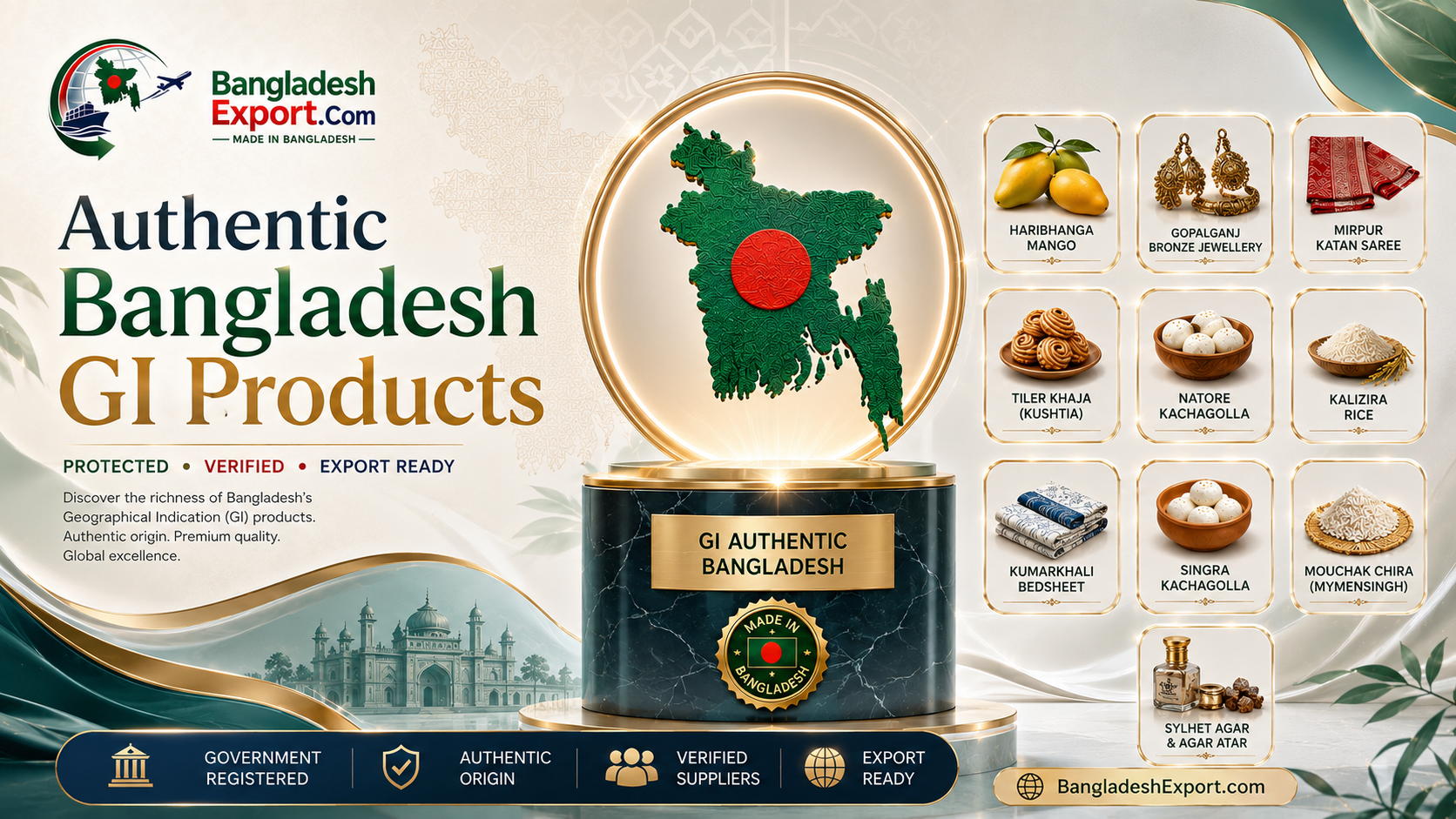
Jessore Molasses — registered as a Bangladesh GI product in 2024 — is one of Bangladesh's most distinctive traditional sweeteners, made from the sap of the date palm tree (Khejur in Bengali) and prized for its deep amber-to-dark-brown color, rich caramel flavor with smoky undertones, and its central role in traditional Bengali sweets and cuisine. Also known as "Khejur Gur" (date palm jaggery), this unrefined sweetener has been produced in the Jessore region of southwestern Bangladesh for centuries, with the specific agro-climatic conditions of the Jessore date-palm belt — the cool winter nights, the well-drained alluvial soil, and the traditional sap-collection and slow-cooking techniques — producing a molasses with measurably superior flavor, aroma, and mineral content than date-palm molasses produced elsewhere. For international buyers in the natural-sweetener, ethnic-food, and health-food segments, Jessore Molasses offers a genuinely authentic Bangladeshi heritage product with growing demand among consumers seeking alternatives to refined sugar.
This guide is for international food importers, diaspora-grocery distributors, ethnic-food retailers, health-food brands, and HORECA buyers sourcing authentic Jessore Molasses directly from verified date-palm farmers and molasses producers. We cover the product's history, the 2024 GI registration, the Jessore production region, the traditional sap-collection and molasses-making technique, quality characteristics, export markets, HS codes, packaging and shipping, authenticity verification, certifications, and direct sourcing from verified food suppliers on BangladeshExport.com.
📜 History and the Jessore Date-Palm Heritage
Buyers can verify the official list of Bangladesh's registered Geographical Indication (GI) products through the Bangladesh Trade Portal: bangladeshtradeportal.gov.bd — GI Products Page
Jessore district (now officially Jashore), situated in southwestern Bangladesh along the Indian border with West Bengal, has been a renowned date-palm cultivation and molasses-production region for over 400 years. The district's unique agro-climatic conditions — winter night temperatures that drop to 8–12°C (versus the Bangladesh average of 12–18°C), well-drained alluvial soil of the Gangetic delta, and a long dry season from October to March — create the ideal environment for date-palm sap production. The cool winter nights are particularly critical: they slow the sap flow rate during the day, allowing the tree to concentrate sugars in the sap, and they trigger the natural fermentation-inhibiting chemistry that makes the collected sap suitable for molasses production rather than spontaneous fermentation into palm wine (tari).
The date-palm sap-collection tradition in Jessore is believed to have originated with the indigenous farming communities of the southwestern Bengal delta, with the practice documented in Mughal-era revenue records from the 17th century. The traditional sap-collector (gachi or shiuli) climbs the date palm tree at dusk using a waist-loop made of palm-frond fiber, makes a thin diagonal slice at the top of the trunk just below the crown, and hangs an earthen pot (katari) to collect the dripping sap overnight. The gachi returns at dawn to collect the pot before the sap ferments in the warming day. A single mature date palm can yield 2–5 liters of fresh sap per night during the peak winter season (December–February), with the sap containing 10–15% natural sugars.
The molasses-making technique involves slow open-pan evaporation of the fresh sap in a wood-fired earthen or iron pan (kata) for 4–6 hours, with the sap reduced to approximately one-fifth of its original volume. The slow, low-temperature evaporation preserves the complex flavor compounds and produces the characteristic caramel color and smoky undertone. By the 19th century, Jessore had become Bengal's most renowned date-palm molasses production region, with the product traded along the river network to Kolkata, Dhaka, and across the Bay of Bengal. The 2024 GI registration protected the "Jessore Molasses" / "Jessore Khejur Gur" name and tied it legally to the Jessore production region. See our complete 60-product GI list and our Tiler Khaja guide for another Bangladeshi GI sweet that uses sesame and molasses-style sweeteners.
🏛️ GI Registration and Production Region
Jessore Molasses was registered by the Department of Patents, Designs and Trademarks (DPDT) under the Ministry of Industries in 2024. The GI registration protects the name "Jessore Molasses," "Jessore Khejur Gur," or "Khejur Gur of Jessore" for the traditional date-palm molasses produced within the geographical boundaries of Jessore (Jashore) district using traditional sap-collection and slow-evaporation techniques. The protected production region covers the entire Jessore district, with the major production upazilas of Jessore Sadar, Bagherpara, Chaugachha, Jhikargachha, Keshabpur, Manirampur, and Sharsha accounting for the bulk of production. Bagherpara, Chaugachha, and Jhikargachha together account for approximately 60% of Jessore's date-palm molasses output, with an estimated 300,000–400,000 mature date palms under sap-collection cultivation.
Buyers should request a GI registration certificate from the supplier and verify the production location — the GI protection does not extend to date-palm molasses produced in Khulna, Satkhira, Magura, Narail, or other neighboring districts even when those products use the same technique. Verification follows the methodology in our GI verification guide.
🌴 Date-Palm Cultivation, Sap Collection, and Molasses Production
The date palm (Phoenix sylvestris) cultivated in Jessore is the wild silver date palm, not the fruit-bearing cultivars of the Middle East. The trees are not planted in orchards but rather grow semi-wild along field boundaries, homestead yards, and road sides. A typical Jessore farming household has 5–20 mature date palms on their land, with each tree taking 12–15 years to reach sap-producing maturity and continuing to produce for 30–50 years. The traditional management involves annual pruning of dead fronds, light soil cultivation around the base, and protection from grazing animals. No irrigation, fertilization, or pesticide application is used — the trees rely entirely on natural rainfall and soil nutrients.
The sap-collection season runs from mid-November to mid-March, with the peak season from late December to mid-February. The traditional gachi (sap-collector) typically manages 30–50 trees, climbing each tree twice daily — at dusk to make the fresh slice and hang the pot, and at dawn to collect the sap. The sap-collection technique involves making a thin (1–2 mm deep) diagonal slice at the top of the trunk, just below the crown, removing a thin layer of bark each day to expose fresh sap-conducting tissue. A single tree produces 2–5 liters of sap per night during peak season, with the sap containing 10–15% sucrose and a rich profile of minerals (potassium, iron, magnesium, zinc) and B-complex vitamins. The fresh sap is sweet, slightly yeasty, and milky-white in color.
Molasses production involves four stages: (1) Filtration — the fresh sap is filtered through muslin cloth to remove tree-bark fragments and insects; (2) Pre-heating — the filtered sap is brought to a low simmer (60–70°C) in a wood-fired earthen or iron pan, with a small amount of natural plant mucilage (from bark of the bael fruit tree) added to coagulate impurities, which are skimmed off; (3) Slow evaporation — the pre-heated sap is simmered at 90–95°C for 4–6 hours, with the volume reduced to approximately one-fifth of the original; (4) Setting and cooling — the concentrated molasses is poured into coconut-shell or earthen molds (traditionally) or into steel trays (modern), where it cools and solidifies into blocks or granules. The traditional earthen pan (kata) and wood fire (using mango or jackfruit wood) contribute to the characteristic smoky undertone of authentic Jessore molasses.
📊 Quality Characteristics and Grading
| Grade | Color | Texture | Sucrose Content | Form | Shelf Life | Retail Range (USD/kg) |
|---|---|---|---|---|---|---|
| A Premium (Block / Nolen Gur) | Dark amber to brown | Soft, pliable, smooth | 60–70% | Block (1–2 kg) | 3–6 months | 6–12 |
| A Standard (Granular) | Golden-brown | Granular, crystalline | 70–80% | Granular (loose) | 6–12 months | 4–8 |
| B Grade (Liquid) | Dark brown | Thick syrup | 50–60% | Liquid in jar | 6–9 months | 3–6 |
| Export Grade (Vacuum-packed) | Dark amber, uniform | Soft block, vacuum-sealed | 65–72% | 500g vacuum block | 12–18 months | 8–14 |
Authentic Jessore Molasses has six distinguishing physical characteristics: (1) deep amber to dark brown color (not black, which would indicate over-cooking or adulteration); (2) rich caramel flavor with a distinctive smoky undertone from the wood-fired evaporation; (3) complex aroma with notes of toffee, smoke, and dried fruit; (4) soft, pliable texture for block form (Nolen Gur) or fine granular texture for granular form; (5) high mineral content — typically 2–3% potassium, 50–100 ppm iron, and significant magnesium, zinc, and B-complex vitamins; (6) low glycemic index (GI 50–55, versus 65–70 for refined sugar), making it preferred by health-conscious consumers. Production is strictly seasonal — sap collection only from mid-November to mid-March, with the new molasses available from late December onwards.
🌍 Export Markets and Buyer Segments
- Middle East (UAE, Saudi Arabia, Qatar, Kuwait, Oman): Largest diaspora market — Bangladeshi expatriates (over 4 million workers) buy Jessore Molasses for personal consumption and for traditional sweets prepared during winter festivals (Poush Parbon — the Bengali winter solstice festival). Retail USD 6–12/kg in Bangladeshi grocery stores in Dubai, Abu Dhabi, Doha, Riyadh. Annual estimated demand: 800–1,500 metric tons.
- EU & UK (UK, Germany, France, Netherlands, Italy): Health-food and ethnic-food retail segment. Bangladeshi diaspora in Birmingham, Tower Hamlets (London), and Manchester are core buyers. Health-food brands position Jessore Molasses as a "low-GI natural sweetener" alternative to refined sugar. Retail EUR 8–15/kg.
- USA & Canada: Diaspora demand concentrated in New York (Jackson Heights), Detroit (Hamtramck), Toronto (East End), Los Angeles. Retail USD 8–14/kg in Bangladeshi grocery stores; USD 12–20/kg in health-food and gourmet retailers.
- Australia, New Zealand: Niche diaspora and health-food market. Retail AUD 16–28 / NZD 18–30/kg.
- Southeast Asia (Malaysia, Singapore): Diaspora demand — Bangladeshi workers and expatriates in Kuala Lumpur and Singapore. Retail MYR 30–55 / SGD 10–20/kg.
- India (especially West Bengal): Cultural affinity market — Khejur Gur is also a traditional Bengali Indian sweetener (with the famous "Khejur Gur of Nadia" being a related West Bengal product). Cross-border formal and informal trade is significant. Retail INR 350–700/kg in border markets.
🏷️ HS Codes and Customs Classification
| HS Code | Description | Typical Use |
|---|---|---|
| 17023000 | Invert sugar, in solid form | Primary classification for date-palm molasses |
| 17029000 | Sugars nes, including molasses (except cane/beet molasses) | Alternative classification for date-palm molasses |
| 17031000 | Cane molasses (excluded from this classification) | Not applicable — for cane molasses only |
| 21069099 | Food preparations, nes | When classified as food preparation |
Most Bangladesh Customs entries for date-palm molasses exports use HS 17023000 or 17029000. Buyers should consult their customs broker and verify destination market food-import requirements for unrefined sweeteners.
📦 Packaging, Shipping, and Storage
Jessore Molasses is a shelf-stable product with proper packaging — no cold chain is required, but cool, dry storage is essential to prevent fermentation and moisture absorption. Standard packaging: (1) Block form (Nolen Gur) — food-grade polyethylene pouches of 500g or 1kg, vacuum-sealed for export grade; (2) Granular form — polypropylene (PP) jars or stand-up pouches of 250g, 500g, or 1kg with desiccant packet; (3) Liquid form — glass jars of 500g or 1kg with tamper-evident cap; (4) HORECA bulk — 5kg or 25kg food-grade plastic buckets with airtight lids. Storage conditions: cool, dry, and dark — temperature 15–25°C, relative humidity below 60%, and protection from direct sunlight. Under proper storage, block molasses has a shelf life of 3–6 months (soft texture), granular molasses 6–12 months, and vacuum-packed export grade 12–18 months.
Shipping options: (1) Sea freight in 20-foot or 40-foot containers — 14–18 day transit to Middle East, 18–25 days to EU, 25–32 days to US East Coast, cost USD 0.20–0.40/kg; (2) Air freight — for urgent small orders, transit 1–3 days, cost USD 2.0–4.0/kg. Required documentation includes: Phytosanitary Certificate (Department of Agricultural Extension), Health Certificate (Directorate General of Health Services for food products), Certificate of Origin (Jessore Chamber of Commerce & Industry), DPDT GI registration certificate copy, BSTI certification under BDS 1135 (Molasses standard), Halal certification (for Middle East buyers). See our export documentation guide for the complete document checklist.
✅ Authenticity Verification — Seven-Point Checklist
To verify that molasses marketed as "Jessore Molasses" is authentic, perform the following seven-point inspection:
- Color inspection: Deep amber to dark brown color (not black, which would indicate over-cooking or adulteration with cane molasses); transparent when held to light in thin layer.
- Aroma inspection: Complex aroma with notes of toffee, smoke, and dried fruit; absence of smoke aroma indicates industrial production, not traditional wood-fired; presence of sulfurous smell indicates cane molasses adulteration.
- Flavor inspection: Rich caramel flavor with distinctive smoky undertone; clean sweet finish without bitterness; lingering complexity on the palate.
- Texture inspection: Soft, pliable texture for block form (Nolen Gur); fine granular texture for granular form; thick syrupy consistency for liquid form. Hard or crystalline texture indicates over-heating or adulteration.
- Mineral content lab test: High potassium (2–3%), iron (50–100 ppm), magnesium, zinc, and B-complex vitamins — significantly higher than refined sugar or cane molasses; testing via ICP-MS or AAS at a recognized laboratory.
- DPDT GI registration: Supplier provides a copy of the DPDT GI registration certificate; for bulk orders, request the producer's GI usage authorization letter.
- Jessore production documentation: BSTI certification under BDS 1135, DAE certificate confirming date-palm sap collection at Jessore district addresses, Jessore Chamber of Commerce membership, and traceability code linking to the producing farm or cooperative.
🏛️ Certifications and Institutional Support
The Jessore Molasses supply chain is supported by multiple institutional certifications and agencies. The Bangladesh Standards and Testing Institution (BSTI), under the Ministry of Industries, issues product certification under BDS 1135 (Molasses standard). The Bangladesh Council of Scientific and Industrial Research (BCSIR) provides mineral-content and adulteration testing. The Department of Agricultural Extension (DAE) registers date-palm cultivation. The Bangladesh Food Safety Authority (BFSA) provides regulatory oversight. For EU export, full HACCP certification is required; the British Retail Consortium (BRC) Global Standard for Food Safety is required by major UK retailers. For Middle East export, Halal certification from a recognized Halal authority is required. For organic claims, EU Organic, USDA NOP, or equivalent certification applies. The Bangladesh Date-Palm Farmers' Cooperative Federation provides industry coordination.
Institutional support for export comes from the Export Promotion Bureau (EPB) for market intelligence and trade-fair participation; the Jessore Date-Palm Molasses Producers' Cooperative for production-side coordination; and the Ministry of Agriculture's Department of Agricultural Marketing for export-oriented production subsidies. Buyers seeking institutional supplier referrals can contact the Jessore Chamber of Commerce & Industry directly or browse the broader Bangladesh exporters' association directory on BangladeshExport.com.
🤝 Sourcing Verified Jessore Molasses Exporters — Five-Step Process
- Browse verified food suppliers: Start with our verified Food & Beverage suppliers — filter by district (Jessore / Jashore) and subcategory (Sweeteners / Molasses / Traditional Foods) to shortlist 8–12 suppliers.
- Post a free RFQ: Submit a Request for Quotation specifying "Jessore Molasses" or "Jessore Khejur Gur" with grade (A Premium Block / A Standard Granular / B Liquid / Export Vacuum-packed), quantity, packaging (block, granular, liquid, HORECA bulk), destination port, and required certifications (BSTI, HACCP, BRC, Halal, Organic). Verified suppliers respond within 24–72 hours.
- Check credentials: For each shortlisted supplier, verify (a) BSTI certification under BDS 1135, (b) BFSA registration, (c) DPDT GI registration copy, (d) Jessore Chamber of Commerce membership, (e) HACCP / BRC / Halal / Organic certification (if claimed), (f) EPB export track record.
- Order a trial shipment: Request 50–200 kg trial shipment. Pay via L/C or escrow. Evaluate against the seven-point authenticity checklist and conduct mineral-content testing (potassium, iron, magnesium) via ICP-MS at a recognized laboratory. Visit the production facility in Jessore in person if bulk order exceeds USD 30,000.
- Finalize directly: For orders over USD 3,000, use irrevocable L/C at sight from a top-50 international bank; for smaller orders, advance payment with 50% deposit and 50% against shipping documents is standard. BangladeshExport.com does not charge commission.
If you are a Jessore date-palm farmer, gachi, or molasses producer: register as a supplier on BangladeshExport.com (free). The platform connects you directly with verified international buyers without intermediary margins.
🚀 Source Authentic Jessore Molasses — Free RFQ
Post a free RFQ for authentic Jessore Molasses (Khejur Gur). Specify grade, form (block/granular/liquid), quantity, packaging, and destination. Sap-collection season November–March with new molasses available from late December. Verified suppliers respond within 24–72 hours.
🚀 Post a Free RFQ → 🔍 Browse Verified Food & Beverage Suppliers🎯 Conclusion
Jessore Molasses is one of Bangladesh's most distinctive traditional GI sweeteners — the 400-year-old date-palm sap-collection tradition, the slow wood-fired evaporation, and the cool winter-night terroir of Jessore produce a molasses with measurably superior flavor, aroma, and mineral content that cannot be replicated by industrial production. For buyers serving diaspora, ethnic-food, health-food, or HORECA segments, authentic Jessore Molasses offers a defensible premium position with growing demand among consumers seeking natural, low-GI, mineral-rich alternatives to refined sugar. The shelf-stable packaging requirements (cool dry storage, 12–18 month shelf life for vacuum-packed export grade) and established food-export infrastructure make Jessore Molasses a low-logistics-risk sourcing decision. BangladeshExport.com makes sourcing free and transparent — start with a free RFQ today.
For the complete catalog of 60+ Bangladesh GI products, see our complete GI products list. For other Bangladeshi GI sweets and sweeteners, see our Tiler Khaja guide, Porabari Chomchom guide, Rasmalai of Cumilla guide, and Balish Misti guide. For broader context on Bangladesh food-export trends, see our 2026 global demand analysis. For step-by-step verification methodology, see our GI verification guide.
❓ Frequently Asked Questions
What makes Jessore Molasses a GI product?
Jessore Molasses was registered as a Bangladesh GI product by DPDT in 2024. The registration protects the name for date-palm molasses produced in Jessore district — where the cool winter-night terroir (8–12°C night temperatures during sap-collection season), well-drained alluvial soil, and traditional wood-fired slow-evaporation technique produce molasses with measurably superior flavor (rich caramel with smoky undertone), mineral content (2–3% potassium, 50–100 ppm iron), and aroma than date-palm molasses produced elsewhere. The GI registration legally distinguishes authentic Jessore Molasses from molasses produced in other districts and from cane molasses.
How is Jessore Molasses different from regular molasses?
Three main differences. First, source: Jessore Molasses is made from date-palm sap (Phoenix sylvestris), versus regular molasses which is typically a byproduct of cane sugar refining. Second, flavor: Jessore Molasses has a rich caramel flavor with a distinctive smoky undertone from wood-fired evaporation, versus the harsh bitter-sweet flavor of cane molasses. Third, mineral profile: Jessore Molasses has high potassium (2–3%), iron (50–100 ppm), magnesium, zinc, and B-complex vitamins, with a low glycemic index (50–55, versus 65–70 for refined sugar).
What is the HS code for molasses exports?
Date-palm molasses uses HS codes 17023000 (invert sugar, solid form — primary classification) or 17029000 (sugars nes, including molasses except cane/beet). Most Bangladesh Customs entries use 17023000 or 17029000.
How do I verify that the molasses is authentic Jessore Molasses?
Use the seven-point checklist: (1) color (deep amber to dark brown, transparent in thin layer); (2) aroma (toffee, smoke, dried fruit notes); (3) flavor (rich caramel, smoky undertone, clean finish); (4) texture (soft pliable for block, fine granular for granular); (5) mineral content lab test (2–3% potassium, 50–100 ppm iron); (6) DPDT GI registration certificate; (7) Jessore production documentation (BSTI under BDS 1135, Jessore Chamber membership, traceability code).
What is the MOQ for Jessore Molasses?
Typical MOQ is 100–500 kg for first-time buyers. Trial shipments of 50–100 kg are available. Bulk orders can reach 5,000–10,000 kg per shipment via sea freight container. Lead time 2–4 weeks from order confirmation, with new-crop availability from late December.
What is the production season for Jessore Molasses?
The date-palm sap-collection season runs from mid-November to mid-March, with the peak season from late December to mid-February. The cool winter nights (8–12°C) during this period are critical for sap sugar concentration and for natural fermentation inhibition. New-crop molasses is available from late December onwards. Off-season supply comes from stored stock — vacuum-packed export grade maintains quality for 12–18 months.
Where can I find verified Jessore Molasses suppliers?
BangladeshExport.com hosts verified Food & Beverage suppliers. Post a free RFQ specifying "Jessore Molasses" or "Jessore Khejur Gur" with your grade, form, quantity, and destination — verified producers will respond within 24–72 hours.