Political Influence and Impunity Drove Bangladesh Banking Crisis: Industry Leaders
Speaking at The Daily Star Centre discussion, Mutual Trust Bank MD Syed Mahbubur Rahman and BIBM Director General Md Ezazul Islam blame 2017 Islami Bank takeover as 'final nail' for sector governance
⚠ Repeated policy concessions, political patronage and a culture of impunity for wilful defaulters have pushed non-performing loans (NPLs) in Bangladesh to a record Tk 6.06 lakh crore, according to bankers and an industry expert. Bad debt across the country's banking sector surged to 32.78 percent of total outstanding loans by the end of June, according to central bank data — a ratio that places Bangladesh among the worst-performing banking systems globally.
🏛 At a discussion at The Daily Star Centre yesterday, the industry experts said that prolonged regulatory forbearance has created a serious moral hazard, discouraging good borrowers from repaying their loans. The discussion was titled "Tk 6 Trillion in Bad Debt: Who Really Pays?". It was the second episode of a discussion series organised by The Daily Star under the broad theme "Business & Beyond".
Syed Mahbubur Rahman, managing director and CEO of Mutual Trust Bank, said: "One of the biggest concerns is that a large portion of the banking sector's NPLs may effectively be unrecoverable." The candid acknowledgement from a sitting bank CEO underscores the depth of the sector's crisis and the limits of further rescheduling or restructuring as a recovery strategy.
📜 How Regulatory Forbearance Masked The Crisis
"Relaxed down-payment requirements, generous rescheduling facilities and extended loan-classification windows had masked the true health of the sector," said Syed Mahbubur Rahman, managing director and CEO of Mutual Trust Bank. "That was the worst thing that has happened," Mahbubur said of the accounting leniency, noting that international investors assess domestic lenders against strict global standards.
The Mutual Trust Bank MD and CEO identified 2017, marked by controversial developments surrounding Islami Bank, as the "final nail in the coffin" for sector governance. The 2017 takeover of Islami Bank by S Alam Group — facilitated by political connections to the then-ruling Awami League government — was followed by aggressive related-party lending that has since resulted in over Tk 98,914 crore in NPLs at the bank alone.
"There was a perception that if you had a connection with the government, you could take money and did not necessarily have to pay it back," Mahbubur said, adding that wilful defaulters frequently enjoy social respect and "VIP treatment" rather than facing social or legal stigma. The cultural normalisation of default — where large borrowers move freely in elite social circles despite owing thousands of crores to the banking system — has been identified by economists as one of the deepest structural problems in Bangladesh's credit culture.
📊 Collateral Valuation Fraud And Judicial Delays
The problem is compounded by inflated collateral valuations and a slow judicial process. Citing loans associated with S Alam Group, Mahbubur said that underlying assets often fall far short of the value of the loans, making recovery impossible. The disconnect between loan exposure and asset coverage means that even if banks successfully pursue recovery through the courts, the proceeds will not be sufficient to make depositors and the banking system whole.
"Furthermore, with over 1 lakh loan-recovery cases pending, obtaining and enforcing a court judgment can take nearly a decade," Mahbubur commented. The judicial backlog effectively neutralises the legal recovery mechanism — borrowers can delay enforcement indefinitely through appeals, transfers and procedural manoeuvres, knowing that the banks carrying the loans face their own time and capital constraints in pursuing cases to completion.
- 💰 Total NPLs: Tk 6.06 lakh crore (32.78% of loans)
- 📜 Pending loan-recovery cases: Over 1 lakh
- ⏳ Average time for court judgment: Nearly 10 years
- 📅 2017 Islami Bank takeover: "Final nail in the coffin"
- 🏛 Wilful defaulters: Enjoy social respect, no legal stigma
- 📊 S Alam Group loans: Often exceed underlying asset values
🏛 Banks Themselves Are Complicit
Mahbubur conceded that banks themselves are also complicit. Aggressive lending amid unhealthy competition has allowed corporate borrowers to take on excessive debt, with funds frequently diverted into non-productive assets such as land. The practice of banks competing to lend to the same large corporate groups — often without independent credit assessment — created concentration risks that have since materialised as defaults across multiple lenders simultaneously.
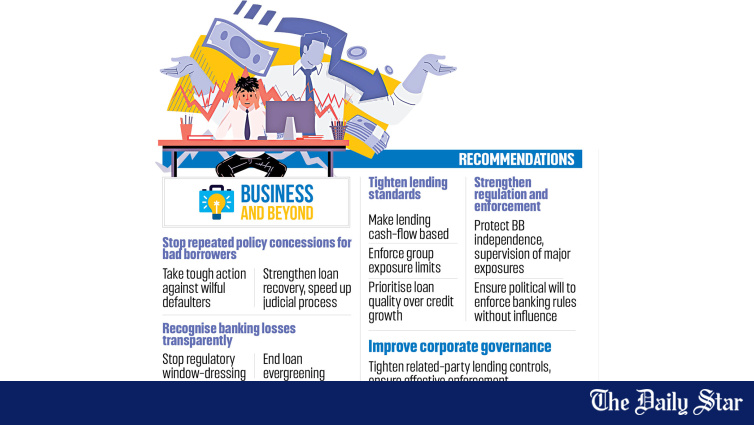
At the discussion, Md Ezazul Islam, director general of the Bangladesh Institute of Bank Management (BIBM), criticised excessive regulatory intervention in interest rates and lending mandates, describing the environment as one of "financial repression". He urged commercial lenders to end the practice of "evergreening" bad debts and base lending decisions strictly on verifiable cash flows rather than corporate reputation or overvalued collateral.
"We need to recognise the losses honestly," said the BIBM director general, warning that the full extent of the damage to the banking sector remains uncertain. The call for honest recognition of losses directly challenges the long-standing practice of rescheduling, restructuring and evergreening that has allowed banks to report lower headline NPL ratios while the underlying asset quality has continued to deteriorate.
💰 Cash Flow Lending Vs Collateral-Based Lending
He stressed that lending must be based on cash flow rather than simply collateral, corporate guarantees, or the reputation and influence of borrowers. "Banks should lend based on a borrower's cash flow, not reputation, influence or collateral alone," said Md Ezazul Islam. The shift from collateral-based lending to cash flow-based lending would represent a structural transformation of Bangladesh's credit culture — one that aligns with international best practice but requires significant upgrades in bank credit assessment capabilities.
He cited the difficulties faced by City Group, saying a viable business could face serious trouble if basic operating conditions deteriorate. "If a factory lacks gas or electricity, providing more loans for machinery does not solve the underlying problem," he said. "Without sufficient cash flow, the borrower may eventually be unable to service the debt." The observation highlights a critical structural issue: many of Bangladesh's NPLs reflect macroeconomic constraints — gas shortages, energy crises, weak demand — rather than borrower misconduct alone.
🤝 Reform Agenda: Group Exposure Limits And Board Accountability
Ezazul also called for tighter enforcement of group exposure limits, saying even a strong corporate group can fail. He said banks must also strengthen controls over related-party lending, while bank boards should be held accountable for major lending decisions. "Boards cannot simply serve the interests of a particular shareholder or business group," he argued.
He called for disclosure of conflicts of interest, proper recording of board decisions and post-mortem reviews of major lending decisions — governance reforms that would bring Bangladeshi bank boards closer to international best practice on fiduciary duty and director accountability. The reform agenda, if implemented, would represent the most significant governance upgrade to Bangladesh's banking sector since the Bank Company Act was last amended.
🌏 What Comes Next For The Banking Sector
For Bangladesh's broader economy, the discussion at The Daily Star Centre crystallised the structural choices facing the banking sector. With LDC graduation approaching in November 2026 and export preferences narrowing, the country's ability to finance trade, infrastructure and industrial capacity expansion depends on a banking system that can deploy credit efficiently. A sector burdened by Tk 6 lakh crore in NPLs — much of it effectively unrecoverable — cannot play that role.
The path forward requires three structural shifts: honest recognition of losses to clear the system of zombie loans; replacement of collateral-based lending with cash flow-based credit assessment; and governance reforms that hold bank boards accountable for lending decisions. Each of these shifts is technically straightforward but politically difficult — they require confronting the politically connected defaulters and bank sponsors who have benefited from the existing system for decades.
The interim government's willingness to push through these reforms, with Bangladesh Bank's enforcement backing, will determine whether Bangladesh's banking sector can be restructured ahead of LDC graduation — or whether the crisis deepens further as more hidden losses come to light. The candid discussion at The Daily Star Centre suggests that industry insiders now recognise the depth of the problem; the question is whether political will exists to act on that recognition.
This news was originally published by The Daily Star. For the full original report, please visit: https://www.thedailystar.net/business/economy/news/political-influence-broke-the-banks-4269911
Related on BangladeshExport
📬 Get Bangladesh Trade News in your inbox
Weekly digest of export industry news, policy updates, and market analysis.
📰 Related Stories