PM Tarique Rahman And Pakistani PM Shehbaz Sharif Pledge Closer Bangladesh-Pakistan Ties At UNGA
Bilateral meeting at UN Headquarters on sidelines of 81st UNGA session discusses mutual interest, regional developments and cooperation areas. Finance Minister Amir Khosru, Foreign Minister Dr Khalilur Rahman, and PR Irene Khan present.
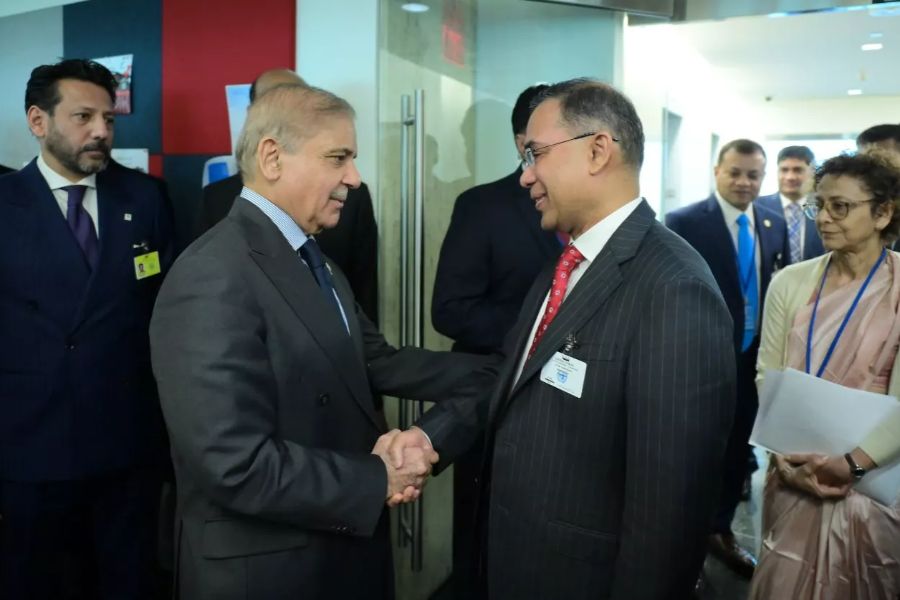
New York, September 24, 2026 — Prime Minister Tarique Rahman and his Pakistani counterpart Shehbaz Sharif on Thursday held constructive discussions on issues of mutual interest, regional and international developments, and potential areas of cooperation for the welfare of the two countries' peoples. The bilateral meeting marked a notable warming of Bangladesh-Pakistan relations after years of strained ties.
🤝 The bilateral meeting was held at the UN Headquarters on the sidelines of the 81st session of the UN General Assembly, said a release issued by the PM's Press Wing.
💬 “The two leaders discussed various aspects of Bangladesh-Pakistan bilateral relations and held constructive exchanges on issues of mutual interest, regional and international developments, and potential areas of cooperation for the welfare of the peoples of the two countries,” the release said.
🌏 Key Outcomes Of The Meeting
The two prime ministers emphasised advancing relations between the two countries based on mutual respect, understanding and cooperation, UNB reported. They also stressed the importance of:
- 📞 Maintaining regular communication between the two governments.
- 📞 Continued dialogue on issues of common interest — both bilateral and regional.
- 📞 Exploring potential areas of cooperation — particularly in trade, investment, and people-to-people contacts.
👥 Bangladesh Delegation
The Bangladesh delegation at the bilateral meeting included:
- 💼 Amir Khosru Mahmud Chowdhury — Finance Minister
- 💼 Dr Khalilur Rahman — Foreign Minister
- 💼 Humaiun Kobir — State Minister
- 💼 Irene Khan — Bangladesh's Permanent Representative to the United Nations
👥 Pakistani Delegation
The Pakistani prime minister was accompanied by:
- 💼 Ishaq Dar — Pakistan's Foreign Minister and Deputy Prime Minister
- 💼 Other senior Pakistani officials
📜 Historical Context: Bangladesh-Pakistan Relations
Bangladesh-Pakistan relations have historically been complicated by the legacy of the 1971 Liberation War, in which Bangladesh (then East Pakistan) fought for and gained independence from Pakistan. The relationship has gone through periods of warmth and coolness over the past five decades:
- 📅 1970s-1980s: Strained relations, with limited diplomatic and trade engagement.
- 📅 1990s-2000s: Gradual normalisation, with periodic high-level visits.
- 📅 2010s: Continued engagement under the Awami League government, though periodic tensions over 1971 war crimes trials.
- 📅 2024-2026: Notable warming of relations following the change of government in Bangladesh in 2024 and the BNP government's accession in February 2026.
📊 Bangladesh-Pakistan Trade Snapshot
Bangladesh-Pakistan bilateral trade has been modest in scale, with significant potential for growth:
- 💰 Bangladesh's exports to Pakistan (FY26): approximately US$80-100 million — primarily RMG, jute products, and tea.
- 💰 Bangladesh's imports from Pakistan (FY26): approximately US$500-600 million — primarily cotton, textiles, medical equipment, and sports goods.
- 💰 Trade gap: significantly in Pakistan's favour, reflecting Pakistan's status as a major cotton exporter.
Key Bangladeshi imports from Pakistan include:
- 🌿 Cotton and cotton yarn — used as input for Bangladesh's RMG sector.
- 🌿 Textile machinery and parts.
- 🌿 Medical equipment — particularly surgical instruments from Sialkot.
- 🌿 Sports goods — particularly cricket equipment from Sialkot.
- 🌿 Leather products — including finished leather and leather goods.
💼 Potential Areas Of Cooperation
The bilateral meeting identified several potential areas of cooperation:
- 🤝 Trade and investment — particularly in textiles, leather, pharmaceuticals, and agricultural products.
- 🤝 Connectivity — including direct shipping links and air services.
- 🤝 Cultural and educational exchanges — including student scholarships and cultural delegations.
- 🤝 Sports cooperation — particularly cricket, given both countries' deep cricketing traditions.
- 🤝 Counter-terrorism cooperation — in regional security dialogue.
- 🤝 Climate change — both countries are climate-vulnerable and share interests in international climate finance.
- 🤝 SAARC revival — both countries have historically supported a stronger South Asian Association for Regional Cooperation.
🏛 The Cotton Trade Angle
One of the most immediate opportunities for Bangladesh-Pakistan trade expansion is in the cotton and textile inputs sector. Bangladesh's RMG industry is the world's second-largest apparel exporter — but the country imports almost all of its cotton requirements.
Pakistan is one of the world's largest cotton producers, with annual production of approximately 10-12 million bales. Currently, Bangladesh sources most of its cotton from:
- 🇮🇳 India — the largest single supplier.
- 🇺🇸 United States
- 🇧🇷 Brazil
- 🇦🇺 Australia
- 🇵🇰 Pakistan — currently a smaller but growing supplier.
Expanding cotton imports from Pakistan could:
- 🌿 Diversify Bangladesh's cotton sourcing — reducing reliance on any single supplier.
- 🌿 Reduce logistics costs — given Pakistan's proximity relative to US, Brazil, and Australia.
- 🌿 Support bilateral trade balance — creating Pakistani demand for Bangladeshi RMG exports in return.
🌏 Regional Diplomatic Implications
The Bangladesh-Pakistan bilateral meeting also has wider regional diplomatic implications:
- 🌏 SAARC revival — both countries have historically supported SAARC, which has been hampered by India-Pakistan tensions.
- 🌏 South Asian connectivity — Pakistan's Gwadar Port and Bangladesh's Chattogram Port could potentially be linked through sea routes.
- 🌏 Islamic world diplomacy — both countries are members of the Organisation of Islamic Cooperation (OIC).
- 🌏 Balance with India — closer Bangladesh-Pakistan ties could complicate Bangladesh-India relations, which have been strained in recent years.
💼 The India Factor
Any warming of Bangladesh-Pakistan relations is closely watched by India — particularly given the historical geopolitics of South Asia. The bilateral meeting comes at a moment when Bangladesh-India relations have themselves been evolving:
- 🇮🇳 India recently proposed a B2B task force to deepen trade ties with Bangladesh.
- 🇮🇳 Border haats reopening and yarn imports were discussed with the Indian envoy.
- 🇮🇳 But strained political relations have limited deeper engagement.
Bangladesh's pursuit of closer ties with both India and Pakistan simultaneously reflects a foreign policy of strategic autonomy — engaging with all major regional powers without becoming over-dependent on any single one.
🏛 Domestic Politics In Bangladesh
The warming of Bangladesh-Pakistan relations has been a notable feature of the post-Awami League political environment. The BNP government, which took office in February 2026, has adopted a more balanced foreign policy approach — moving away from the Awami League's historically India-centric orientation.
Domestically, the renewed engagement with Pakistan has been received with mixed reactions:
- ✅ Supporters argue that engaging with Pakistan serves Bangladesh's economic and diplomatic interests.
- ⚠ Critics recall the trauma of the 1971 Liberation War and question the wisdom of warming relations with Pakistan.
- 📋 Pragmatists argue that Bangladesh should engage with all countries based on mutual interest, without being constrained by historical grievances.
📜 Next Steps
Following the bilateral meeting, the next steps in Bangladesh-Pakistan relations are likely to include:
- 📝 Foreign secretary-level consultations — to follow up on the leaders' discussions.
- 📝 Trade delegations — particularly from the textile and cotton sectors.
- 📝 Cultural exchanges — including sports and educational initiatives.
- 📝 Visa facilitation — to ease travel for business, tourism, and family visits.
- 📝 Direct shipping links — reducing logistics costs for bilateral trade.
Both countries have also agreed to maintain regular communication and dialogue on issues of common interest — suggesting that the renewed engagement is intended to be sustained rather than a one-off diplomatic exchange.
💼 Wider Strategic Implications
For Bangladesh's broader foreign policy, the meeting with Prime Minister Shehbaz Sharif reinforces the country's commitment to a multi-aligned foreign policy — engaging with all major powers and regional players without becoming overly aligned with any single partner. This approach allows Bangladesh to:
- 🌏 Maximise its bargaining power in international negotiations.
- 🌏 Diversify its trade and investment partnerships.
- 🌏 Maintain strategic flexibility in a rapidly evolving global order.
- 🌏 Protect its national interests without becoming entangled in great power competition.
The Bangladesh-Pakistan bilateral meeting at UNGA is therefore not just a diplomatic exchange — it is a statement of Bangladesh's strategic intent to pursue an independent, interest-driven foreign policy in the years ahead.
This news was originally published by The Financial Express. For the full original report, please visit: https://thefinancialexpress.com.bd/national/tarique-shehbaz-discuss-ways-to-deepen-ties
📬 Get Bangladesh Trade News in your inbox
Weekly digest of export industry news, policy updates, and market analysis.
📰 Related Stories

✍️ More from System Administrator