Padma Barrage Construction to Begin Early 2027, Cost Seen at Tk 55,000 Crore
Water Resources Minister Anee inspects the Satbaria site as first-phase works worth around Tk 35,000 crore head to inauguration
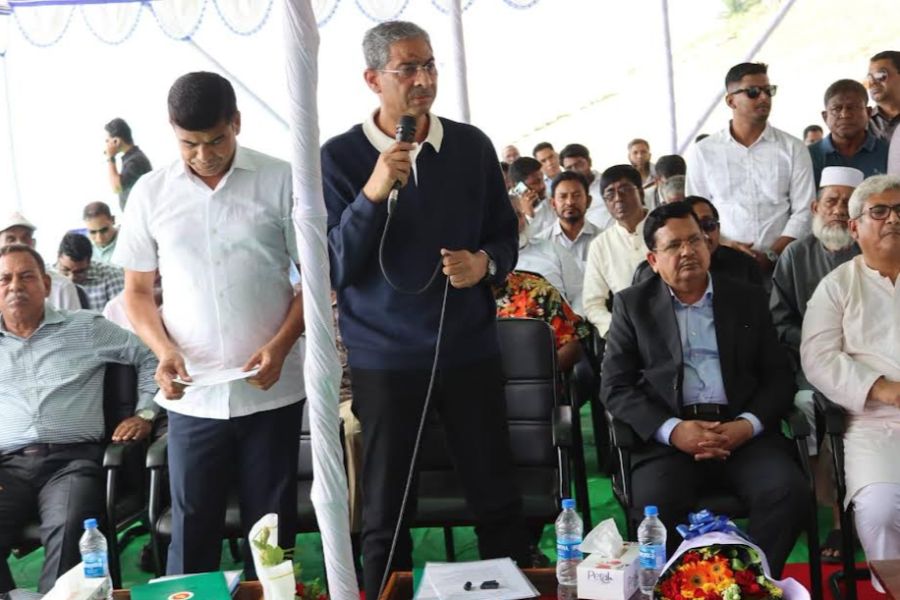
🌊 Water Resources Minister Shahiduddin Chowdhury Anee said on Sunday that construction of the Padma Barrage project is expected to be inaugurated in January or February next year — putting a firm early-2027 timeline on one of the country's most consequential and long-discussed water infrastructure ambitions. Around seven crore people in Bangladesh's southwestern region would benefit from the project, the minister said, which is expected to bring significant socio-economic development to disadvantaged and affected communities across the region.
📍 The minister made the remarks during a discussion after inspecting the proposed project site on the bank of the Padma River at Satbaria Kanchan Park in Sujanagar upazila of Pabna, reports BSS, citing a press release. Anee noted that the government took the initiative within two and a half months of assuming office, describing it as a landmark project and a major challenge for the country — a framing that acknowledges both the transformative promise and the engineering, financing and resettlement demands the barrage entails.
💰 The cost outline is now public: the estimated cost of the first phase is around Tk 35,000 crore, with work on the second phase needing to begin while the first phase is still under way, the minister said. According to current estimates, a total of Tk 50,000 crore to Tk 55,000 crore would be required to complete the project — placing the barrage among the largest single infrastructure undertakings in Bangladesh's history, comparable in scale to the Padma Bridge itself.
🌳 Why the southwest needs this barrage
💧 The project's logic is rooted in the delta's changing hydrology. Upstream withdrawals and the natural dynamics of the Gorai-Padma system have reduced dry-season flows into the southwest, allowing salinity to push deeper inland through rivers and groundwater — degrading farmland, threatening drinking water supplies and corroding the region's industrial equipment. The proposed barrage would hold back monsoon-season freshwater and regulate its release through the lean months, restoring dry-season flows for irrigation, recharging rivers that have turned brackish, and supporting navigation on routes that silt up each winter.
🌾 The agricultural arithmetic is the headline: the southwest contains some of the country's most productive rice, jute, vegetable and aquaculture land, and crop intensity in many districts is limited less by soil than by the availability of reliable dry-season water. A regulated freshwater supply unlocks additional cropping seasons, expands shrimp- rice rotation options in controlled conditions, and stabilises the drinking-water situation for districts where salinity has forced households onto expensive alternatives. The seven-crore beneficiary figure the minister cited spans farmers, fishers, transport operators and every household whose water bill, food price or livelihood is touched by river hydrology.
⚠ The challenges the minister acknowledged
🧭 Calling the project a major challenge is candour worth taking seriously. Barrages of this scale involve detailed hydraulic modelling to ensure regulation upstream does not starve downstream ecosystems, sediment management designs that determine the structure's lifespan, land acquisition and resettlement for communities along the alignment, and — most critically — a financing plan for Tk 50,000 crore-plus that must balance the national budget, development-partner support and private participation where feasible. The sequencing decision the minister highlighted — starting phase two while phase one proceeds — is itself an acknowledgement that the works cannot be allowed to stretch across decades, as stalled river projects have historically lost momentum, costs and confidence.
📋 The January-February inauguration date now anchors expectations. If site preparation, contractor mobilisation and the first cofferdam works follow on schedule, the project moves from planning archives to physical reality — and the southwest's seven crore residents will begin to judge it by the milestones every large project must ultimately meet: earth moved, concrete poured, water regulated, and benefits delivered on the timeline promised at the ribbon.
🚧 The engineering precedent the project leans on is regional. India's Farakka barrage — upstream on the Ganges — demonstrated decades ago how a single river structure can redraw the hydrology, agriculture and politics of everything downstream, a lesson Bangladesh lived on the receiving end during the dry-season sharing disputes of the 1970s-90s. The Padma Barrage is in many ways the country's answer to that asymmetry: infrastructure that gives Bangladesh its own capacity to store, time and allocate freshwater rather than accept whatever the river delivers. Its design documents reportedly incorporate lessons from both the Farakka experience and the Ganges-Kobadak irrigation system's long operational history, and the proximity of the site to existing G-K infrastructure in Pabna is no accident — the barrage would connect directly into the country's largest pump-based irrigation command area.
📈 The macroeconomic timing also matters. Bangladesh is currently navigating tight external accounts, LDC-graduation transitions and post-flood reconstruction demands — yet the case for a water-storage barrage rests on returns that compound for generations, from agricultural output and food-price stability to reduced drinking-water costs and preserved industrial equipment in brackish zones. International infrastructure assessments have repeatedly ranked dry-season water security among the highest-return investments available to delta economies. The real test for planners will be sequencing cash flows so that early spending on the first phase generates visible benefits — irrigation command areas activated, navigation stretches restored — that sustain public and political support for the second phase's larger demands.
This news was originally published by The Financial Express. For the full original report, please visit: https://thefinancialexpress.com.bd/national/padma-barrage-construction-to-begin-early-next-year-anee
📬 Get Bangladesh Trade News in your inbox
Weekly digest of export industry news, policy updates, and market analysis.
📰 Related Stories