India Recommends Anti-Subsidy Duties Up To $140 Per Tonne On Bangladesh Jute Goods After Anti-Dumping Duties
DGTR final findings impose countervailing duties ranging from $101.54 to $140.04 per tonne on Bangladeshi jute yarn, twine, sacking and hessian, compounding impact of earlier anti-dumping duties.
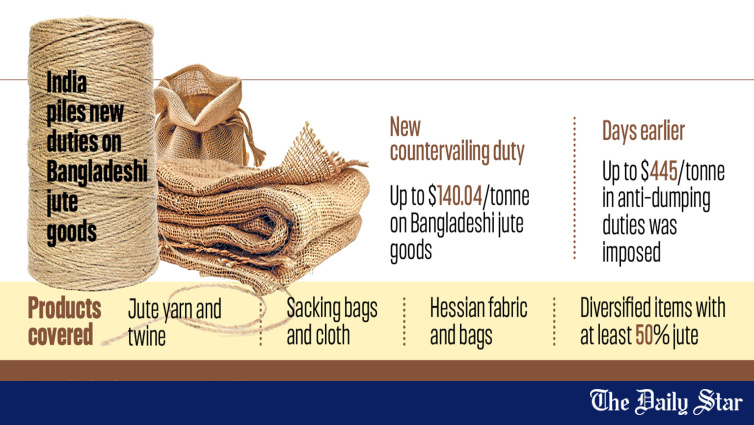
⚠ Days after imposing fresh anti-dumping duties on jute goods, India has recommended anti-subsidy duties of up to $140.04 per tonne on jute products imported from Bangladesh, in a double-barrelled trade restriction that threatens to further depress Bangladesh''s already-slumping jute exports to its largest neighbour. India''s Directorate General of Trade Remedies (DGTR) recommended the duty after investigating imports from Bangladesh and Nepal, with final findings published on 28 September 2026.
📊 The new tariff, known as a countervailing duty, is intended to offset subsidies provided by exporting countries. The DGTR launched the investigation last year following petitions from the Indian Jute Mills Association (IJMA) and the A.P. Mesta Twine Mills Association (AJMA), which represent Indian millers who have been losing market share to cheaper imports from Bangladesh and Nepal. The investigation examined market and import data for the 12 months from April 2024 to March 2025.
🏛 What the duties cover
The investigation covered jute yarn and twine, sacking bags and cloth, hessian fabrics and bags, and diversified jute products containing at least 50 percent jute. In its final findings, the DGTR recommended a tiered duty structure based on the level of cooperation from individual Bangladeshi exporters:
- ✅ Sagar Jute Spinning Mills and Oriental Jute Mills: $101.54 per tonne
- ✅ Six sampled millers (three exporter groups): Rates ranging from $101.54 to $132.36 per tonne
- ✅ 18 non-sampled co-operating millers: Uniform duty of $116.48 per tonne
- ⚠ All other Bangladeshi jute goods exporters: Residual countervailing duty of $140.04 per tonne
- 🌏 Nepalese exporters: Anti-subsidy duties ranging from $54.77 to $60.54 per tonne
A total of 24 Bangladeshi millers co-operated with the investigation and were assigned specific duty rates. The six sampled millers were placed in three exporter groups with specific rates, while the 18 non-sampled co-operating millers face a uniform duty of $116.48 per tonne.
💰 Compound impact with anti-dumping duties
The latest measure comes as Bangladesh''s jute goods shipments to India have already declined significantly. Bangladesh''s jute goods exports to India fell 18 percent year-on-year to 1.17 lakh tonnes in fiscal year 2024-25, according to the DGTR.
On 24 September 2026, India''s finance ministry imposed anti-dumping duties of up to $445 per tonne on jute products from Bangladesh, including jute yarn and twine, following a mid-term review completed in June. Before the latest anti-dumping order, India had imposed duties ranging from $19 to $352 per tonne on jute yarn and twine, hessian fabric and jute sacking bags from Bangladesh and Nepal. Those duties were later expanded to cover jute sacking cloth from Bangladesh, contributing to a slump in shipments to one of the country''s largest export markets for jute goods.
The combination of anti-dumping duties (which target below-cost pricing) and anti-subsidy/countervailing duties (which target state subsidies) means Bangladeshi jute exporters now face double taxation on the same products — a situation that Bangladeshi industry experts argue is unfair under international trade rules.
👥 Bangladesh''s jute export performance
Bangladesh earned $1.16 billion from jute and jute goods exports in FY21, according to the Export Promotion Bureau (EPB). Shipments fell to $820 million in FY25 before exports recovered by 8 percent year-on-year to $884 million in FY26. Despite the recovery in FY26, the latest Indian trade restrictions threaten to reverse those gains, particularly given that India has historically been one of the largest destinations for Bangladeshi jute exports.
Bangladesh''s jute sector employs hundreds of thousands of workers across the country''s jute mills, many of which are state-owned or have been recently restructured. The sector has been a strategic priority for the government, which sees jute — Bangladesh''s traditional "golden fibre" — as a key export diversification play beyond readymade garments. India''s successive trade restrictions threaten to undermine that strategy.
🤝 Industry reaction
Mostafa Abid Khan, chief executive officer of the Bangladesh Foreign Trade Institute (BFTI), a think tank under the commerce ministry, said the latest measures by Indian authorities would further affect jute goods exports to the neighbouring country. However, he argued that subsidies are never given to any specific producer. "As far as I know, they are given by a country to a sector. So, countervailing duties imposed on a specific industry should not be considered valid."
"Besides, it is our understanding that while imposing anti-dumping duty on jute products, subsidies provided to the sector were not adjusted. Therefore, it is obvious that anti-dumping duties contain subsidy effects as well. Therefore, as per Article VI of GATT-1994, countervailing duty cannot be imposed on jute products when such anti-dumping duties are in force. It is a real concern for Bangladesh," Khan added.
Tapash Pramanik, chairman of the Bangladesh Jute Spinners Association (BJSA), questioned how countervailing duties could be imposed when an anti-dumping duty is already in place. He said the incentive structure enjoyed by the jute industry a decade ago, or before that, no longer exists — but Indian authorities are not taking Bangladesh''s concerns into account. "We would urge the government to challenge the move by India in the international arena," he added.
🌏 Legal and trade implications
The legal questions raised by BFTI''s Mostafa Abid Khan point to a potential inconsistency with Article VI of the General Agreement on Tariffs and Trade (GATT) 1994, which governs both anti-dumping and countervailing duties. The article generally prohibits the imposition of both remedies simultaneously on the same product where they would result in double-counting of the same injury or price effect.
If Bangladesh decides to challenge India''s move, the most likely forum would be the World Trade Organization''s dispute settlement mechanism, although that route can take years to deliver results. Alternatively, Bangladesh could seek bilateral consultations with India under the existing trade agreements between the two countries, or escalate the matter through diplomatic channels.
The BJSA''s call for an international challenge signals growing frustration within Bangladesh''s jute industry at what is perceived as India''s protectionist stance towards its domestic jute industry. The Indian Jute Mills Association (IJMA) has been lobbying the Indian government for years to restrict imports from Bangladesh, arguing that Bangladeshi jute mills benefit from government subsidies that give them an unfair competitive advantage in the Indian market.
💰 Strategic significance for Bangladesh''s jute sector
The latest Indian trade restrictions are a significant blow for Bangladesh''s jute sector, which has been working to diversify its export markets and move up the value chain into diversified jute products. While Bangladesh has been making progress in developing new export destinations in the Middle East, Europe and North America, India remains a critically important market for low-value jute products such as yarn, twine and sacking.
For Bangladesh''s broader export strategy, the Indian restrictions underscore the risks of dependence on a single market for any export category. They also highlight the need for Bangladesh to invest in trade defence capabilities — both to defend its exporters against unfair trade remedies abroad, and to use its own trade remedy tools where appropriate to protect domestic industries from unfair import competition.
The Bangladesh government will now need to decide whether to challenge India''s move at the WTO, seek bilateral consultations, or accept the restrictions and focus on diversifying jute exports to other markets. With Bangladesh''s jute exports already under pressure from global competition and changing consumer preferences, the coming months will be critical for the sector''s survival and recovery.
This news was originally published by The Daily Star. For the full original report, please visit: https://www.thedailystar.net/business/economy/news/india-now-moves-levy-anti-subsidy-duty-jute-goods-4286331
Related on BangladeshExport
📬 Get Bangladesh Trade News in your inbox
Weekly digest of export industry news, policy updates, and market analysis.
📰 Related Stories