Factory Production Falls 40% as Gas Crisis Forces Bangladesh Holiday Extensions
Mitali Fashion, Kohinoor Chemical, PRAN-RFL, Little Star Spinning all hit as Excelerate LNG terminal remains offline after July 21 fire
Dhaka, August 4, 2026 — The dyeing section of Mitali Fashion's factory in the Konabari area of Gazipur has been closed for eight days due to a gas shortage, leaving 18 of the factory's 30 sewing production lines idle and offering a stark illustration of the production crisis now spreading across Bangladesh's industrial heartlands.
Mitali Fashion Chairman Abu Yusuf Abdullah told Prothom Alo on Monday that the gas shortage had made it difficult to keep up production, and warned that the company would not be able to ship garments on time against several export orders. The company might have to offer discounts to buyers as a result, eroding already-thin margins in a sector struggling with weak global demand and intensifying tariff pressure.
The Mitali Fashion case is not isolated. Factories across the country have been suffering from a severe gas shortage for two weeks, compounded by electricity load-shedding. Production at many industries has fallen by half, disrupting the supply of several food and non-food products and threatening export shipments at a moment when Bangladesh can least afford missed deliveries.
📊 40 Percent Production Drop in Two Weeks
Prothom Alo spoke to the owners of 15 factories on Monday, and leaders of business organisations also described the impact of the gas shortage. Their combined observations show that factory production has fallen by 40 percent over the past two weeks. Some factories said they were extending the holiday around the government holiday on August 5, effectively using forced downtime to manage the gas shortage rather than admitting a formal shutdown.
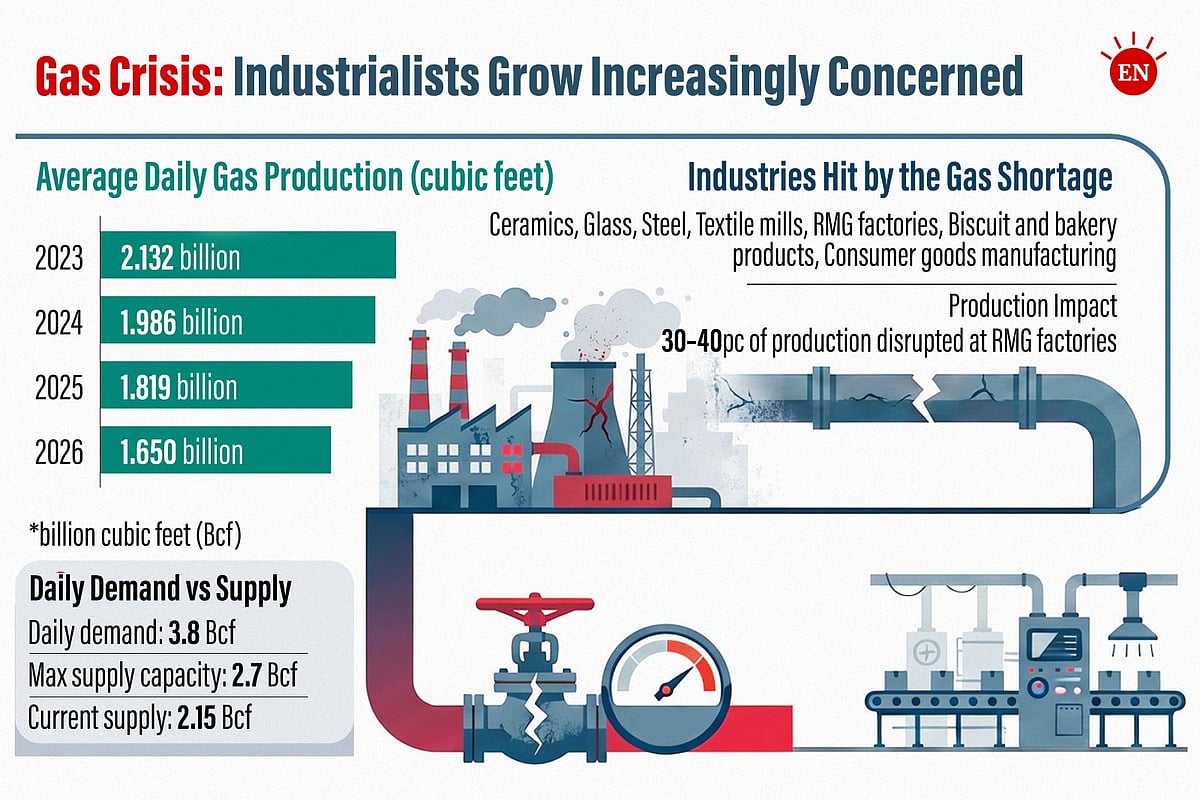
Businesspeople from various sectors said the gas shortage was disrupting production in glass, steel, textiles and garments, ceramics, biscuits and cakes, and consumer goods. Lower production is increasing costs and causing losses across these industries. If the gas shortage is not resolved soon, some companies may have to take measures such as laying off workers — a prospect that would compound the already severe employment crisis in the apparel belt.
🔥 Origin of the Crisis: July 21 LNG Terminal Fire
Bangladesh's industrial sector has been facing gas shortages for a long time, but the crisis intensified after a liquefied natural gas (LNG) terminal was shut down following a fire on July 21. Petrobangla has said gas supply could increase by 300 million cubic feet per day if the terminal is partially brought back into operation soon, but the timeline for that resumption remains uncertain.
Bangladesh produces gas from its own fields and also imports it. There are two floating terminals in Maheshkhali, Cox's Bazar, for converting imported LNG into gas for supply. One of them, operated by US company Excelerate Energy, is closed because of the fire. As a result, overall daily gas supply in the country has fallen to 2.15 billion cubic feet. Once the terminal resumes operation, supply is expected to rise to 2.7 billion cubic feet. Daily demand, however, stands at 3.8 billion cubic feet — meaning even a fully operational system would leave a significant shortfall.
🧹 Consumer Goods: Kohinoor Chemical Hit Hard
The Kohinoor Chemical factory in the Tejgaon industrial area of Dhaka operates two shifts from 6am, producing for a total of 16 hours a day. But production has been suspended during the day because of the gas shortage, with operations resuming only at night when gas pressure improves somewhat. As a result, production of soap, detergent, and cosmetics has fallen by 20 percent.
Kohinoor Chemical Senior Vice-President (Brand) Golam Kibria Sarkar told Prothom Alo that the cost of importing raw materials had increased because of the Middle East crisis, compounding the impact of the gas shortage. The combined pressures have made it impossible to supply enough products to meet market demand, and the company is incurring losses overall, he said.
🍚 PRAN-RFL: Industrial Park Production at 40-45%
PRAN-RFL Group reported that production at its industrial park in Habiganj had fallen to 40-45 percent of capacity. Gas shortages had nearly halted electricity generation through captive generators, leaving the factories to operate somehow on electricity supplied by the rural power network — a stopgap measure that cannot sustain full industrial output.
Production at the group's industrial facilities in Narsingdi and other areas has also been disrupted. Because of the gas shortage, the company has been forced to reduce production and supply of plastic furniture, biscuits and cakes, bakery products, and other goods. PRAN-RFL Group Director (Marketing) Kamruzzaman Kamal told Prothom Alo that overall, only about 60 percent of production capacity could currently be utilised because of the gas shortage.
"Many products, including export items, could not be supplied according to demand," Kamal said, while expressing hope that the crisis would be resolved soon — a hope that hinges on the Excelerate terminal resuming operations, which remains uncertain.
🧵 Textile Sector: Little Star Spinning Mills
The textile sector, which supplies yarn and fabric to the apparel industry, has been particularly hard hit. Little Star Spinning Mills in Savar has the capacity to produce 24,000 pounds of yarn a day, but production stood at only 10,000 pounds on Monday because of the gas shortage. For several days before that, production had remained at 40-50 percent of capacity.
Little Star Group Chairman Khorshed Alam said that operating a factory at half capacity can result in significant financial losses, because fixed costs — including worker salaries, machinery depreciation, and overhead — continue regardless of output. The mathematics of partial operation are particularly punishing for spinning mills, which depend on continuous production runs to maintain yarn quality and consistency.
🛢️ The Gas Supply Arithmetic
The gap between supply and demand explains why the crisis is so severe and why partial solutions are insufficient. Even with the Excelerate terminal fully operational, Bangladesh's gas supply would reach only 2.7 billion cubic feet per day against demand of 3.8 billion cubic feet — a shortfall of 1.1 billion cubic feet, or roughly 29 percent of demand. Without the terminal, the shortfall balloons to 1.65 billion cubic feet, or 43 percent of demand.
For export-oriented industries that depend on continuous gas supply for dyeing, boiler operation, and captive power generation, even a 20 percent shortfall translates into significant production losses. The 40 percent production drop reported across the 15 factories surveyed by Prothom Alo suggests that many factories are experiencing effective shortfalls well above the national average, likely because they are lower in the gas rationing priority list.
📋 Strategic Context
The gas crisis has emerged as the single most pressing constraint on Bangladesh's industrial recovery, compounding the challenges of weak global demand, US tariff pressure, and the looming loss of duty-free market access after LDC graduation. With the Excelerate terminal's resumption timeline uncertain and no immediate prospect of bridging the 1.1-1.65 billion cubic feet daily shortfall, factory owners are being forced into difficult choices about which production lines to keep running, which to suspend, and which orders to delay or cancel.
The decision by some factories to extend the August 5 holiday reflects a pragmatic adaptation — using the government holiday as cover for gas-driven downtime that might otherwise attract unwanted attention from buyers and the media. But the underlying reality is that Bangladesh's industrial machine is operating well below capacity, and the path back to full production depends on energy solutions that remain stubbornly out of reach.
This news was originally published by Prothom Alo English. For the full original report, please visit: https://en.prothomalo.com/business/local/xgg04kc868
Related on BangladeshExport
📬 Get Bangladesh Trade News in your inbox
Weekly digest of export industry news, policy updates, and market analysis.
📰 Related Stories