Economy Cannot Function by Shutting Down Companies: Finance Minister Amir Khosru
Finance Minister Amir Khosru Mahmud Chowdhury tells Parliament that S. Alam Group companies must continue operating while owners face corruption trial, defending BB's decision to allow fresh LC for SS Power.
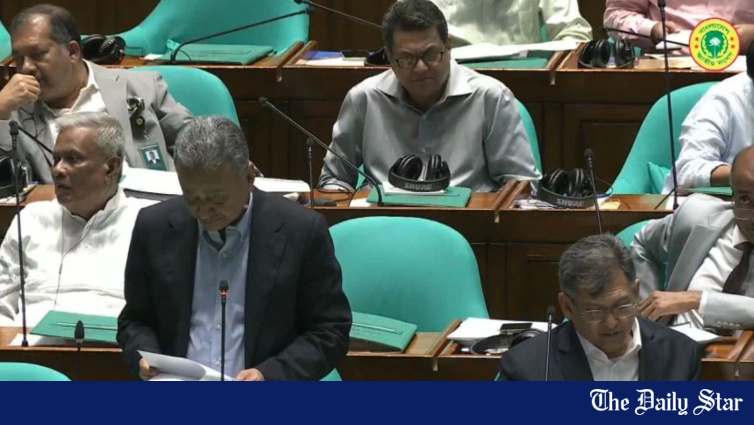
🏛 Dhaka, Bangladesh — Finance Minister Amir Khosru Mahmud Chowdhury has stated that if a company is closed down, its impact on the nation’s economy must be calculated. “The economy does not run on emotion; it must operate on the foundation of law,” he declared in Parliament on Sunday, 6 September 2026.
💬 The finance minister made these remarks during the Question Hour at the start of the parliamentary sitting chaired by Deputy Speaker Barrister Kayser Kamal, responding to a supplementary question from Abdul Hannan Masud, NCP (National Citizen Party) Member of Parliament for Noakhali-6, regarding the decision to issue new loans to various entities owned by the S. Alam Group instead of putting them up for auction.
💰 S. Alam Group: Tk 225,000 Crore in Loans
📊 In his supplementary question, Hannan Masud stated that Bangladesh now ranks as a global leader in default loans. He noted that Bangladesh Bank granted permission to SS Power — an entity owned by S. Alam Group, one of the top loan-defaulting conglomerates — to open an LC worth $3,197,561. Currently, total loans held under various entities owned by the S. Alam Group exceed Tk 225,000 crore.
💬 He asked the minister whether the government, by extending special loans rather than auctioning off or nationalising these defaulting entities, is effectively encouraging loan defaulters and whether this would disincentivise foreign lenders in various sectors.
⚖ Companies Are Legal Entities Separate from Owners
💬 In response, the finance minister stated that there are established principles for managing the economy and financial sector, noting that the identity of an individual is separate from the identity of an institution.
💬 “If an individual is involved in corruption, you can file a case against them, send them to prison, or even execute them. But the company is a legal body — the company must be treated separately... its operations must be allowed to continue, regardless of which company it is,” said Amir Khosru.
📊 He further explained: “If any company in the country is shut down due to an individual, remember that people work at that company, it has liabilities, and its loans must be repaid. That company contributes to the economy. No country’s economy can function by harming employment and shutting down companies.”
🤝 Trials Continue for Personal Corruption
⚖ The finance minister added that those involved in corruption within the company are not being spared, with legal proceedings underway against every one of them. They will be tried for their personal corruption.
💬 “If the owners are corrupt, they face trial. Those trials are ongoing and will continue. Justice will be delivered for their personal corruption,” he said.
🏛 Asserting that Bangladesh Bank is not extending loans in violation of the law, Amir Khosru stated that rescheduling is permitted where provisions exist. Companies that qualify under the law will avail themselves of that opportunity, while those that do not qualify will not. However, those who are personally corrupt will face justice — their trials are underway and will continue.
📊 Six State Banks Tk 147,776 Crore Default Loans
💰 The finance minister also informed Parliament that default loans across six state-owned banks stood at Tk 147,776.36 crore as of 30 June 2026. These institutions are Agrani, Janata, Rupali, Sonali, BASIC, and Bangladesh Development Bank. The finance minister provided this data in response to a question from Jamaat-e-Islami member of parliament Md. Abdul Alim.
📊 According to the figures presented:
- 🏦 Janata Bank: Tk 75,396.67 crore (highest)
- 🏦 Agrani Bank: Tk 29,029.67 crore
- 🏦 Rupali Bank: Tk 19,281.74 crore
- 🏦 Sonali Bank: Tk 15,048.39 crore
- 🏦 BASIC Bank: Tk 8,131.09 crore
- 🏦 Bangladesh Development Bank: Tk 888.79 crore
💰 Per Capita Debt Tk 129,239
📊 In response to a query from Reza Ahammad (Kushtia-1), the finance minister revealed that the per capita debt burden of the country’s citizens currently stands at Tk 129,239 as of 31 March 2026. He explained that to ease the per capita debt burden on the public, the government is focusing on enhancing revenue collection, ensuring sound and efficient public financial management, and streamlining debt management.
📈 According to him, initiatives are being undertaken to reduce borrowing needs by boosting state revenues. Simultaneously, emphasis is being placed on making government expenditure more cost-effective and productive, while curbing non-essential spending to lower financing demand.
🌏 Strategic Context: S. Alam Group Saga
🤝 The S. Alam Group case has become a defining test of Bangladesh’s approach to resolving legacy banking sector problems. The conglomerate — one of the country’s largest private industrial groups with interests in power, cement, steel, banking and consumer goods — has been at the centre of the country’s loan default crisis following allegations of massive financial irregularities, connected lending and capital flight.
⚖ The political transition in early 2026 saw criminal cases filed against S. Alam Group’s top leadership, with the group’s chairman and directors facing prosecution for alleged fraud, money laundering and loan default. However, the question of what to do with the operating companies — which employ tens of thousands of workers and owe hundreds of thousands of crores to banks — has posed a complex policy dilemma.
✅ The finance minister’s statement signals the government’s chosen path: separate the legal personality of the company from the personal liability of its owners. By allowing companies to continue operating while pursuing individuals for corruption, the government aims to preserve employment, recover bank loans through operational cash flow, and maintain industrial output — all while delivering justice against those responsible for the underlying financial crimes.
📊 For Bangladesh’s banking sector, this approach has both supporters and critics. Supporters argue it preserves systemic stability and protects workers. Critics warn it could create moral hazard by signalling that defaulting conglomerates can continue accessing bank financing while their owners face individual prosecution. The coming months will reveal whether the strategy delivers the dual goals of justice and economic stability — or whether it allows legacy problems to persist under a new legal framework.
This news was originally published by Prothom Alo English / The Daily Star / The Business Standard. For the full original report, please visit: https://en.prothomalo.com/bangladesh/parliament/zqaltv0w45
Related on BangladeshExport
📬 Get Bangladesh Trade News in your inbox
Weekly digest of export industry news, policy updates, and market analysis.
📰 Related Stories