Dhaka Stocks End Flat as Earnings Season Jitters Offset Late Bargain Hunting
DSEX slips 1.43 points to 5,450.60 after a four-week losing streak of 127 points, as turnover hits a near 10-month low
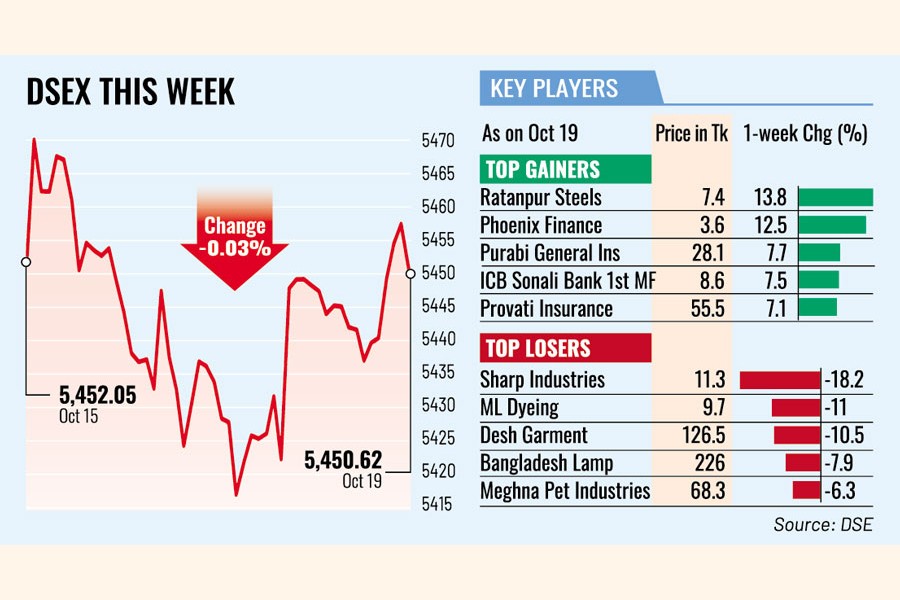
📉 Stocks ended the holiday-shortened week almost flat as investor caution over corporate earnings and dividend declarations, persistent economic challenges and escalating geopolitical tensions in the Middle East dampened market sentiment. The market remained under pressure throughout the week, with intermittent bargain hunting failing to generate a sustained recovery, market analysts said.
💼 More than 20 listed companies announced their quarterly and annual financial results during the week, with many reporting weaker-than-expected earnings amid high energy costs and persistent inflation — the core reason investors stayed defensive ahead of the disclosure season's peak. The week opened with renewed selling pressure after a brief recovery in the preceding sessions, and technical glitches affecting trading terminals at several brokerage firms further disrupted market activity in the opening session.
🗓 The market saw just three trading sessions, including Saturday, as trading remained suspended for the Durga Puja holidays. The first two sessions ended lower, while bargain hunting in the final session helped the market recoup most of its earlier losses — a late-week pattern that analysts read as valuation-driven opportunism rather than a turn in sentiment.
📈 Index snapshot: near-flat close after four red weeks
📊 The DSEX, the benchmark index of the Dhaka Stock Exchange (DSE), shed just 1.43 points over the week to close at 5,450.60. The index has now lost 127 points over four consecutive weeks, reflecting persistent weakness in the market. Two other DSE indices saw mixed performance: the DS30 index of blue-chip shares gained seven points to close at 2,103, while the Shariah-based DSES index lost more than seven points to settle at 1,078.
📀 EBL Securities, in its weekly market analysis, said the shortened trading week ended almost flat as investor caution surrounding the ongoing earnings and dividend declaration season continued to weigh on market momentum. According to Sheltech Brokerage, the market experienced strong selling pressure alongside its lowest single-day turnover of the year, amid concerns over earnings and dividend announcements, the domestic macroeconomic outlook and escalating geopolitical tensions in the Middle East — though bargain hunting emerged in the final session, particularly in blue-chip banking stocks, helping the market recover most of its earlier losses.
🏦 Movers and sectors
⬇ Selective large-cap stocks, including Beacon Pharma, Islami Bank, National Bank, Sharp Industries and Apex Footwear, together contributed around 11 points to the DSEX's decline. Gains in BRAC Bank, Prime Bank, Eastern Bank, Asiatic Laboratories and Matin Spinning Mills, however, offset most of those losses, leaving the benchmark index virtually unchanged.
💸 Trading activity weakened as investors remained largely on the sidelines. Average daily turnover fell by more than 16 percent to Tk 3.95 billion from Tk 4.71 billion in the previous week, indicating a decline in activity even after adjusting for the fewer sessions — with technical disruptions across brokerage trading terminals aggravating the subdued participation and pushing opening-day turnover to a nearly 10-month low.
🗂 The textile sector dominated turnover, accounting for 23.5 percent of total trading activity, followed by general insurance at 12.6 percent and banking stocks at 11.3 percent. Market breadth remained negative, with 213 issues declining against 126 advancing and 42 unchanged — figures indicating that selling pressure continued to outweigh buying interest despite the near-flat weekly close. Sectoral performance was mixed: food, pharmaceuticals and engineering stocks faced corrections, while banking, power and telecommunications stocks closed in positive territory.
💹 At the individual-stock level, Saiham Textile emerged as the week's most-traded issue, with shares worth Tk 80 million changing hands, followed by Paramount Textile, Sonali Aansh Industries, Prime Bank and BRAC Bank in the turnover rankings. The Chittagong Stock Exchange (CSE), meanwhile, closed in positive territory: its All Share Price Index (CASPI) gained 28 points to close at 14,601, while the Selective Categories Index (CSCX) rose 27 points to settle at 8,975.
🔭 What comes next for the market
💥 Looking ahead, investors will assess whether the renewed buying interest can be sustained and whether the benchmark index can defend its support zone. The securities regulator's proposed market-development initiatives, developments in geopolitical conflicts, and upcoming earnings and dividend announcements are expected to remain the key near-term drivers of market direction, Sheltech Brokerage said.
🤔 The backdrop matters for a market that has become a barometer of economic confidence. A four-week, 127-point slide, turnover at 10-month lows and breadth that stays negative even on flat closes all point to a wait-and-see posture: investors are not exiting en masse, but they are refusing to commit fresh capital until earnings visibility improves. For listed manufacturers and banks — the very companies that anchor Bangladesh's export economy — the earnings season thus carries a double burden, reporting today's margin pressure while signalling whether the macro tightening cycle has genuinely peaked.
🚀 The optimists' case rests on two legs: blue-chip banking shares found buyers at current levels, suggesting floor-building in the strongest balance sheets, and the regulator's market-development agenda — long discussed — could yet deliver institutional pipeline measures. The pessimists' case is simply the trend: four straight weeks lower, geopolitical risk flowing through fuel prices, and an inflation path that keeps discount rates high. Which narrative wins will be visible within a couple of sessions — either the support zone holds and turnover recovers, or the index resumes its slide and the earnings season becomes a source of fresh pressure rather than clarity.
This news was originally published by The Financial Express. For the full original report, please visit: https://thefinancialexpress.com.bd/bangladesh/stocks-end-flat-as-earnings-concerns-weigh-on-market-sentiment
📬 Get Bangladesh Trade News in your inbox
Weekly digest of export industry news, policy updates, and market analysis.
📰 Related Stories