BARVIDA Urges Bangladesh To Lift Ban On Reconditioned Electric Vehicles
Reconditioned vehicle importers propose regulated framework allowing 5-year-old used EVs with 70% battery State of Health certification, charging infrastructure incentives
🚘 The Bangladesh Reconditioned Vehicles Importers and Dealers Association (BARVIDA), through a press release today, said reconditioned EVs could be imported under a regulated framework while maintaining international safety, environmental and technical standards. The association has formally urged the government to withdraw the import ban, warning that the restriction could deprive consumers of affordable electric mobility options and slow Bangladesh's transition to cleaner transport.
📊 The association said the government's new import policy, published on August 24, completely prohibits the import of used and reconditioned electric vehicles, despite such vehicles being widely used and traded in many countries. The ban marks a sharp reversal from Bangladesh's earlier policy direction, which had been gradually opening the auto market to reconditioned vehicles as part of broader efforts to modernise the country's transport fleet.
🌏 Global Precedent For Used EV Imports
According to BARVIDA, reconditioned electric vehicles are being exported regularly from countries including Japan, South Korea, Germany and other European nations. Several countries allow the import of used EVs subject to age limits, safety requirements and other regulatory conditions. The reference to international precedent is strategically significant — it positions Bangladesh's ban as out of step with global practice, particularly at a time when countries including New Zealand, Sri Lanka and several African nations are actively importing used EVs to accelerate transport decarbonisation.
Japan, in particular, has emerged as a major exporter of used EVs following the rapid domestic adoption of electric and hybrid vehicles. Japanese reconditioned EVs typically come with detailed battery health certifications, service histories and warranty coverage — providing a level of consumer protection that, with appropriate regulatory safeguards, could be replicated in the Bangladeshi market.
💰 Affordability Case For Reconditioned EVs
BARVIDA argued that new EVs remain beyond the purchasing capacity of many middle- and lower-middle-income consumers, while reconditioned EVs could offer a more affordable alternative. It said expanding access to EVs could also help Bangladesh move towards its target of increasing the use of electric vehicles in the transport sector by 2030.
The affordability argument carries weight in Bangladesh's price-sensitive auto market. A new electric vehicle typically costs between Tk 35 lakh and Tk 1.5 crore depending on model and specifications, while a comparable reconditioned EV could be available at 40-60% of the new price. For middle-class households and ride-sharing drivers considering the switch from internal combustion engine (ICE) vehicles, the price differential is decisive in determining whether EV adoption is financially viable.
- 📅 Import policy publication date: August 24, 2026
- 🚘 Proposed age limit: Up to 5 years
- 🔋 Minimum battery State of Health (SOH): 70%
- 🌏 Source countries: Japan, South Korea, Germany, EU nations
- 💰 New EV price range: Tk 35 lakh - Tk 1.5 crore
- 💵 Reconditioned EV: 40-60% of new EV price
- 🌏 Bangladesh EV adoption target: 2030
📜 BARVIDA's Proposed Regulatory Framework
The association proposed allowing the import of used or reconditioned EVs for up to five years. It also recommended setting a minimum battery State of Health (SOH) of 70 percent and making battery-life certification by the relevant authorities mandatory to protect consumers. The 70% SOH threshold aligns with international standards used in jurisdictions that permit used EV imports — it ensures that imported vehicles retain sufficient battery capacity to deliver meaningful driving range while preventing the dumping of degraded battery packs in the Bangladeshi market.
It further called for mandatory inspection and certification by authorised agencies before imported EVs are cleared. This pre-clearance inspection regime would address concerns about vehicle safety, structural integrity and battery compliance — creating a regulatory barrier against the import of substandard or unsafe vehicles.
BARVIDA proposed banning the import of EVs that have been damaged in floods, fires or serious accidents, as well as vehicles with significant structural damage. It also called for a battery recycling and safe-disposal framework and incentives for investment in charging stations, servicing, battery diagnostics and recycling facilities.
🔋 Battery Recycling And Charging Infrastructure
The call for a battery recycling and safe-disposal framework reflects growing recognition that EV adoption creates a parallel need for end-of-life battery management. Lithium-ion batteries in EVs typically have a useful automotive life of 8-10 years, after which they either require refurbishment, second-life applications in stationary storage, or recycling to recover critical minerals including lithium, cobalt, nickel and manganese.
For Bangladesh, building domestic battery recycling capacity is strategically significant for two reasons. First, it would prevent the accumulation of hazardous battery waste that would otherwise end up in landfills or informal recycling channels. Second, it would position Bangladesh to capture value from the global battery materials supply chain — particularly as demand for critical minerals surges amid the global energy transition.
The call for charging infrastructure incentives aligns with broader industry concerns about the slow pace of EV charging station deployment in Bangladesh. While the country has made progress in establishing charging points in Dhaka and Chattogram, coverage in tier-2 cities and along major highways remains inadequate — creating range anxiety that constrains EV adoption even among consumers who can afford new vehicles.
💵 Duty And Tax Structure Review
The association also sought a review of the existing duty and tax structure for electric vehicles, saying the current price-based structure should be reconsidered in consultation with relevant sectors. It recommended reviewing the age limit and other import conditions after evaluating the policy's impact over a specified period.
Bangladesh's current EV duty structure applies a combination of customs duty, supplementary duty, regulatory duty and VAT that can push the effective tax burden on imported EVs above 100% of vehicle value. The price-based structure means that reconditioned EVs — which are cheaper — attract lower absolute tax revenue for the government but also remain more affordable for consumers. A reformed structure that distinguishes between new and used EVs, and provides calibrated tax relief for vehicles meeting environmental and safety standards, could align fiscal policy with the country's EV adoption targets.
🤝 Broader Economic And Environmental Context
"Bangladesh is going through a period when we need to protect the environment, save fuel and foreign currency, safeguard consumers' purchasing power, increase investment and employment, develop charging infrastructure and lay the foundation for the country's future EV industry," BARVIDA said in its press release.
The statement captures the multi-dimensional stakes of the EV import policy decision. On the environmental side, transport accounts for a significant share of Bangladesh's urban air pollution, and accelerated EV adoption could deliver meaningful public health benefits. On the foreign exchange side, EVs reduce dependence on imported petroleum products — though they increase dependence on imported batteries and critical minerals, creating a more complex foreign exchange calculus than simple fuel substitution suggests.
On the industrial side, the EV transition creates opportunities for domestic investment in charging infrastructure, battery servicing, vehicle conversion and component manufacturing. BARVIDA's call for incentives in these areas reflects the association's view that a regulated reconditioned EV market could catalyse development of a broader EV services ecosystem — creating jobs and attracting investment beyond the import trade itself.
📜 Government Engagement And Next Steps
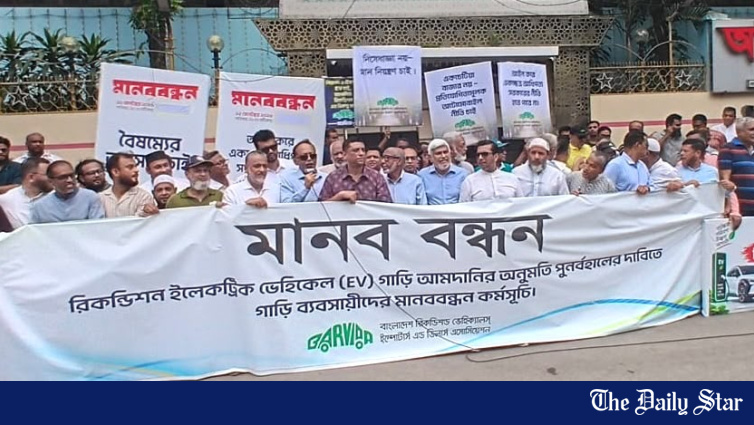
The association said its appeal had already been submitted to the relevant ministries and the highest levels of government. It expressed hope that the government would reconsider the ban in the public interest. BARVIDA Secretary General Riyaz Rahman said the association would be compelled to pursue a stronger programme if the government did not address the concerns of businesses involved in the reconditioned vehicle sector and consumers, according to the release.
The press release said current and former leaders of BARVIDA and businesspeople associated with the sector attended a human chain organised by the association — signalling that the industry is mobilising public support for its demands rather than relying solely on back-channel lobbying. The human chain marks an escalation from policy advocacy to public protest, indicating the depth of industry concern about the import ban's commercial impact.
For Bangladesh's broader EV transition strategy, the BARVIDA proposal offers a constructive middle path between the current complete ban and an unregulated open import regime. A well-designed regulatory framework — incorporating age limits, battery health standards, pre-clearance inspection and recycling obligations — could unlock affordable EV access for middle-class consumers while protecting against the import of substandard vehicles. Whether the government takes up this opportunity or maintains the outright ban will shape Bangladesh's EV adoption trajectory for years to come.
This news was originally published by The Daily Star. For the full original report, please visit: https://www.thedailystar.net/business/news/withdraw-import-ban-reconditioned-used-evs-barvida-4270991
Related on BangladeshExport
📬 Get Bangladesh Trade News in your inbox
Weekly digest of export industry news, policy updates, and market analysis.
📰 Related Stories