Bangladesh Drafts Policy to Award 7% Edge to Unsolicited State Asset Investors
Invest Bangladesh Act 2026 enables transfer of 44 state-owned assets, with original proposers to receive a 7% scoring advantage in competitive bidding for SOE revival
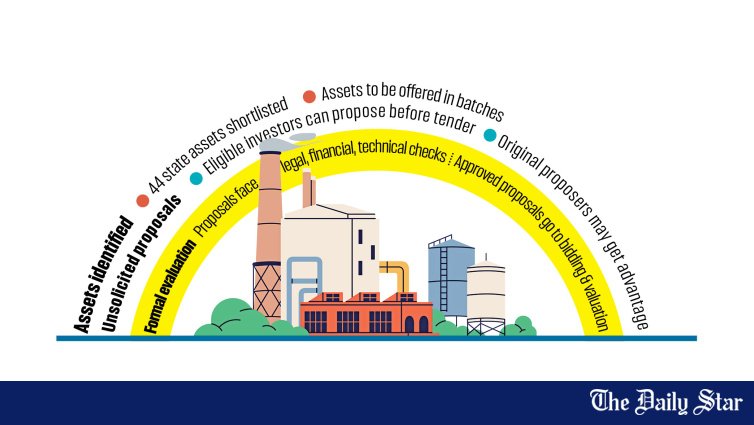
💰 An investor who submits an unsolicited proposal to revive or develop a state-owned enterprise may receive a 7 percent advantage in the subsequent competitive bidding process under a proposed government policy designed to monetise Bangladesh's vast portfolio of underperforming state assets. The provision is part of a draft policy on transferring, leasing or selling state-owned industrial and commercial enterprises, unused land and facilities, shares and ownership rights.
🏛 The Invest Bangladesh Act, 2026 provides the legal basis for such transfers. The draft policy was discussed with government and private-sector representatives at a stakeholder consultation on July 27. A revised version has since been circulated for final comments. Once finalised, the policy is expected to unlock billions of dollars in private capital for the revival of state-owned enterprises (SOEs) that have long been a fiscal drag on the national budget.
📊 44 State Assets Identified For Transfer
The government has identified 44 state-owned assets for the initiative and plans to offer them in batches rather than all at once — a sequencing approach designed to avoid flooding the market and to maintain price discipline across asset classes. The portfolio spans five major state-owned industrial corporations, each with its own legacy of accumulated losses, idle capacity and underutilised land.
- 🌾 Bangladesh Sugar and Food Industries Corporation (BSFIC): 13 assets
- 👕 Bangladesh Textile Mills Corporation (BTMC): 12 assets
- 🧪 Bangladesh Chemical Industries Corporation (BCIC): 10 assets
- 🧱 Bangladesh Jute Mills Corporation (BJMC): 5 assets
- 🔧 Bangladesh Steel and Engineering Corporation (BSEC): 4 assets
The dominance of sugar and textile mills in the list reflects the structural decline of these legacy sectors. BSFIC's state-owned sugar mills have been running at a fraction of capacity for years, while BTMC's textile mills have largely been shuttered since the 2020 closure of 25 jute mills under the previous government. The new policy offers a pathway to revive these assets through private capital rather than continued fiscal support.
📜 How The Unsolicited Proposal Mechanism Works
Under the draft policy, domestic or foreign companies, joint ventures, consortia and other eligible entities can submit proposals before a formal tender is invited. If the authorities decide to proceed, the original proposer must compete with other eligible bidders. Its evaluated score may be increased by 7 percent if the advantage is disclosed in the tender or proposal documents in advance.
The benefit, however, would not give the original proposer an automatic right to the asset, a first right to negotiate or a guarantee of winning the contract. Another bidder could therefore win if its proposal scores sufficiently higher even after the 7 percent advantage is applied. This structure — known as a "Swiss challenge" mechanism in international procurement practice — is designed to reward the initiative of unsolicited proposers while preserving competitive tension in the bidding process.
The policy would cover full or partial transfers of enterprises, leases, strategic sales, joint ventures, revenue-sharing arrangements, and management or operational partnerships. The breadth of permissible transaction structures gives the government flexibility to retain ownership of strategic assets while transferring operational control to private investors — a model that has been used successfully in India, Pakistan and Vietnam to revive state-owned enterprises without fully privatising them.
💵 Two-Stage Proposal Process
An investor seeking to submit an unsolicited proposal would first have to provide a concept paper outlining the proposed transaction, expected investment, potential economic and social benefits, and their experience and capacity. The relevant authority would assess the proposal based on the legal status of the enterprise or asset, land-use plans, public interest, potential investment, and economic and social benefits.
If the proposal is considered suitable, the investor could be asked to submit a detailed proposal covering the technical, financial and commercial structure, feasibility studies, financing plans, implementation schedule, environmental and social issues, and required regulatory approvals. The government would not be required to proceed simply because a proposal had been submitted. The investor would also have to bear the cost of preparing the proposal — a structural feature that filters out speculative submissions and ensures only serious investors engage with the process.
If the government decides to proceed, the asset would be formally put up for transaction. The usual processes of due diligence, valuation, investor selection, approval and contracting would then apply.
🏛 Oversight Committee And Independent Valuation
The draft also proposes an Investment Transaction Coordination and Oversight Committee to oversee the process. The committee would review transaction plans, valuations, tender documents, investor-selection strategies and draft agreements before recommending the highest-ranked or best-valued bidder to the final approving authority. The committee would not have final approval powers unless these are specifically given to it by law. It also could not introduce new eligibility or evaluation criteria after the process had started — a safeguard designed to preserve the integrity of competitive bidding.
The policy also calls for independent professional valuation of state assets and businesses. Depending on the type of asset, valuation could use market value, income, asset value, comparable transactions or fair value. The use of multiple valuation methodologies reflects the diversity of the 44 assets — from operating mills with revenue streams to idle land parcels where land value alone represents the bulk of the asset's worth.
🌏 Strategic Significance For Bangladesh's Economy
The privatisation programme carries significant strategic implications for Bangladesh's macroeconomic position. State-owned enterprises have historically been a major fiscal burden, with cumulative losses across BSFIC, BTMC, BCIC, BJMC and BSEC running into tens of thousands of crores of taka over the past two decades. Beyond direct fiscal costs, the SOEs occupy valuable industrial land that could be redeployed for higher-value manufacturing or logistics infrastructure.
For an economy preparing to graduate from LDC status in November 2026, the policy offers a tangible mechanism to attract foreign direct investment (FDI) into the manufacturing sector. Foreign investors — particularly from China, India, the Middle East and Southeast Asia — have historically expressed interest in acquiring Bangladeshi state assets but have been deterred by the absence of a transparent privatisation framework. The Invest Bangladesh Act 2026, combined with the new unsolicited proposal mechanism, addresses that gap.
The government says the policy aims to put state assets to more productive use while protecting its financial interests, workers' legitimate dues and the wider public interest. Worker protection will be a critical political test: previous attempts to privatise state-owned jute and textile mills faced strong labour resistance, and the new policy's success will depend on credible commitments to worker compensation, retraining and re-employment.
🤝 What Comes Next
With the revised draft circulated for final comments, the policy is now in the final lap of inter-ministerial consultation. Once finalised, it will be presented to the cabinet for approval and gazette notification. The first batch of state assets is expected to be offered to investors in late 2026 or early 2027, with the unsolicited proposal window opening concurrently.
For Bangladesh's export diversification agenda, the policy could be transformative. If foreign investors acquire and revive state-owned textile mills, the additional capacity could support the country's ambition to scale non-RMG exports. If sugar and chemical industries are revived under private management, Bangladesh could reduce its import dependence on refined sugar, fertiliser and industrial chemicals — improving the trade balance and freeing up foreign exchange reserves. The coming 12-18 months will reveal whether the policy delivers on its promise or whether political resistance caps its impact, as has happened with previous privatisation attempts.
This news was originally published by The Daily Star. For the full original report, please visit: https://www.thedailystar.net/business/economy/news/unsolicited-investors-may-get-edge-state-asset-bids-4269886
Related on BangladeshExport
📬 Get Bangladesh Trade News in your inbox
Weekly digest of export industry news, policy updates, and market analysis.
📰 Related Stories