Bangladesh Tariff Edge in US Apparel Market: Can It Cash In on Vietnam, China Decline?
2025 US exports: Bangladesh $8.20B (+11.71%), Vietnam $16.75B, China -35.55%; tariff advantage 2.5-10 points over China/Vietnam; but cotton overexposure and MMF shift pose risks
Dhaka, August 5, 2026 — Bangladesh's 2025 was strong on paper: $8.20 billion in US exports, up 11.71 percent, lifting its share to 10.53 percent — inside a market that shrank 1.74 percent in value and 3.70 percent in quantity. But 2026 is cooling faster, reshaped further by the new tariffs, and whether Bangladesh can convert its current tariff advantage into durable market share depends on how fast it moves on fibre diversification, compliance, and trade policy.
📊 2025 US Apparel Market: Who Won, Who Lost
- 🇧🇩 Bangladesh: $8.20B (+11.71%), 10.53% share
- 🇻🇳 Vietnam: $16.75B (+), 21.5% share (extended lead)
- 🇨🇳 China: $10.64B (-35.55%), 13.66% share (collapsed)
- 🇰🇭 Cambodia: Fastest growth at +26.93%
- 🌏 Asia total: 72.6% of all US apparel imports
Vietnam extended its lead to $16.75 billion (21.5 percent share); China collapsed to $10.64 billion, down roughly 35.55 percent (13.66 percent share). Cambodia grew fastest at 26.93 percent. Asia supplied 72.6 percent of all US apparel imports — a dominance that is being reshaped by the tariff war's differential impact across supplier countries.
📉 2026: Market Cooling Faster
But 2026 is cooling faster, reshaped further by the new tariffs. January-May US imports fell 9.25 percent in value and 9.49 percent in quantity. Bangladesh slipped 8.08 percent, roughly tracking the market. China's fall deepened to 42.75 percent; India dropped 26.37 percent; Pakistan fell 12.35 percent. The broad-based decline suggests that the tariff war is shrinking the overall US apparel import market, not just reallocating shares among suppliers — a dynamic that makes it harder for any single country to gain absolute volume even when its relative position improves.
💰 The Tariff Math: Bangladesh Has an Edge
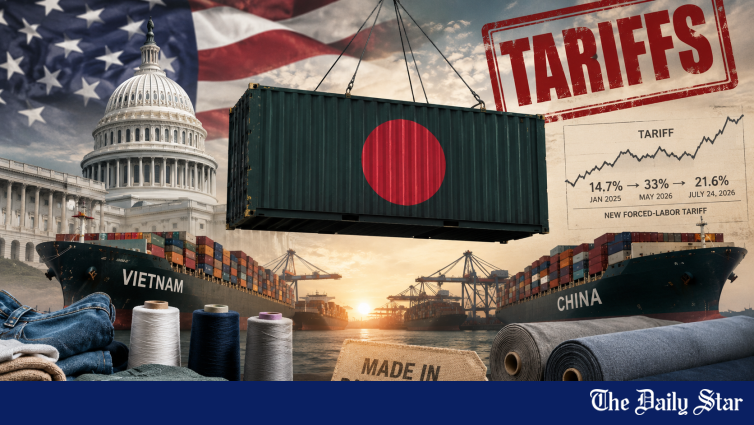
The tariff math has shifted favourably. From a shared 15.6 percent baseline, the new forced-labour levy adds 10 points for Bangladesh, India, Indonesia, Pakistan, and Cambodia (25.6 percent total), but 12.5 points for China and Vietnam — pushing China to 35.6 percent and Vietnam to 28.1 percent.
- 🇧🇩 Bangladesh total tariff: 25.6% (15.6% baseline + 10% forced labour)
- 🇻🇳 Vietnam total tariff: 28.1% (15.6% + 12.5%)
- 🇨🇳 China total tariff: 35.6% (15.6% + 12.5% + existing tariffs)
- ✅ Bangladesh advantage over Vietnam: 2.5 percentage points
- ✅ Bangladesh advantage over China: 10 percentage points
This 2.5-to-10-point tariff edge represents a genuine competitive advantage — but it is a window, not a permanent structural shift. The advantage exists only as long as the current tariff structure remains in place, and the Trump administration has shown a pattern of adjusting tariff rates in response to political dynamics.
🧵 Structural Weakness: Fibre Mix
One structural weakness remains: fibre mix. In 2025, man-made fibres (MMF) accounted for 56.61 percent of US import quantity, the larger, faster-growing category. Bangladesh stays cotton-heavy (61.61 percent of quantity, 68.29 percent of value), while Vietnam leans MMF (62.48 percent). Bangladesh's unit prices remain the cheapest of the major suppliers, but price alone won't offset a shrinking, second-hand-competing, MMF-tilting market.
- 🧵 MMF share of US imports: 56.61% (larger, faster-growing)
- 🌾 Bangladesh cotton-heavy: 61.61% of quantity, 68.29% of value
- 🧵 Vietnam MMF-heavy: 62.48%
📋 The Opportunity and the Risk
The near-term opportunity: convert today's 2.5-to-10-point tariff edge into real order reallocation from Vietnam and China, secure tariff rate quota (TRQ) terms to push the effective rate closer to 15.6 percent, market that advantage to buyers, and shift to MMF and technical-textile capacity to intercept where demand is actually growing.
Compliance credentials — the very issue behind the new tariff — become a market-access requirement, not a formality. Margins must come from productivity, efficiency, and product upgrading, not further price cuts that leave factories underwater.
The riskier path is equally plausible: a shrinking, thrifting, Gen Z-driven US market that buys less and passes less spend to any supplier, cotton overexposure that gets bypassed as MMF demand grows, and a resurgent Cambodia eating into Bangladesh's price-tier orders. US retail apparel prices rose just 0.3 percent in 2025, versus 2.7 percent overall inflation. The Bureau of Economic Analysis (BEA) data show apparel's share of US consumer spending shrinking — 2.08 percent in 2025, down from 2.10 percent in 2023 and 2.23 percent in 2021 — as budget-conscious Gen Z consumers shift spending toward experiences and second-hand clothing.
📋 Strategic Context
Whether Bangladesh converts its current tariff advantage into durable share, or watches this window close, depends on how fast it moves on TRQ, fibre diversification, and compliance — and on raising its own competitive floor rather than defending today's position. The tariff edge is real but temporary. The structural shifts in the US apparel market — toward MMF, toward lower overall consumption, toward second-hand competition — are permanent. Bangladesh cannot rely on tariff differentials alone to secure its position in the US market; it must build the manufacturing capabilities, product mix, and compliance infrastructure that will make it competitive regardless of tariff rates. The 10 percent forced labour tariff that initially appeared to be a burden has paradoxically given Bangladesh a relative advantage over China and Vietnam — but that advantage will only translate into market share gains if Bangladeshi exporters actively pursue order reallocation, invest in MMF capacity, and demonstrate compliance credentials that go beyond box-ticking.
This news was originally published by The Daily Star. For the full original report, please visit: https://www.thedailystar.net/business/news/rare-edge-brutal-tariff-war-can-bangladesh-cash-4240046
📬 Get Bangladesh Trade News in your inbox
Weekly digest of export industry news, policy updates, and market analysis.
📰 Related Stories