BGMEA and OCAB Launch Joint Initiative to Attract Chinese Investment in RMG
One-stop matchmaking platform to connect Chinese investors with Bangladeshi factories; BGMEA President Mahmud Hasan Khan leads delegation; OCAB VP Lisa Lou attends
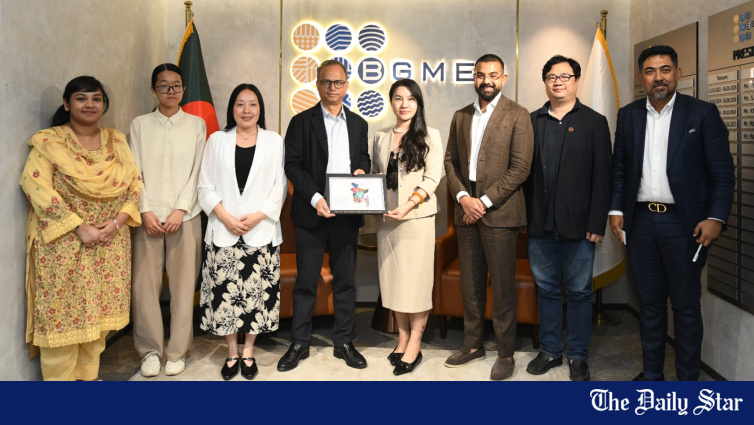
Dhaka, August 5, 2026 — The Bangladesh Garment Manufacturers and Exporters Association (BGMEA) and the Overseas Chinese Association in Bangladesh (OCAB) have launched a joint initiative to attract Chinese investment in the country's ready-made garment (RMG) sector — establishing a one-stop business matchmaking platform designed to connect Chinese investors with Bangladeshi manufacturers seeking capital, technology, and strategic partnerships.
The initiative was discussed at a bilateral meeting held at the BGMEA Complex in Dhaka's Uttara, where leaders of the two organisations explored ways to facilitate investment, technology transfer, and business partnerships between Chinese investors and Bangladeshi garment manufacturers. The meeting represents a concrete step toward addressing one of the sector's most pressing needs: attracting fresh capital to modernise production capabilities and reopen distressed factories.
👥 Delegation Composition
- 👕 BGMEA delegation: Led by President Mahmud Hasan Khan
- 🇨🇳 OCAB delegation: Vice President Lisa Lou, Vice President and Secretary General Vivian Huang, Executive Director Steven Zhang, Secretary Tina Hu
🌏 Chinese Interest in Bangladesh RMG
During the meeting, the Chinese delegation said greater foreign investment would be crucial for developing and modernising Bangladesh's upstream supply chain for the garment industry, according to a statement from the BGMEA. They said many Chinese companies were interested in setting up factories, transferring technology, and expanding operations in Bangladesh, but lacked reliable and comprehensive information needed to make investment decisions — an information gap that the new matchmaking platform is designed to fill.
The Chinese delegation sought BGMEA's support in providing relevant information and facilitating coordination with potential local partners. The request reflects the practical challenges that foreign investors face when entering Bangladesh's garment sector: navigating a complex regulatory environment, identifying credible local partners, and assessing the operational status of factories that may be available for acquisition or joint venture.
🤝 BGMEA Response: Data Collection and Matching
Responding to the proposal, BGMEA President Mahmud Hasan Khan said the association would collect information from its member factories through email to identify businesses seeking foreign investment or strategic partnerships. According to BGMEA, factory owners interested in bringing in Chinese capital and advanced technology — either for operational or closed factories — or those willing to enter joint ventures through full or partial ownership transfers, will be asked to provide their details.
The association said it would assess the information received and share relevant details with OCAB to help match potential Chinese investors with Bangladeshi manufacturers. The matching process represents a significant institutional innovation — using BGMEA's membership database as a structured channel for connecting distressed factories with foreign capital, rather than leaving such transactions to ad hoc individual negotiations.
🏢 One-Stop Matchmaking Platform Goals
BGMEA said the joint initiative aims to establish a one-stop business matchmaking platform that would:
- ✅ Facilitate investment partnerships between Chinese investors and Bangladeshi manufacturers
- ✅ Support reopening of closed or financially distressed factories through fresh capital and technology injection
- ✅ Enable technology transfer from Chinese firms to upgrade Bangladesh's upstream supply chain
- ✅ Provide comprehensive information to Chinese investors seeking to enter or expand in Bangladesh
📋 Strategic Context
The BGMEA-OCAB initiative comes at a critical moment for Bangladesh's garment sector. With nearly 700 factories closed or financially distressed, 370 of which have been recommended for the Tk 60,000 crore stimulus package, the sector urgently needs fresh capital to complement the government's financial support. Chinese investment could provide not only capital but also the advanced manufacturing technology and upstream supply chain capabilities that Bangladesh needs to move beyond basic cut-make-trim operations into higher-value manufacturing.
The initiative also reflects a broader geopolitical shift in which Chinese manufacturers, facing rising costs and trade tensions with the US, are seeking to relocate production to countries like Bangladesh that offer lower labour costs and preferential market access. If the matchmaking platform successfully channels this Chinese interest into concrete investments, it could help reopen distressed factories, modernise production capabilities, and strengthen Bangladesh's position in global apparel supply chains. The success of the initiative will ultimately depend on whether BGMEA can collect sufficient quality data from its members, whether Chinese investors find matching opportunities, and whether the regulatory environment supports rather than impedes foreign investment in the sector. The BGMEA-OCAB partnership also signals a broader strategic alignment between Bangladesh and China in the apparel sector — one that could help Bangladesh build the upstream textile supply chain capabilities it currently lacks, reducing dependence on imported raw materials and capturing more value within the domestic economy. For the 370 distressed factories recommended for the Tk 60,000 crore stimulus package, Chinese investment could provide the complementary capital and technology that financial stimulus alone cannot deliver — potentially offering a pathway to revival that combines government support with private sector expertise and market access. The OCAB delegation's emphasis on the information gap faced by Chinese investors highlights a broader challenge: Bangladesh's investment promotion infrastructure has not historically been well-equipped to serve the needs of foreign manufacturers seeking sector-specific data, partner verification, and regulatory navigation. The BGMEA's willingness to serve as the data-collection and matching intermediary represents a new model for investment facilitation — one that leverages the association's deep knowledge of its member factories to bridge the information gap that has historically deterred foreign investment. If successful, this model could be replicated by other sectoral associations to attract investment beyond the garment industry, creating a broader ecosystem of investment facilitation that strengthens Bangladesh's position as a manufacturing destination for global supply chains.
This news was originally published by The Daily Star. For the full original report, please visit: https://www.thedailystar.net/business/news/bgmea-ocab-join-hands-attract-chinese-investment-rmg-4240091
Related on BangladeshExport
📬 Get Bangladesh Trade News in your inbox
Weekly digest of export industry news, policy updates, and market analysis.
📰 Related Stories