Bangladesh "Mattress Money" Growth Signals Weak Depositor Trust in Banks
Currency outside banks growing; reported weak financial condition of some banks slows deposit rebound; by Jubair Hasan, Financial Express
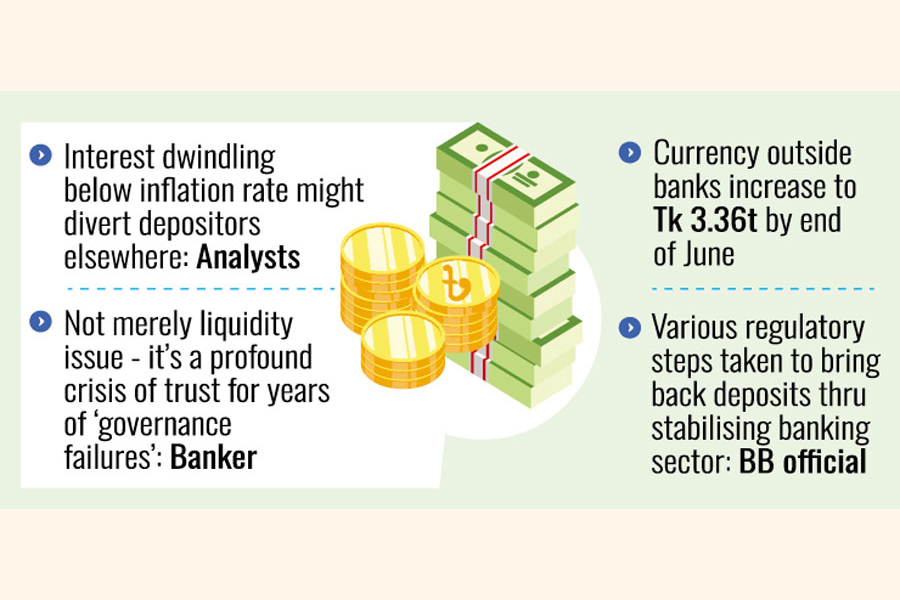
Dhaka, August 6, 2026 — Money outside the country's bank vaults was growing until the latest official data available, signifying that depositor trust in the banking sector has not yet revived fully — a phenomenon locally known as "mattress money" that reflects the persistent erosion of confidence in Bangladesh's financial system.
The growth of currency outside banks — money that households and businesses are holding in cash rather than depositing in bank accounts — is a direct indicator of trust in the banking sector. When depositors believe their money is safe in banks, they deposit it; when they fear bank failures, frozen accounts, or capital controls, they withdraw and hold cash. The continued growth of mattress money suggests that the trust deficit created by the banking sector's NPL crisis (32.26 percent of outstanding loans) and the collapse of several high-profile banks (S Alam, Beximco, Nassa) has not yet been reversed.
📊 The Trust Deficit
Reported weak financial condition of some banks slows deposit rebound. The Bangladesh Bank's data showing deposit growth of 11.41 percent in May 2026 (cited in the Q4 inflation report) appears healthy on the surface — but the growth of currency outside banks suggests that a significant portion of the money supply is bypassing the banking system entirely. This creates a dual problem: banks have less deposit base to lend from (contributing to the 33-year low in private sector credit growth), while the informal cash economy grows beyond the reach of monetary policy.
🏛️ Why Depositors Are Worried
- ⚠️ NPL ratio: 32.26% of outstanding loans are non-performing
- 🏢 Bank failures: S Alam, Beximco, Nassa groups defaulted; banks collapsed
- 💳 Capital deficits: Many banks facing capital provisioning deficits
- 💲 Deposit rates below inflation: Banks cutting deposit rates to 8.5-9% vs 9.16% inflation
- 👥 Crorepatis jumping 21%: Wealth concentration raising concerns about banking system integrity
The combination of these factors creates a powerful incentive for depositors to hold cash rather than entrust it to banks that may be unable to return it. The recent cut in deposit rates to 8.5-9 percent (below the 9.16 percent inflation rate) means that depositors are effectively losing purchasing power by keeping money in banks — providing a rational economic incentive to seek alternative stores of value, including cash held outside the banking system.
📋 Strategic Context
The growth of mattress money represents a structural threat to Bangladesh's financial system. Banks rely on deposits to fund lending; if depositors withdraw and hold cash, banks' lending capacity contracts — contributing to the 4.47 percent private sector credit growth (33-year low) that is constraining investment and economic recovery. The Bangladesh Bank's repo rate cut from 10 percent to 9.5 percent is intended to stimulate lending, but it cannot be effective if banks lack the deposit base to lend from.
Reversing the mattress money trend requires restoring depositor trust — which in turn requires resolving the NPL crisis, strengthening bank governance, and ensuring that depositors are confident their money is safe. The Tk 60,000 crore stimulus package and the 370 factory recommendations from BGMEA, BTMA, and BKMEA represent steps toward financial recovery, but they address the lending side of the equation. The deposit side — the foundation of the banking system — can only be rebuilt through demonstrated improvements in bank soundness, transparent reporting of financial conditions, and credible deposit insurance that assures depositors their money will be available when they need it. Until that trust is restored, the growth of mattress money will continue to undermine the banking system's ability to finance economic recovery.
The growth of mattress money represents a structural threat to Bangladesh's financial system. Banks rely on deposits to fund lending — if depositors withdraw and hold cash, banks' lending capacity contracts, contributing to the 4.47 percent private sector credit growth (33-year low) that is constraining investment. The Bangladesh Bank's repo rate cut from 10 percent to 9.5 percent is intended to stimulate lending, but it cannot be effective if banks lack the deposit base to lend from. Reversing the mattress money trend requires restoring depositor trust — which in turn requires resolving the NPL crisis, strengthening bank governance, and ensuring that depositors are confident their money is safe. The Tk 60,000 crore stimulus package and the 370 factory recommendations represent steps toward financial recovery, but they address the lending side. The deposit side can only be rebuilt through demonstrated improvements in bank soundness, transparent reporting, and credible deposit insurance that assures depositors their money will be available when needed.
The mattress money phenomenon also has implications for Bangladesh's monetary policy transmission mechanism. When money is held outside the banking system, the central bank's policy rate changes have reduced effectiveness — because the cash held under mattresses is not directly influenced by deposit rate changes. The Bangladesh Bank's decision to cut the repo rate from 10 percent to 9.5 percent is intended to stimulate lending by reducing banks' cost of funds, but if banks lack sufficient deposits to lend, the rate cut's impact is muted. The combination of negative real deposit rates (8.5-9 percent deposit rate vs 9.16 percent inflation), growing mattress money, and the 32.26 percent NPL ratio creates a triple constraint on the banking system's ability to finance economic recovery. The recent report showing surplus liquidity at Tk 3,27,877 crore suggests that some banks have ample funds — but the concentration of that liquidity in specific banks, combined with the NPL burden at others, means that the banking system as a whole is not effectively channelling savings into productive investment. Resolving this structural dysfunction requires not just monetary policy adjustments but fundamental banking sector reform, including governance improvements, NPL resolution, and the restoration of depositor confidence through demonstrated financial discipline.
This news was originally published by The Financial Express. For the full original report, please visit: https://thefinancialexpress.com.bd/economy/mattress-money-growth-means-lax-depositor-trust-revival
📬 Get Bangladesh Trade News in your inbox
Weekly digest of export industry news, policy updates, and market analysis.
📰 Related Stories