Bangladesh Rooftop Solar Nears 1,000MW Milestone Despite Tax Hurdles: IEEFA
IEEFA estimates actual capacity at ~1,000MW (official: 418MW); new tax raised burden from 1% to 17%; net-metering delays persist; 500MW pipeline; converting diesel pumps could save $244M/year
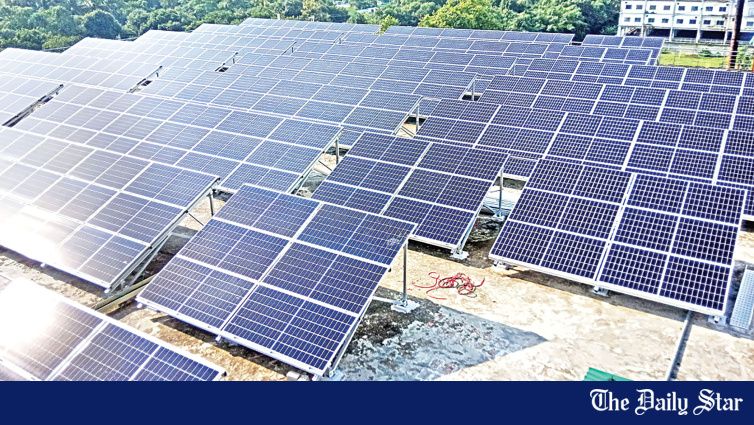
Dhaka, August 5, 2026 — Bangladesh's rooftop solar industry is nearing a milestone of 1,000 megawatts (MW) in installed capacity, but regulatory and policy barriers could undermine its growth momentum, according to the Institute for Energy Economics and Financial Analysis (IEEFA) — offering a rare bright spot in a country grappling with a severe energy crisis.
A briefing note published by the think tank said the new tax structure has raised the tax on industrial rooftop solar equipment to about 17 percent from the previous 1 percent, making such projects significantly more expensive. Delays in approving net-metering connections, which allow rooftop solar systems to feed surplus electricity into the national grid, continue to hamper adoption, it added.
☀️ Capacity: Official vs Actual
Official data show Bangladesh had 418.1MW of rooftop solar capacity as of June 2026. However, IEEFA found that 239 large establishments and business groups alone account for 667MW — already exceeding the official total. The institute estimates the country's actual rooftop solar capacity could be around 1,000MW after including smaller installations below 0.15MW that are not fully reflected in official statistics.
- ☀️ Official capacity (June 2026): 418.1MW
- 🏢 239 large establishments alone: 667MW
- 📊 IEEFA estimated actual: ~1,000MW (including small installs)
- 📈 Grid-scale variable renewable: 859MW (June 2026)
- 🛠️ EPC pipeline: 500+ MW
- 📉 Daytime demand reduction: ~6% (Apr-Jun 2024 vs 2026)
The estimate is notable because Bangladesh's grid-scale variable renewable energy capacity stood at 859MW as of June 2026, according to the briefing note, "Role of Distributed Resources in Energy Transition: A Multi-Country Perspective", which examines the growth of distributed energy resources (DERs) in Bangladesh, Australia, and India.
💬 IEEFA Analyst Perspective
"Compared to the grid-scale variable renewable energy capacity of 859MW as of June 2026, the country's growing rooftop solar capacity provides an encouraging signal for Bangladesh's power sector," said Shafiqul Alam, co-author of the report and lead analyst for Bangladesh Energy at IEEFA. "The rooftop solar sector is expected to grow further, with engineering, procurement, and construction (EPC) companies holding a project pipeline of more than 500MW," he told The Daily Star.
The growing use of rooftop solar also appears to be easing pressure on the national grid. IEEFA's analysis of half-hourly daytime electricity demand between April 16 and June 11 in 2024 and 2026 found demand fell by as much as 6 percent. While weather conditions and weaker industrial activity also contributed to the decline, the institute said rooftop solar appeared to have played a catalytic role.
⚠️ Tax Burden: From 1% to 17%
The new tax structure has raised the effective tax burden on industrial rooftop solar projects to 17 percent from 1 percent under the previous capital-machinery provision, IEEFA said. According to industry stakeholders, the 17 percent comprises 15 percent value-added tax (VAT) and 2 percent advance income tax, while customs duty and supplementary duty remain zero.
The impact is particularly severe for smaller rural projects, as many are unlikely to qualify for duty benefits because project implementation contracts are often beyond the reach of small suppliers and traders undertaking remote installations. The institute recommended a full duty waiver for rooftop solar projects.
"With the government stipulating a target to install a renewable energy capacity of 10,450MW between 2026 and 2030 in its strategy document, relying on rooftop solar for more than 50 percent new capacity, a full duty waiver to all rooftop solar projects will likely help achieve the goal," said Shafiqul Alam.
🧱 Solar Irrigation: Massive Untapped Potential
Delays in net-metering approvals remain another major obstacle. Although government guidelines require applications to be approved within 10 to 15 days, rooftop solar and solar irrigation projects continue to face delays. IEEFA estimated that more than 93 percent of Bangladesh's solar irrigation capacity remains off-grid. As irrigation pumps are used for only 110 to 150 days a year, the absence of net metering leaves them idle for much of the year, weakening project economics.
Bangladesh has more than 10 lakh diesel-powered irrigation pumps but only 3,556 solar-powered ones, the briefing note said. Converting one-third of the diesel-powered pumps to solar could reduce the annual diesel import bill by about $244 million, or Tk 3,000 crore — a potentially transformative saving for a country struggling with foreign exchange constraints.
- ⛽ Diesel irrigation pumps: 10+ lakh
- ☀️ Solar irrigation pumps: 3,556 only
- 💰 Annual savings if 1/3 converted: $244M / Tk 3,000 crore
- 📉 Solar irrigation off-grid: 93%
- ⏱️ Pump usage days/year: 110-150 days (idle rest of year without net metering)
📋 Strategic Context
The IEEFA report's findings are particularly significant for Bangladesh at a moment when the gas crisis has forced factories to operate at 30-50 percent of capacity and the country is spending billions on LNG imports. Rooftop solar represents one of the few energy solutions that can be deployed quickly, without relying on gas supply or imported fuel — and the 6 percent reduction in daytime grid demand demonstrates that it is already making a measurable contribution.
However, the 17-fold increase in the tax burden (from 1% to 17%) represents a direct contradiction of the government's stated renewable energy targets. If Bangladesh is to achieve 10,450MW of renewable capacity by 2030 with more than 50% from rooftop solar, the current tax structure is a self-inflicted obstacle that must be removed. Similarly, the net-metering approval delays and the 93% off-grid solar irrigation rate represent administrative failures that are costing the country both in foregone energy generation and in unnecessary diesel import spending. The $244 million annual saving from diesel pump conversion alone would cover a significant portion of Bangladesh's foreign exchange needs — yet only 3,556 of 10 lakh pumps have been converted. The policy gap between Bangladesh's renewable energy ambitions and its actual implementation has never been clearer.
This news was originally published by The Daily Star. For the full original report, please visit: https://www.thedailystar.net/business/economy/news/rooftop-solar-nears-1000mw-despite-policy-hurdles-4240251
📬 Get Bangladesh Trade News in your inbox
Weekly digest of export industry news, policy updates, and market analysis.
📰 Related Stories