Bangladesh RMG Exports to US Fall 5.75% in Jan-Jun 2026: OTEXA Data
June alone up 5.74% to $763.57M; total US apparel imports down 8.04% to $35.09B; Cambodia grows 12.32%, China collapses -37.69%; Bangladesh volume down 3.69%
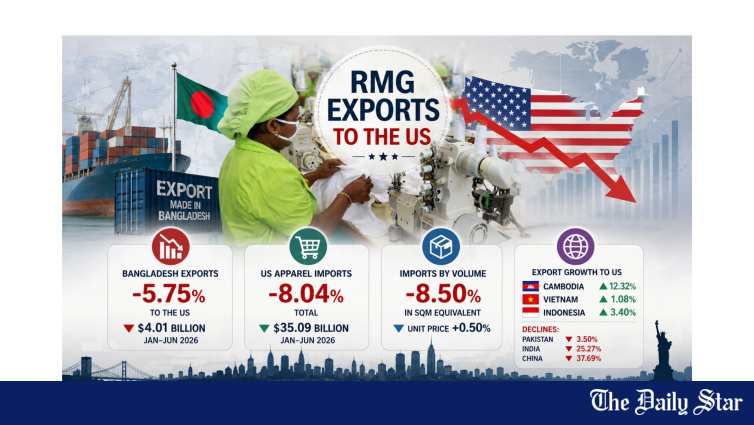
Dhaka, August 6, 2026 — Bangladesh's ready-made garment (RMG) exports to the United States fell 5.75 percent in the January-June 2026 period, according to the latest data from the Office of Textiles and Apparel (OTEXA) — even as June alone showed a modest recovery with exports rising 5.74 percent year-on-year to $763.57 million.
The mixed picture reflects a broader pattern in the US apparel import market, which contracted significantly in the first half of 2026. Total US apparel imports fell to $35.09 billion, down 8.04 percent from the same period in 2025. By volume, US apparel imports dropped 8.50 percent in square metre equivalents, while the average unit price rose 0.50 percent — suggesting that American consumers are buying less clothing but paying slightly more per unit.
📊 Bangladesh Performance: January-June 2026
- 📉 Bangladesh exports to US (Jan-Jun): -5.75% YoY
- 📈 June 2026 alone: $763.57M (+5.74% YoY)
- 📉 Bangladesh export volume: -3.69%
- 📉 Bangladesh unit price: -2.15%
- 📊 Total US apparel imports: $35.09B (-8.04%)
- 📉 US import volume: -8.50% (square metre equivalents)
- 📈 US avg unit price: +0.50%
The fact that Bangladesh's export decline (-5.75 percent) was smaller than the overall US market contraction (-8.04 percent) suggests that Bangladesh actually gained marginal market share during the period — even as its absolute export volume fell. This is consistent with the analysis showing Bangladesh holding a 10.53 percent share of the US apparel import market, with a tariff advantage over both China and Vietnam.
🌏 Competitor Performance: Winners and Losers
The OTEXA data reveals striking divergences among Bangladesh's competitors in the US market:
- ✅ Cambodia: +12.32% (value), +14.59% (volume) — strongest performer
- ✅ Indonesia: +3.40% (value), +10.89% (volume)
- ✅ Vietnam: +1.08% (value), +3.30% (volume)
- ❌ Pakistan: -3.50% (value), +2.26% (volume)
- ❌ Bangladesh: -5.75% (value), -3.69% (volume)
- ❌ India: -25.27% (value), -22.74% (volume)
- ❌ China: -37.69% (value), -26.30% (volume) — sharpest decline
The data confirms the ongoing shift in US apparel sourcing away from China, whose exports collapsed by 37.69 percent. Cambodia emerged as the primary beneficiary of this shift, growing 12.32 percent — likely capturing orders that would otherwise have gone to Chinese suppliers. Vietnam maintained positive growth at 1.08 percent, while Bangladesh and Pakistan both experienced declines, suggesting that the China-plus-one diversification is favouring Southeast Asian suppliers over South Asian ones.
💰 Unit Price Trends
In terms of unit price, those of Vietnam and Bangladesh both fell by 2.15 percent, Cambodia's by 1.98 percent, India's by 3.28 percent, Pakistan's by 5.63 percent, Indonesia's by 6.75 percent, and China's by 15.46 percent. China's dramatic 15.46 percent unit price decline suggests that Chinese suppliers are aggressively cutting prices to maintain volume — a strategy that is failing to prevent the overall collapse of their US market share.
Bangladesh's 2.15 percent unit price decline, while modest compared to China's, represents a margin erosion that compounds the sector's other financial pressures. With factories already operating at reduced capacity due to the gas crisis, and with the 10 percent forced labour tariff adding to the cost burden, the ability to absorb further price reductions is limited.
📋 Strategic Context
The OTEXA data provides a concrete data point for the tariff advantage analysis that has been discussed in recent trade policy commentary. Bangladesh's total tariff of 25.6 percent (15.6 percent baseline + 10 percent forced labour levy) gives it a 2.5-point advantage over Vietnam (28.1 percent) and a 10-point advantage over China (35.6 percent). Yet despite this advantage, Bangladesh's exports fell while Vietnam's grew — suggesting that the tariff differential alone is not sufficient to drive order reallocation. Vietnam's superior fibre diversification (62.48 percent MMF vs Bangladesh's 61.61 percent cotton-heavy mix) and its broader free trade agreement network likely explain why it is capturing more of the China-exit orders than Bangladesh.
The June recovery (+5.74 percent to $763.57 million) offers a glimmer of hope that the worst of the decline may have passed. If the June trend continues into the second half of 2026, Bangladesh could end the year with a smaller overall decline — or potentially flat performance. However, the ongoing gas crisis, the 33-year low in private sector credit growth, and the persistent weakness in global demand suggest that a sustained recovery is not yet assured. The BGMEA's focus on securing tariff rate quota (TRQ) terms, diversifying into MMF products, and marketing the tariff advantage to US buyers represents the right strategic direction, but the OTEXA data shows that translating strategy into actual market share gains remains a work in progress. The June recovery, if sustained, could mark the beginning of a turnaround — but with the gas crisis constraining production capacity, the banking sector's 32.26 percent NPL ratio limiting credit availability, and the 33-year low in private sector credit growth signalling weak investment, the structural constraints on Bangladesh's export recovery remain formidable. The comparison with Cambodia is particularly instructive: a smaller, lower-capacity supplier is growing at 12.32 percent while Bangladesh declines — suggesting that agility, fibre mix, and buyer relationships matter more than scale in the current US market environment. For Bangladesh to reverse the declining trend, it will need to move beyond cotton-heavy production (61.61 percent of volume) into the MMF categories where US demand is growing, invest in compliance credentials that go beyond box-ticking to address the forced labour concerns driving the tariff structure, and actively market its 2.5-10 point tariff advantage to US buyers who may not be aware of the cost differentials. The OTEXA data should serve as a wake-up call: the tariff advantage is real but temporary, and without strategic action to convert it into durable market share, the window of opportunity will close as competitors adapt to the new tariff landscape.
This news was originally published by The Daily Star. For the full original report, please visit: https://www.thedailystar.net/business/news/bangladeshs-rmg-exports-the-us-fall-575-jan-jun-4241606
Related on BangladeshExport
📬 Get Bangladesh Trade News in your inbox
Weekly digest of export industry news, policy updates, and market analysis.
📰 Related Stories