Bangladesh's Plunder Economy: Extortion, Bank Loot And Capital Flight
Economist Abdullah A Dewan unpacks National Professor Mahbub Ullah's characterisation of Bangladesh as a plunder economy, distinguishing retail extortion from wholesale institutionalised extraction
⚠ National Professor Mahbub Ullah recently described Bangladesh as a "plunder economy," arguing that extortion operates as a form of informal taxation that distorts investment and prevents the economy from becoming genuinely productive. His characterisation is provocative, but it raises an even more important question: is Bangladesh primarily suffering from an extortion economy, or has extortion become only one component of a much broader architecture of plunder? The distinction matters because it determines the policy response required.
🏛 He made the remarks at a seminar titled "Economic Outlook and Emerging Challenges: Priorities for the Coming Days," jointly organised by the Economic Reporters Forum (ERF) and the Centre for Policy Dialogue (CPD) in Dhaka last week. The distinction he raises matters because extortion is a mechanism of extraction; plunder is a system — and the difference between addressing a mechanism versus addressing a system determines whether economic reform succeeds or fails.
📜 Extortion As Informal Taxation
When a trader, transporter, contractor or factory owner must pay chanda (toll) simply to conduct ordinary business, that is extortion. It resembles taxation because money is extracted as a condition for participating in economic activity. But unlike legitimate taxation, which at least in principle finances roads, schools, healthcare, security and other public goods, extortion produces no corresponding public benefit. It is taxation without representation, accountability or public expenditure — a pure deadweight loss on productive enterprise.
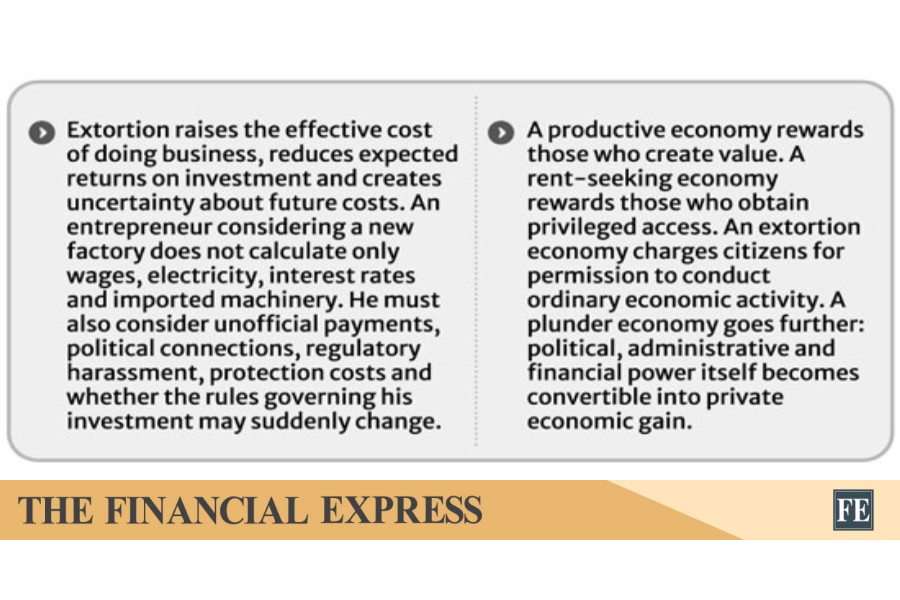
The economic damage therefore extends far beyond the amount collected. Extortion raises the effective cost of doing business, reduces expected returns on investment and creates uncertainty about future costs. An entrepreneur considering a new factory does not calculate only wages, electricity, interest rates and imported machinery. He must also consider unofficial payments, political connections, regulatory harassment, protection costs and whether the rules governing his investment may suddenly change. Together, these constitute an invisible extraction premium imposed on productive enterprise — a premium that competitors in Vietnam, India or Cambodia do not face.
💰 From Extortion To Plunder: The Wholesale Extraction
But an economy becomes a plunder economy when extraction moves beyond street-level transactions and becomes embedded within institutions themselves. Bank loans obtained through political influence and never seriously intended to be repaid are not conventional extortion. Inflated public projects, procurement manipulation, regulatory favoritism, politically allocated contracts, deliberate loan defaults and illicit transfers of capital abroad operate differently. Yet economically they share a common characteristic: wealth is transferred from productive society toward actors possessing privileged access to political, administrative or financial power.
This is where the distinction between retail and wholesale extraction becomes useful. Extortion is often the retail face of extraction; institutionalised plunder is its wholesale counterpart. The retail side — toll collection at transport hubs, protection payments at marketplaces, informal fees for regulatory approvals — affects millions of small transactions daily. The wholesale side — politically directed bank loans, inflated government procurement contracts, sanctioned capital flight — operates through fewer but vastly larger transactions that move billions of dollars out of productive use.
📊 The Numbers Behind The Plunder Economy
CPD Distinguished Fellow Dr Fahmida Khatun, at the seminar, offered a cautiously more optimistic reading of the present economy, pointing to some improvement in foreign-exchange reserves and inflation while also emphasising continuing weakness in production, investment, employment and energy supply. The distinction between stabilisation and recovery, however, is crucial. Headline inflation, for example, edged down only from 9.16 per cent in June to 8.32 per cent in July — hardly a movement warranting celebration. Foreign-exchange reserves have improved more meaningfully, providing a welcome external financing cushion, but the underlying productive indicators remain weak.
Indeed, the accompanying indicators tell the more consequential story:
- 📈 Industrial output contracted by 0.28 per cent
- 📊 GDP growth fell to 2.22 per cent
- 💰 Private investment remained below 22 per cent of GDP
- 💵 Private-sector credit growth sank to 4.47 per cent
- ⚠ Non-performing loans reached 32.26 per cent of total lending
- 📜 Total NPLs at Tk 6.06 trillion (Tk 6.06 lakh crore) by June 2026
These are not the fingerprints of a structurally recovering economy. They suggest that a degree of macroeconomic stabilisation may be occurring around the edges while the productive core remains profoundly fragile. The financial-sector numbers are particularly disturbing: non-performing loans reached Tk 6.06 trillion at the end of June. Political influence and weak governance have been identified among the causes, while earlier concealment of bad loans suggests that the deterioration did not arise overnight — it was systematically masked through rescheduling, restructuring and evergreening.
🌏 The Plunder Economy's Structural Logic
Placed side by side, these statistics reveal something deeper. On one side stands weak productive investment. On the other stands an extraordinary accumulation of impaired financial assets. The issue is therefore not simply that Bangladesh lacks capital. The more troubling possibility is that too much capital has been allocated, diverted or trapped in ways that fail to create productive capacity — that is the essence of the plunder-economy proposition.
A productive economy rewards those who create value. A rent-seeking economy rewards those who obtain privileged access. An extortion economy charges citizens for permission to conduct ordinary economic activity. A plunder economy goes further: political, administrative and financial power itself becomes convertible into private economic gain — a structural feature that distorts incentives across the entire economy.
These processes should not be analysed separately. Bangladesh's predicament is better understood as a multidimensional matrix in which extortion, banking weakness, political patronage, regulatory discretion, corruption, energy shortages, capital flight and weak investment interact with one another. Consider the entrepreneur facing unreliable gas supplies. Businesses report that diesel-based production can cost nearly four times as much as gas-based production. Add high financing costs, bureaucratic uncertainty and informal payments, and the expected return from expanding productive capacity falls further. Some entrepreneurs postpone investment. Others shift capital toward land, trade, financial assets or foreign destinations. The productive base consequently weakens.
🔄 The Circular Trap Of Plunder Economics
The process becomes circular. Low investment constrains employment and growth. Weak growth reduces revenue generation. Weak revenue increases government borrowing. Banking-sector weakness makes productive credit more difficult or expensive. Political connections become more valuable precisely because ordinary market mechanisms function poorly. Rent-seeking then becomes more attractive relative to entrepreneurship — a self-reinforcing cycle that drives capital away from productive deployment and toward speculative or extractive activity.
Plunder, therefore, is not merely money being stolen. It alters the incentive structure of the economy, and that may ultimately be its most damaging consequence. When entrepreneurs see that political access yields higher returns than productive investment, the smartest minds in the economy redirect their efforts toward securing political favour rather than building competitive businesses. The result is an economy that produces fewer goods, fewer jobs and less innovation than its resource base and human capital would otherwise support.
🤝 What Comes Next: Reform Imperatives
For Bangladesh's reform agenda, the plunder-economy framing carries clear policy implications. Addressing retail extortion requires strengthened law enforcement and political will at the local level. Addressing wholesale plunder requires structural reforms to banking sector governance, public procurement transparency, anti-money-laundering enforcement and political finance regulation — reforms that touch the core of how political power is exercised and financed.
The interim government's willingness to push through these structural reforms ahead of LDC graduation in November 2026 will determine whether Bangladesh escapes the plunder-economy trap or whether the stabilisation gains of recent months prove to be temporary relief on a structural downward trajectory. The seminar at ERF-CPD crystallised the diagnosis; the coming months will reveal whether the political system can absorb the treatment.
This news was originally published by The Financial Express. For the full original report, please visit: https://thefinancialexpress.com.bd/views/plunder-or-extortion-economy
📬 Get Bangladesh Trade News in your inbox
Weekly digest of export industry news, policy updates, and market analysis.
📰 Related Stories