Bangladesh Plastic Factories Run at 30% Capacity Amid Energy Crisis: BPGMEA
BPGMEA President Shamim Ahmed: capacity down from 50% to 30-40%; industry urges rooftop solar adoption at seminar with STAC Foundation
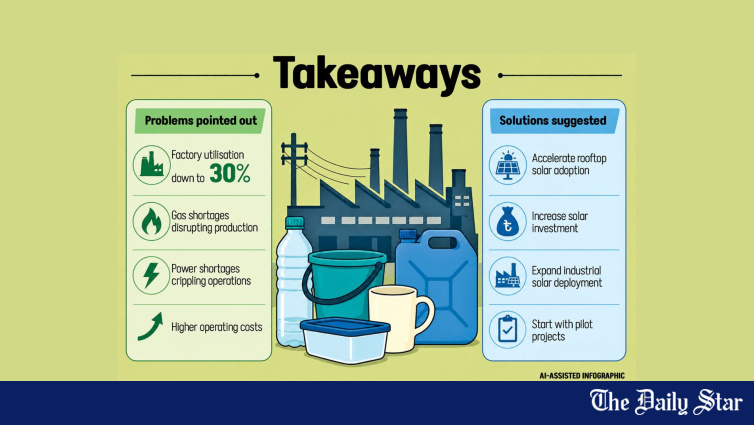
Dhaka, August 5, 2026 — Bangladesh's plastic goods manufacturers are operating at just 30 to 40 percent of installed capacity as the prolonged energy crisis continues to cripple industrial production across the country — with the industry now pushing for rooftop solar adoption as a potential survival strategy.
The warning came at a seminar on "Renewable Energy: The Future of Sustainable Manufacturing", organised by the Bangladesh Plastic Goods Manufacturers and Exporters Association (BPGMEA) and the STAC Foundation. Shamim Ahmed, president of BPGMEA, said uninterrupted electricity is critical for the plastic industry. "Our main raw material is plastic, but without power we cannot run our factories," he said.
📊 Capacity Deterioration
According to Shamim, the industry's operating capacity has deteriorated sharply because of persistent gas and electricity shortages. "A few days ago we were saying factories were operating at around 50 percent capacity. Now I am not even sure whether we are operating at 30-40 percent. Many factories cannot even reach 30 percent capacity," he said.
- 📉 Previous capacity utilisation: ~50%
- 📉 Current capacity utilisation: 30-40% (some below 30%)
- ⚠️ Trend: Continuing to deteriorate
- 🔌 Root cause: Gas and electricity shortages
"This situation has continued since the gas crisis began. Business leaders have repeatedly raised the issue with the government because without reliable energy, it will not be possible to sustain industrial production," Shamim added. The plastic industry's experience mirrors the broader pattern documented across Bangladesh's industrial sector: textile mills operating at 30-50 percent, garment factories at 60-70 percent, and now plastic factories dropping below 30 percent.
☀️ Rooftop Solar as Survival Strategy
On sustainability, Shamim said reducing dependence on fossil fuels was essential to cutting carbon emissions and urged industries to adopt resource-efficient and cleaner production (RECP) alongside energy-efficient practices and renewable energy solutions. The seminar's focus on rooftop solar reflects a growing recognition within Bangladesh's industrial sector that the government cannot solve the energy crisis quickly enough — and that manufacturers must take their own steps to secure reliable power supply.
The IEEFA report published the same day found that Bangladesh's rooftop solar capacity is nearing 1,000MW, with a 6 percent reduction in daytime grid demand attributable to rooftop solar installations. For the plastic industry — where electricity is the primary input for injection moulding, extrusion, and other manufacturing processes — rooftop solar could provide a partial solution to the grid power shortage, particularly for daytime operations. However, the new tax structure raising the burden on industrial rooftop solar from 1 percent to 17 percent makes such investments significantly more expensive, directly contradicting the government's stated renewable energy targets.
📋 Strategic Context
The BPGMEA's revelation that plastic factories are operating below 30 percent capacity adds another sector to the growing list of industries devastated by Bangladesh's energy crisis. The plastic industry is particularly important for Bangladesh's export diversification agenda, as plastic products represent one of the non-RMG export categories that the government is trying to grow. With LDC graduation approaching and the need to diversify exports beyond garments, the collapse of plastic manufacturing capacity to below 30 percent represents a direct setback to the country's economic strategy.
The industry's push for rooftop solar is pragmatic but insufficient. Rooftop solar can address daytime electricity needs but cannot replace gas for processes that require thermal energy. The plastic industry's survival depends on a combination of rooftop solar for electricity, reliable gas supply for thermal processes, and policy support that recognises the sector's strategic importance to export diversification. The BPGMEA president's call for government action reflects a growing frustration within the business community: industries that have invested in Bangladesh's manufacturing capacity are now unable to utilise that capacity because of energy supply failures that are fundamentally a government responsibility. Without urgent resolution of the gas crisis and removal of the tax barriers to rooftop solar adoption, Bangladesh risks losing its plastic manufacturing base — a loss that would further concentrate the export economy in the garment sector and undermine the diversification goals outlined in the LDC graduation roadmap. The combination of the 17 percent tax on rooftop solar, the ongoing gas shortage, and the deteriorating capacity utilisation across multiple industrial sectors represents a policy failure that demands immediate correction if Bangladesh is to maintain its industrial base and achieve its export diversification targets.
The BPGMEA's revelation adds the plastic sector to the growing list of industries devastated by the gas crisis. The plastic industry is particularly important for Bangladesh's export diversification agenda — plastic products represent one of the non-RMG export categories that the government is trying to grow as part of its LDC graduation preparation. The collapse of plastic manufacturing capacity to below 30 percent represents a direct setback to the country's economic strategy. The industry's push for rooftop solar is pragmatic but insufficient — rooftop solar can address daytime electricity needs but cannot replace gas for thermal processes. The survival of the plastic sector depends on a combination of rooftop solar for electricity, reliable gas supply for thermal processes, and policy support that recognises the sector's strategic importance to export diversification. The 17 percent tax on rooftop solar equipment (raised from 1 percent) creates a direct contradiction with the government's renewable energy targets and should be urgently reviewed if Bangladesh is to maintain its industrial base across multiple sectors.
This news was originally published by The Daily Star. For the full original report, please visit: https://www.thedailystar.net/business/global-economy/news/plastic-factories-run-30-capacity-amid-energy-crisis-4240231
📬 Get Bangladesh Trade News in your inbox
Weekly digest of export industry news, policy updates, and market analysis.
📰 Related Stories