Bangladesh Industry in a Bind: Factories Idle as Gas Crisis Bites, NPLs Hit Tk 588,704 Crore
MGI paying Tk 45 crore/month interest on 7 stalled Comilla factories; City Group losing Tk 5 crore/day on 6 idle plants; 1,850+ industrial gas connections pending
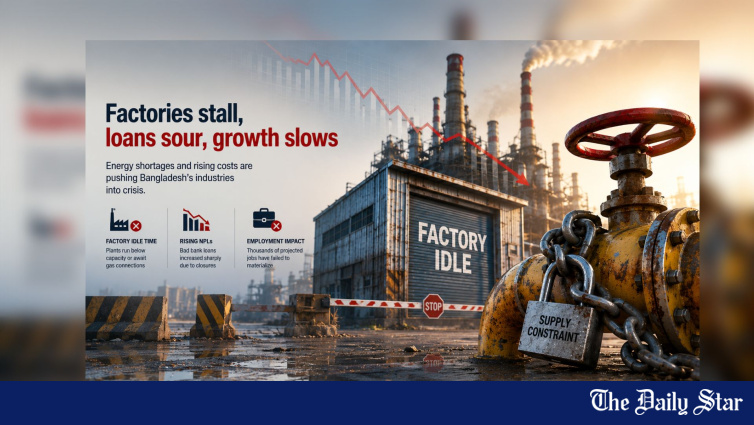
Dhaka, August 4, 2026 — A chronic energy shortage, coupled with rising costs, a shortage of finance, and global economic headwinds, has forced many factories to shut down in recent years, taking the steam out of Bangladesh's economic engine — with newly built plants sitting idle, billions of taka in bank loans going unpaid, and thousands of jobs that were supposed to materialise nowhere to be seen.
Factories across key industrial belts are operating well below capacity because of the gas shortage, while many newly built plants remain idle with no clear timeline for starting production. As machinery sits unused, businessmen continue to repay mounting bank loans. Workers affected by factory closures move from one mill to another in search of work, while shuttered businesses are adding to the country's growing burden of non-performing loans (NPLs).
📊 Industrial Growth Slows Sharply
The prolonged energy crisis, combined with the disruption that followed the political changeover in August 2024, has left clear marks on the industrial sector. Industrial growth slowed to 2.86 percent in fiscal year 2025-26 from 3.71 percent a year earlier, according to provisional estimates by the Bangladesh Bureau of Statistics (BBS) — a deceleration that translates directly into lost jobs, lower tax revenue, and reduced export capacity.
Fazlee Shamim Ehsan, president of the Bangladesh Employers Federation, said their dying units managed to operate at about 78 percent of capacity before the latest round of gas crisis. Now many are running at roughly half of their normal capacity. "Still, we are in a much better situation in comparison with other factories. Factories in Kanchpur to Narsingdi industrial belt are facing the worst," he said.
Amid these constraints, business leaders describe the energy crisis as the "biggest obstacle" to achieving Bangladesh's target of $100 billion in exports by 2030 — a target that now appears increasingly aspirational rather than achievable under current energy supply conditions.
🛢️ 1,850+ Industrial Gas Connections Pending
As of mid-July, more than 1,850 applications for industrial gas connections were awaiting approval after the government instructed Petrobangla to suspend all new gas connections. The decision has dealt another blow to large industrial groups and garment manufacturers that have spent years seeking gas connections for completed factories — factories that now stand as monuments to misallocated capital.
Industries have faced gas shortages for years, but business leaders say the situation deteriorated after the US-Israel war on Iran triggered fresh shocks in global energy markets. The crisis worsened further after an accident at a floating liquefied natural gas terminal in Cox's Bazar cut the country's pipeline gas supply by more than 17 percent.
🏭 Meghna Group: Tk 7,320 Crore Stalled in Comilla
Meghna Group of Industries (MGI), one of the country's largest industrial conglomerates, has invested Tk 7,320 crore in glass and steel rod factories at the Comilla Economic Zone. Construction finished between one-and-a-half and two-and-a-half years ago. The factories were financed largely through domestic and foreign loans, but they cannot begin production without gas. As a result, the group is paying about Tk 45 crore a month in interest on idle capacity.
MGI Chairman Mostafa Kamal said, "In the Comilla Economic Zone, seven factories in total were supposed to create jobs for 15,000 people. But now everything is stalled due to the lack of gas." The lost employment is particularly painful at a moment when Bangladesh is struggling to create jobs for a young and growing workforce.
"If we had been told from the beginning that gas would not be available, we would not have made such massive investments," he commented. "The government now seeks foreign investment, but if investors face this situation, given Bangladesh's poor rating, the risk will only worsen."
🏢 City Group: Tk 14,000 Crore Losing Tk 5 Crore Daily
City Group faces a similar problem — but on an even larger scale. It has invested about Tk 14,000 crore in six factories, including sugar, salt, and cement plants, at Hoshendi Economic Zone at Gajaria of Munshiganj. City Group even spent about Tk 110 crore to build its own gas pipeline, yet it has still not received a gas connection. The factories have been ready since 2022 but cannot begin operations because of the lack of gas.
The company is paying nearly Tk 5 crore a day in bank interest — an extraordinary burden that illustrates the scale of capital destruction happening across Bangladesh's industrial sector. According to a City Group official, who requested anonymity, the six factories would directly employ around 10,000 people if they were operational.
- 💰 MGI investment: Tk 7,320 crore (7 factories, Comilla EZ)
- 💲 MGI monthly interest: Tk 45 crore
- 💰 City Group investment: Tk 14,000 crore (6 factories, Hoshendi EZ)
- 💲 City Group daily interest: Tk 5 crore
- 👥 Combined potential jobs: 25,000 (15,000 MGI + 10,000 City Group)
💳 Currency Depreciation Compounds the Pain
An entrepreneur in Narsingdi, who requested anonymity, said he invested Tk 600 crore in a spinning mill after being promised a gas connection by 2024. Following the fall of the Awami League government that year, the connection never came. He said he has had to seek additional bank loans while continuing to pay interest on expensive machinery that remains idle inside the factory.
The entrepreneur has also been hit by the depreciation of the taka, which has lost about 40 percent of its value against the US dollar over the past three years. He opened letters of credit (LCs) when the exchange rate stood at Tk 85 to the dollar. By the time payments were due, it had climbed to more than Tk 123, leaving him with heavy losses and a shortage of working capital.
💰 NPLs Surge to Tk 588,704 Crore (32.26%)
Many big businesses with political links also ran into trouble after the Awami League government fell in August 2024. Large groups including S Alam Group, Beximco Group, and Nassa Group defaulted on their loans after their businesses shut down and production stopped as owners fled, became fugitives, or were arrested.
As these companies failed to repay their loans, bad debt in the banking sector rose sharply. At the end of 2024, NPLs stood at Tk 345,765 crore, up from Tk 211,392 crore six months earlier. By the end of March this year, total NPLs climbed to Tk 588,704 crore, equal to 32.26 percent of the Tk 1,824,668 crore in outstanding loans, according to Bangladesh Bank — meaning roughly one-third of all bank loans in Bangladesh are now non-performing.
- 📊 NPLs end-2024: Tk 345,765 crore
- 📊 NPLs end-March 2026: Tk 588,704 crore
- 📈 NPL ratio: 32.26% of total outstanding loans (Tk 1,824,668 crore)
- 💰 6-month NPL increase (mid-2024 to end-2024): Tk 134,373 crore
🤝 Government Response: Tk 60,000 Crore Stimulus
To ease the pressure, the central bank under the interim government introduced more flexible loan restructuring and rescheduling facilities for businesses affected by factors beyond their control. After taking office, the BNP-led government made economic growth and employment its priorities. As part of that effort, it sought to reopen closed factories and industries, while the central bank introduced a series of support measures, including a Tk 60,000 crore stimulus package.
Anis A Khan, former chairman of the Association of Bankers Bangladesh (ABB), told The Daily Star that many industrial groups had fallen into distress because of circumstances beyond their control rather than poor business decisions. "Take City Group, for example. If it had received a gas connection for its economic zone on time, it would have been able to repay its bank loans on schedule."
Anis, also the former managing director of Mutual Trust Bank, said the company would not have ended up in its current situation. "To keep the economy on track, these businesses need to be supported." The framing matters: it positions the industrial crisis not as a failure of private sector management, but as a policy-induced problem that requires policy-led solutions.
📋 Strategic Context
The industrial crisis described in this investigation represents the most visible manifestation of Bangladesh's broader macroeconomic challenges. Factories that were built in anticipation of gas connections that never materialised represent billions of dollars in misallocated capital — investments that could have generated exports, employment, and tax revenue, but are instead generating only bank interest charges and NPLs.
For the LDC graduation roadmap that targets 7 percent GDP growth by 2029, the idle factories of Comilla and Munshiganj represent a powerful counter-narrative. Achieving the roadmap's targets requires not just new investment, but the activation of existing stranded capacity — the factories that are built, equipped, and staffed but cannot run because the gas pipeline stops at the factory gate. Until the energy supply problem is solved, no amount of monetary stimulus or loan restructuring can restore Bangladesh's industrial sector to health. The Tk 60,000 crore stimulus package announced by the central bank may buy time for distressed businesses, but it cannot substitute for the gas supply that those businesses actually need to operate.
This news was originally published by The Daily Star. For the full original report, please visit: https://www.thedailystar.net/business/news/industry-bind-4239371
📬 Get Bangladesh Trade News in your inbox
Weekly digest of export industry news, policy updates, and market analysis.
📰 Related Stories