Bangladesh Eyes Global Halal Hub Status Leveraging ASEAN Experience, Says Commerce Minister Muktadir
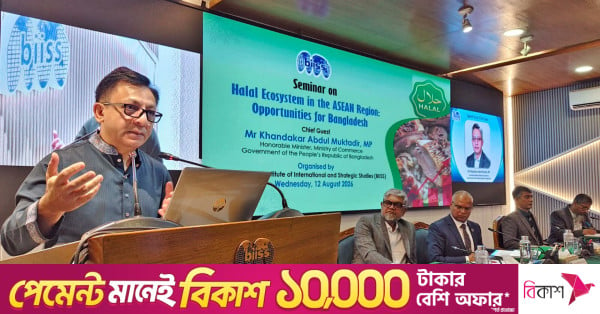
Dhaka, August 12, 2026 — Bangladesh is positioning itself to become a global halal hub, leveraging the experience of ASEAN countries — particularly Malaysia — to diversify its export basket beyond ready-made garments. Commerce Minister Khandakar Abdul Muktadir outlined the strategic vision at a high-level seminar organised by the Bangladesh Institute of International and Strategic Studies (BIISS) in Dhaka on Wednesday, titled “Halal Ecosystem in the ASEAN Region: Opportunities for Bangladesh”.
Speaking as chief guest, Muktadir called for building a strong, internationally standardised halal ecosystem in Bangladesh, leveraging the proven experience of the ASEAN region. With the global halal economy projected to surpass $7 trillion in the coming years, the minister framed the push as a critical new pillar for the country's export diversification agenda — especially as Bangladesh prepares for LDC graduation in November 2026.
🌐 Beyond Food: The Expanding Halal Economy
A key theme of the seminar was that the halal economy has evolved well beyond its traditional food-and-beverage perimeter. Minister Muktadir emphasised that the modern halal economy now encompasses pharmaceuticals, cosmetics, modest fashion, tourism, logistics, technology, financing, and international certification — opening multiple high-value pathways for Bangladeshi exporters.
For a country that already has globally competitive pharmaceutical, leather, and apparel industries — and a predominantly Muslim population of 170 million — the strategic fit is obvious. Bangladesh can serve both as a major production hub and as a domestic market anchor for halal-certified products, mirroring the playbook that Malaysia and Indonesia have used to build globally recognised halal brands.
📚 The Malaysia Model: From Product Category to Economic System
Speakers at the seminar highlighted Malaysia's halal ecosystem as the most relevant model for Bangladesh. Malaysia has transformed halal from merely a product category into a complete economic system covering production, research, certification, marketing, and export. The country's Halal Industry Master Plan, JAKIM certification authority, and dedicated Halal Industrial Parks together create a vertically integrated ecosystem that international buyers trust.
By contrast, Bangladesh's current halal certification landscape is fragmented across multiple agencies — the Islamic Foundation, BSTI, and various private certifiers — creating inconsistency, duplication, and credibility gaps in international markets. Consolidating this landscape under a single, internationally recognised authority is widely seen as the single most important reform needed to unlock the sector's potential.
🏗️ Five Strategic Priorities Identified
Seminar participants identified five strategic priorities for Bangladesh to capture a meaningful share of the global halal market:
- 📜 Internationally recognised national halal assurance framework — single certification authority aligned with OIC and ASEAN standards
- 🏭 Specialised halal industrial clusters — dedicated zones with modern laboratories, logistics, and cold-chain infrastructure
- 🔧 Upgrade existing industries — align pharmaceuticals, cosmetics, leather, and apparel with halal production standards
- 👥 SME and entrepreneur engagement — involve small businesses, researchers, and young entrepreneurs in the halal ecosystem
- 🌏 Bangladesh Halal Brand — promote a unified national brand through economic diplomacy and trade missions
Together, these priorities form a coherent roadmap that mirrors Malaysia's successful trajectory — adapted to Bangladesh's specific industrial strengths and market position.
👥 High-Level Stakeholder Convergence
The seminar brought together an unusually broad cross-section of stakeholders, signalling serious institutional commitment to the halal agenda. BIISS Director General Major General ASM Ridwanur Rahman delivered the welcome address, while BIISS Research Director Dr Mahfuz Kabir presented the keynote paper.
The panel discussion featured Akhtar Hossain, Deputy Director of the Islamic Foundation's Halal Certification (Livestock) Division, and SM Abu Sayeed, Deputy Director (Halal Certification) of Bangladesh Standards and Testing Institution (BSTI) — the two agencies most directly responsible for halal certification in the country. Their presence signalled that the institutional pieces are beginning to align around a more integrated halal certification architecture.
📊 Why Bangladesh Has Natural Advantages
Speakers noted that Bangladesh brings several structural advantages to the global halal race:
- 🌏 170 million Muslim population — large domestic market anchor
- 🌾 Strong agricultural base — livestock, poultry, fisheries, and agro-processing capacity
- 💊 Globally competitive pharma — Bangladesh exports medicines to 150+ countries, many Muslim-majority
- 👞 Leather and footwear — existing capacity can pivot to halal-compliant processes
- 👕 Apparel expertise — modest fashion is one of the fastest-growing halal segments
- 👥 Workforce — low-cost, young labour force supports labour-intensive halal production
Bangladesh's existing strengths in agriculture, food processing, pharmaceuticals, leather, and apparel could help the country become an important part of the global halal supply chain — provided the certification, quality, and branding infrastructure is built out.
🚧 The Critical Bottleneck: Certification Credibility
Despite the structural advantages, speakers were candid about the critical bottleneck: certification credibility. Bangladesh's current halal certification ecosystem suffers from inconsistency, multi-agency overlap, and inadequate international recognition — making it difficult for Bangladeshi exporters to command premium prices in halal-sensitive markets.
The minister's first call to action was to build an “independent, reliable and internationally recognised halal certification system to build global confidence in Bangladeshi products and open up new markets.” Without that foundation, the broader halal hub vision will struggle to translate from aspiration to export earnings.
🌐 Strategic Context: A New Pillar for Post-LDC Bangladesh
The halal hub push arrives at a strategically pivotal moment. With LDC graduation scheduled for November 2026 and the gradual erosion of duty-free access in several developed markets, Bangladesh urgently needs to diversify its export basket beyond ready-made garments. The halal economy — with its fast-growing global demand, premium pricing, and natural fit with Bangladesh's industrial base — offers exactly the kind of diversification lever the country needs.
Speakers emphasised that halal products could become a new pillar of Bangladesh's exports if quality, safety, transparency, and international credibility are ensured alongside religious compliance. The implication is clear: religious compliance alone is not enough to win in global halal markets. Bangladesh must deliver international-grade quality and verification systems that Muslim and non-Muslim buyers alike can trust.
For an export economy that has spent decades building its reputation on the back of $45 billion in garment exports, the next decade may well be defined by how successfully it captures the $7 trillion global halal opportunity. The BIISS seminar suggests that the policy conversation is finally catching up with the scale of the prize — and the clock is now ticking on execution.
This news was originally published by The Business Standard. For the full original report, please visit: https://www.tbsnews.net/economy/asean-experience-can-help-bangladesh-emerge-global-halal-hub-commerce-minister-1512971
Related on BangladeshExport
📬 Get Bangladesh Trade News in your inbox
Weekly digest of export industry news, policy updates, and market analysis.
📰 Related Stories