Bangladesh Gas Supply Improves Slightly as FSRU Boiler Repaired: Crisis Far From Over
Excelerate Energy terminal resumes via one boiler (300 mmcfd); second boiler equipment arrived from abroad; full repair requires shutting operational boiler for testing; demand still 3.8 bcf/day
Dhaka, August 7, 2026 — Liquefied natural gas (LNG) supply from the Excelerate Energy floating terminal has resumed through one of its two boilers after a two-week shutdown, bringing partial relief to gas-strapped industries, households and power plants — but the country's broader energy crisis is far from over as the structural gap between demand and supply remains wide and the second boiler is not expected online before August 10.
🛢️ Resumption Timeline
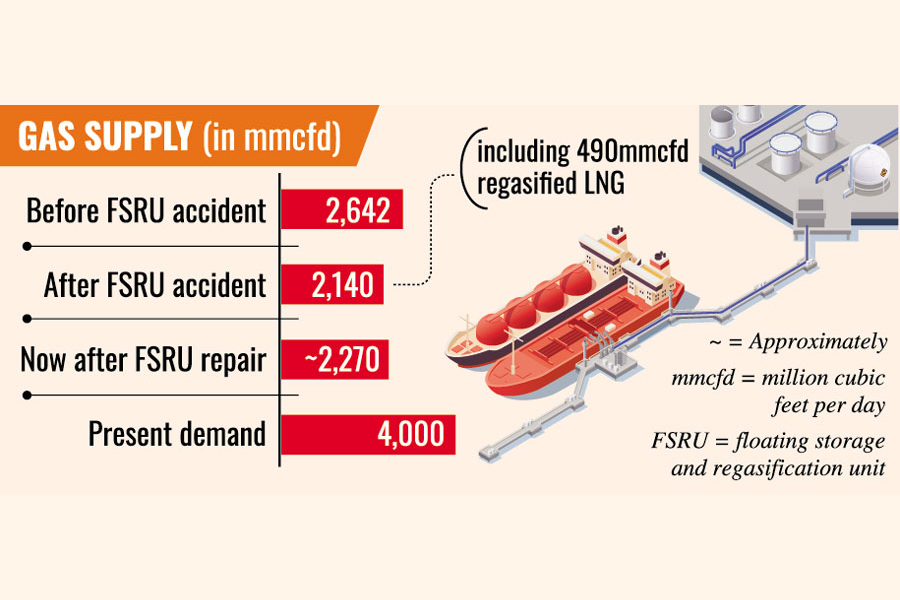
According to Bangladesh Oil, Gas and Mineral Corporation (Petrobangla) and Gas Transmission Company Limited (GTCL) sources, gas supply from the terminal operated by US-based Excelerate Energy resumed at 3:10 am on Thursday, August 6. The terminal initially supplied 115 million cubic feet of gas per day (mmcfd), which gradually increased to 300 mmcfd before Thursday evening as pressure stabilised. There are two floating terminals in Moheshkhali, Cox's Bazar, for supplying imported LNG: Excelerate Energy's terminal (capacity 600 mmcfd) and Summit's terminal (capacity 500 mmcfd). Excelerate's terminal was shut down on July 21 following a boiler fire, a disruption that worsened the country's ongoing gas crisis and affected everything from household cooking to industrial production, power generation and CNG filling stations.
🔧 Boiler Repair Status and the Catch
According to Petrobangla, Excelerate's terminal has two boilers, each with a capacity to supply 300 mmcfd of gas. One was damaged in the July 21 fire, while gas supply resumed on August 6 through the undamaged boiler. Meanwhile, work is underway to repair the damaged boiler. Several pieces of equipment imported from abroad arrived at Dhaka airport on Wednesday and may reach the Moheshkhali terminal on Thursday after customs clearance. According to the senior Petrobangla timeline, it may not be possible to restart the damaged boiler before August 10 after completing all the necessary testing and commissioning work.
A senior official involved in operating the terminal told Prothom Alo that once the damaged boiler is ready for testing, the currently operational boiler will have to be shut down temporarily. Gas supply from Excelerate's terminal will then stop completely for at least 12 hours before resuming gradually. This presents an operational dilemma: completing the full repair requires accepting a brief but complete supply interruption, which could cause further disruption to industries already operating at severely reduced capacity.
📊 Supply-Demand Math
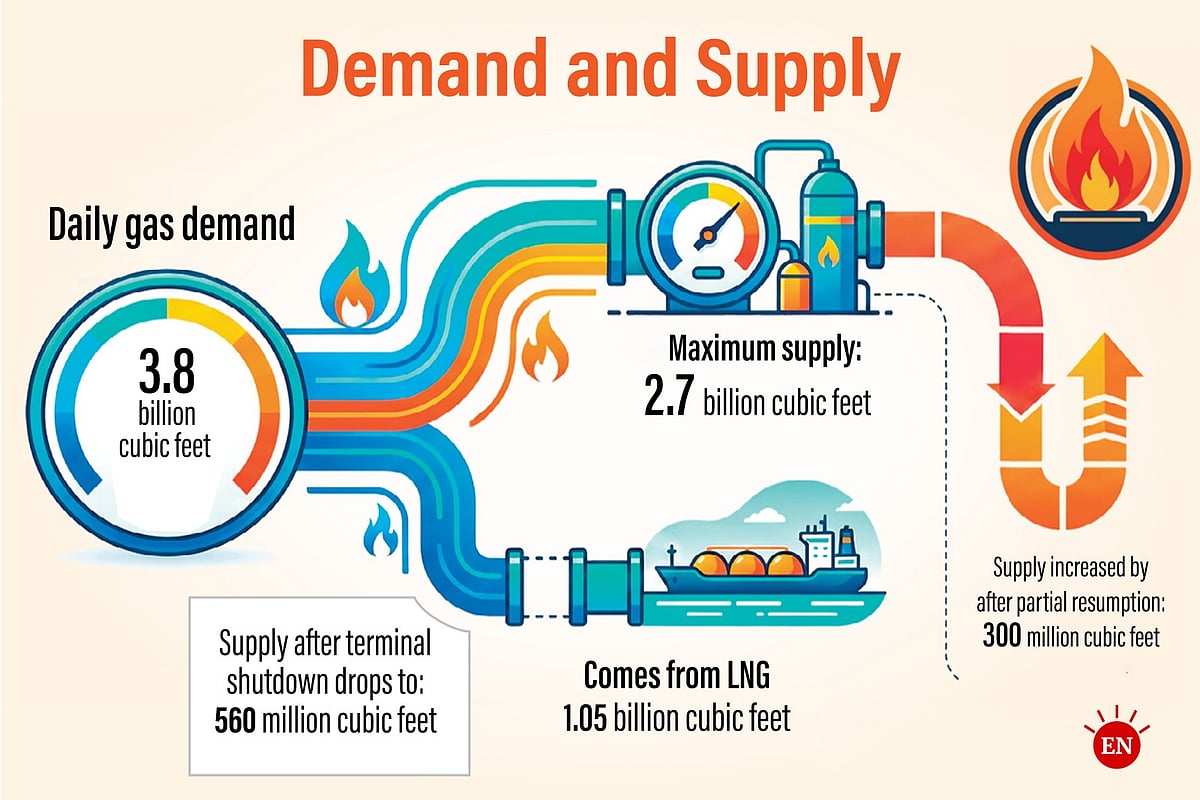
The country's daily gas demand stands at around 3.8 billion cubic feet (bcf), while up to 2.7 bcf is normally supplied — leaving a structural shortfall of 1.1 bcf per day even under normal conditions. Of the 2.7 bcf supply, LNG accounts for around 1.05 bcf, with the remainder coming from domestic gas fields whose output has been declining steadily for several years.
- 📈 Normal total supply: ~2.7 bcf/day (LNG 1.05 bcf + domestic 1.65 bcf)
- 📉 Supply during Excelerate shutdown: ~2.15 bcf/day (Summit 570 mmcfd + domestic)
- 📀 Supply after partial Excelerate resumption: ~2.45 bcf/day
- 📈 Expected supply after full Excelerate repair: ~2.7 bcf/day (back to normal)
- 📉 Daily structural gap: ~1.1 bcf (cannot be closed by LNG alone)
After Excelerate's terminal shut down on July 21, Summit's terminal supplied LNG above its rated capacity for four consecutive days, reaching around 570 mmcfd per day — a level that risks equipment fatigue if sustained. Since then, Summit has scaled back to its design capacity of around 500 mmcfd per day.
🏛️ Government Response and State Minister's Statement
State Minister for Power, Energy and Mineral Resources Anindya Islam Amit said in a Facebook post on Wednesday that the country faced a gas shortage after supply from the LNG terminal was suspended due to a technical fault. The disruption caused low pressure and interruptions in gas supply for industrial, power and residential consumers, he said. Following repairs to the technical fault, the terminal is now able to supply 200–250 mmcfd of gas to the national grid — a figure slightly below Petrobangla's reported 300 mmcfd, reflecting the gradual ramp-up profile.
💡 Power Sector Impact
The power sector is the country's largest consumer of gas. Lower gas supplies reduce gas-fired power generation, widening the electricity shortfall. Load-shedding reached 3,000–3,500 megawatts at peak over the past few days. Even on Wednesday (a weekly holiday), peak load-shedding stood at around 3,000 MW. However, heavy rain throughout Thursday reduced electricity demand — by 5:00 pm, maximum load-shedding had fallen to just 325 MW. Power shortages could rise again if temperatures increase, underscoring the weather-driven volatility of the crisis.
👕 Industrial and Export Consequences
After the power sector, industries are the largest consumers of gas. Factories in different parts of the country have long been struggling with inadequate gas supplies. New industrial gas connections remain suspended, while existing factories are struggling to maintain production. The gas shortage over the past two weeks has further complicated operations at manufacturing plants, with some factories giving workers unpaid leave. Business owners fear that in addition to falling exports — particularly in the ready-made garment, textile and plastic sectors — the supply of daily commodities in the local market will be disrupted if the situation does not improve.
🌏 The Bigger Picture: 15 Years of Structural Deficit
Energy experts note that for the past 15 years Bangladesh's gas sector has operated with a supply shortfall against demand. Domestic gas production has also been declining steadily, increasing the country's dependence on LNG imports. LNG now accounts for around 35–40 percent of the country's total daily gas supply — meaning any disruption to LNG imports immediately worsens the broader gas crisis. In 2024, Summit's LNG terminal remained shut for about three and a half months after being damaged by a cyclone. In 2022, the government also halted spot-market LNG purchases for seven consecutive months after global prices surged. Even more striking, despite a higher-than-global-average success rate in discovering gas fields relative to exploration efforts, Bangladesh has not conducted adequate exploration — and even 14 years after settling its maritime boundary, the country is yet to discover oil or gas in the Bay of Bengal.
✅ What Comes Next
The next 72 hours are critical. If the imported boiler equipment clears customs and reaches Moheshkhali on schedule, the second boiler could be tested by August 10 — triggering the 12-hour complete shutdown required for commissioning. After that, the terminal should ramp back to its full 600 mmcfd capacity over 48–72 hours, returning national supply to the 2.7 bcf baseline. Combined with the government's August 6 approval for direct purchase of eight additional LNG cargoes from Blackcube, Global Fuel, Plentitude and Vitol, the short-term supply outlook is stabilising. But until domestic gas exploration accelerates and the second FSRU at Moheshkhali comes online, Bangladesh will remain structurally exposed to LNG supply shocks — with every industrial sector, from RMG to plastics to shrimp processing, paying the price.
This news was originally published by Prothom Alo English. For the full original report, please visit: https://en.prothomalo.com/business/local/vem1zvoa4i
📬 Get Bangladesh Trade News in your inbox
Weekly digest of export industry news, policy updates, and market analysis.
📰 Related Stories