Bangladesh Foreign Aid Drops 37% to $5.24B as Debt Servicing Hits Record
ERD data shows project loan commitments halved while principal repayments crossed $2.95B; foreign aid disbursements also declined to $8.07B
Dhaka, August 4, 2026 — Foreign aid commitments fell sharply in fiscal year 2025-26 while debt servicing climbed to a record high, highlighting Bangladesh's tightening external financing conditions as the country grapples with slowing concessional inflows and rising repayment obligations on loans contracted during the past decade's infrastructure investment boom.
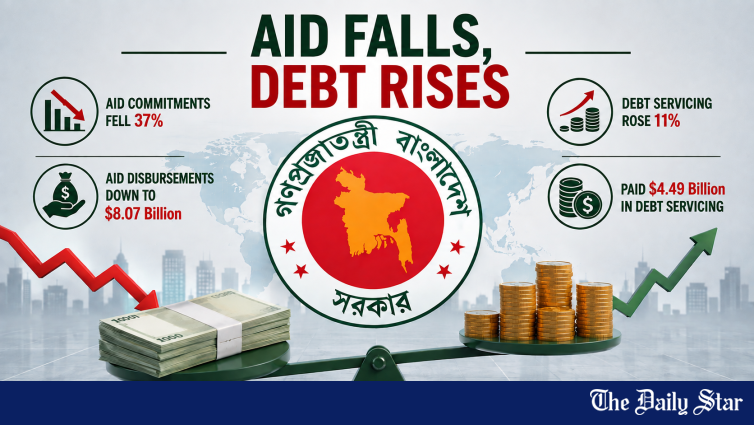
Total foreign assistance commitments dropped 37 percent to $5.24 billion in FY26 from $8.32 billion a year earlier, according to provisional data from the Economic Relations Division (ERD). The decline was driven primarily by a sharp reduction in project loan commitments, which fell to $5.01 billion from $7.94 billion a year earlier — a 37 percent drop that points to waning development partner enthusiasm for new Bangladeshi projects.
📊 Commitments: Project Loans and Grants Both Fall
The decline in foreign aid commitments was broad-based, affecting both project loans and grants — the two main channels through which Bangladesh receives concessional external financing. The numbers tell a clear story of tightening external financing conditions.
- 💰 Total commitments: $5.24B (FY26) vs $8.32B (FY25) — down 37%
- 💼 Project loan commitments: $5.01B (FY26) vs $7.94B (FY25) — down 37%
- 🤝 Grant commitments: $233.78M (FY26) vs $381.65M (FY25) — down 39%
The fact that both project loans and grants declined by similar margins suggests the drop is not driven by a single donor decision or a specific sectoral issue, but rather reflects a broader pattern of development partner caution — whether driven by Bangladesh's macroeconomic trajectory, project implementation challenges, or the broader global environment for concessional finance.
💳 Disbursements: Modest Decline, Grant Uptick
Foreign aid disbursements also declined, though at a slower pace than commitments — suggesting that previously agreed projects are still being financed, even as the pipeline of new commitments narrows. Bangladesh received $8.07 billion in foreign assistance during FY26, down from $8.57 billion in the previous fiscal year.
Within total disbursements, project aid disbursements fell to $8.02 billion from $8.52 billion, while grant disbursements actually increased to $553.95 million from $454.56 million — a rare bright spot in an otherwise deteriorating external financing picture. The grant increase, while modest in dollar terms, is significant because grants do not require repayment and therefore do not add to future debt servicing burdens.
- 💰 Total disbursements: $8.07B (FY26) vs $8.57B (FY25) — down 6%
- 💼 Project aid disbursements: $8.02B (FY26) vs $8.52B (FY25) — down 6%
- 🟢 Grant disbursements: $553.95M (FY26) vs $454.56M (FY25) — up 22%
💰 Debt Servicing: Record High of $4.49 Billion
Meanwhile, the country's external debt-servicing burden continued to rise, reaching a record high. Bangladesh paid $4.49 billion in principal and interest on foreign loans during FY26, up from $4.09 billion a year earlier — an increase of nearly 11 percent. The rise reflects the repayment phase of loans contracted over the past decade, particularly for large infrastructure and mega projects that are now beginning to require principal repayments.
Breaking down the debt servicing figures reveals the underlying dynamics:
- 💳 Principal repayments: $2.95B (FY26) vs $2.60B (FY25) — up 13%
- 💲 Interest payments: $1.54B (FY26) vs $1.49B (FY25) — up 3%
- 💰 Total debt servicing (USD): $4.49B (FY26) vs $4.09B (FY25) — up 11%
- 🧾 Total debt servicing (BDT): Tk 54,957 crore (FY26) vs Tk 49,391 crore (FY25)
The fact that principal repayments grew faster (13 percent) than interest payments (3 percent) is particularly significant, because it indicates that Bangladesh is now paying down the principal on loans that were disbursed during the infrastructure investment boom of the mid-to-late 2010s. Many of these projects — including power plants, metro rail lines, port expansions, and highway networks — experienced delays, cost overruns, or failed to generate the expected economic returns on schedule.
📋 The Arithmetic of Eroding Buffers
The combination of falling commitments, modestly declining disbursements, and rising debt servicing creates a challenging arithmetic for Bangladesh's external finances. Net foreign aid inflows — disbursements minus debt servicing — fell to $3.58 billion in FY26 from $4.48 billion in FY25, a decline of roughly 20 percent. In other words, Bangladesh is receiving less net external financing even as its development needs continue to grow.
This narrowing of net inflows is happening at a particularly delicate moment, with the country approaching LDC graduation in November 2026 and seeking a three-year deferral from the United Nations. Development partners evaluating Bangladesh's deferral request will be looking closely at the country's external financing trajectory, and the data published by ERD offers little comfort: a shrinking pipeline of new commitments, stagnant disbursements, and rising repayment obligations.
🌏 Why Commitments Are Falling
While the ERD data does not specify the reasons for the commitment decline, several factors are likely at play. First, Bangladesh's gradual transition toward middle-income status has reduced its eligibility for the most concessional forms of development finance, pushing some traditional partners to redirect their lending toward lower-income countries. Second, concerns about Bangladesh's macroeconomic management — including banking sector stress, reserve depletion, and slow project implementation — may have made development partners more cautious about committing new funds.
Third, the global environment for concessional finance has become more competitive, with multiple developing countries seeking limited donor resources amid a slowdown in multilateral lending. Finally, Bangladesh's own absorptive capacity — the ability to design, approve, and implement donor-financed projects on schedule — has long been a constraint, and any deterioration in implementation performance tends to translate into reduced future commitments.
💰 Implications for the Development Pipeline
The 37 percent drop in project loan commitments will have consequences that extend well beyond the current fiscal year. Project loans typically finance multi-year infrastructure programmes, meaning that today's commitments translate into disbursements over the next three to five years. A drop in FY26 commitments will therefore constrain the pipeline of new infrastructure, energy, transport, and social sector projects that can be initiated in FY27 and beyond.
For a country that needs substantial investment to sustain growth, strengthen climate resilience, and prepare for LDC graduation, the narrowing of the concessional financing pipeline is a structural concern — not an immediate crisis, but a slow-moving erosion of the external buffers that have historically supported Bangladesh's development model.
📋 Strategic Context
The ERD data reinforces the analysis offered by SANEM Executive Director Selim Raihan in a separate commentary on Bangladesh's external sector: the country is not facing an immediate balance-of-payments crisis, but its external financing cushion is visibly thinning. Restoring development partner confidence, improving project implementation, and strengthening export competitiveness will be essential safeguards against the mounting external vulnerabilities revealed by these numbers.
The good news for Bangladesh is that grant disbursements actually increased in FY26, suggesting that development partners remain willing to support targeted programmes even as they pull back from large project loans. The challenge for policymakers will be to translate that willingness into broader renewed confidence — and to ensure that future borrowing delivers the timely, productive returns needed to service the rising debt burden.
This news was originally published by The Daily Star. For the full original report, please visit: https://www.thedailystar.net/business/news/bangladeshs-foreign-aid-commitments-fall-37-debt-servicing-rises-11-4238476
📬 Get Bangladesh Trade News in your inbox
Weekly digest of export industry news, policy updates, and market analysis.
📰 Related Stories