Bangladesh to Build Economic Zones on Land of 3 Closed State-Owned Mills: BEZA
Dhaka, August 18, 2026 — The Bangladesh Economic Zones Authority (BEZA) has approved plans to establish economic zones on the land of three closed state-owned mills — Latif Bawany Jute Mills Limited and Karim Jute Mills Limited in Demra, Dhaka, and Kushtia Sugar Mills Limited — in a move aimed at putting long-unused industrial assets back into productive use, attracting domestic and foreign investment, and creating jobs. The decision was taken at a BEZA governing board meeting in August 2026, with the land of the three state-owned enterprises to be formally transferred to BEZA.
📊 The Three Sites: A Combined 353 Acres
- 🧵 Latif Bawany Jute Mills, Demra — ~83 acres (closed since 2000; established 1953)
- 🧵 Karim Jute Mills, Demra — ~50 acres (closed since 2000; established 1954)
- 🌾 Demra combined site — ~133 acres of unused industrial land
- 🍭 Kushtia Sugar Mills — 220 acres (production suspended 2020; established 1965–66)
- 📊 Total land available — ~353 acres across the three sites
🏭 Why These Mills Closed
Each of the three mills tells a story of Bangladesh's industrial history — once-profitable state-owned enterprises (SOEs) that eventually became unsustainable under the Bangladesh Jute Mills Corporation (BJMC) and the Bangladesh Sugar and Food Industries Corporation (BSFIC):
- 🧵 Latif Bawany and Karim Jute Mills (Demra) — both established in the early 1950s (1953 and 1954 respectively) and brought under BJMC management in 1972 after independence. Closed since 2000 due to persistent losses.
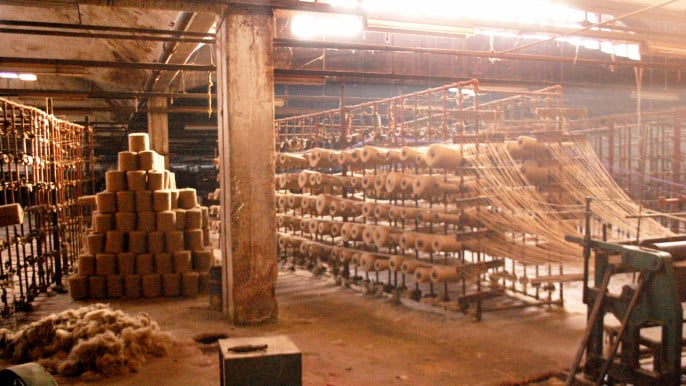
- 🍭 Kushtia Sugar Mills — established in 1965–66, initially operated profitably but began incurring persistent losses after the 1990s. Production suspended in 2020 due to continued losses. Machinery worth hundreds of crores of taka has remained unused and is gradually deteriorating.
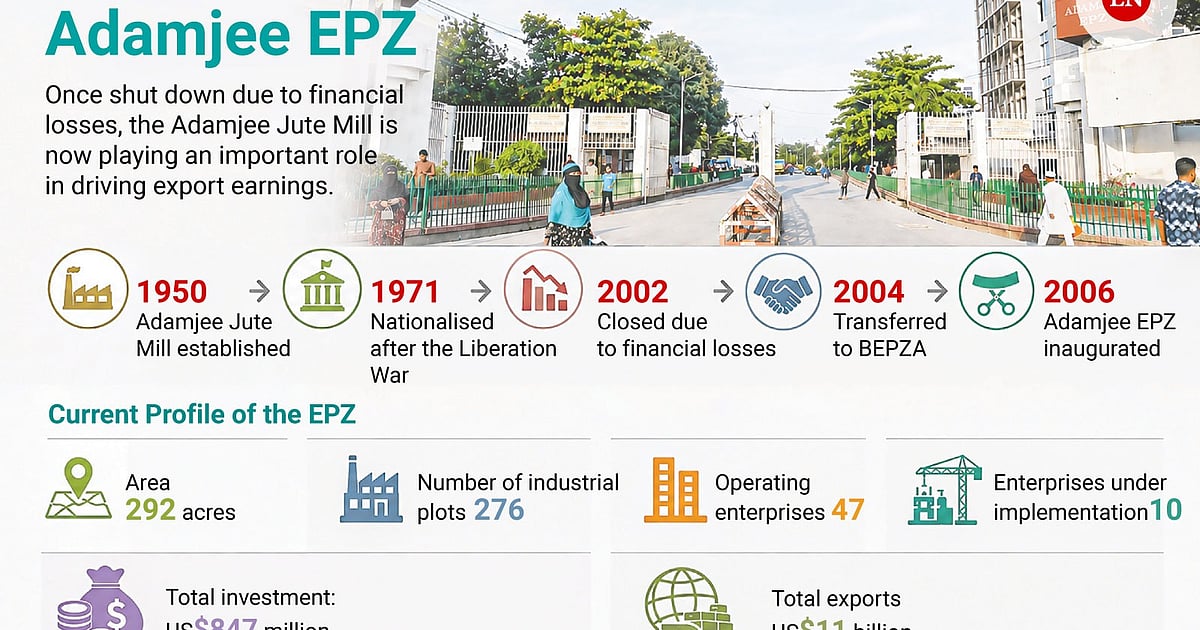
- 🧵 Adamjee Jute Mills (precedent) — the most-cited example. After independence, it was nationalised and came under BJMC. Prolonged losses, weak management, technological limitations and labour unrest pushed it into crisis. The government shut down the mill on 30 June 2002 after years of losses. On 1 December 2004, the government decided to hand over its land to BEPZA. The site is now the Adamjee EPZ — one of Bangladesh's most successful export processing zones.
🤝 The Adamjee EPZ Precedent
BEZA officials cite the success of Adamjee EPZ — developed on the site of the former Adamjee Jute Mills — as the model for the three new economic zones. The transformation demonstrates how unused industrial assets can be turned into productive economic centres, generating export earnings, employment, and investment that far exceed what the loss-making SOE could ever have produced.
Saleh Ahmed, Executive Member (Investment Promotion) of BEZA, told TBS: "We are now working on how the transfer process will be carried out. In this regard, we are considering Adamjee Jute Mills as an example." He said the process would follow the same approach as Adamjee — where the government settled the mill's liabilities (including worker severance, BJMC debts, and outstanding tax obligations) and then handed over clean title to BEPZA. "We are working on transferring the land of these closed mills after the government settles all their outstanding liabilities," Saleh added.
🚧 Infrastructure Requirements
The proposed zones will require significant infrastructure investment to create an investment-friendly industrial environment:
- 🛣 Internal roads — connecting zone plots to highways and access points
- ⛽ Gas supply — industrial-grade gas connection for manufacturing operations
- ⚡ Electricity — dedicated substations and grid connectivity, ideally with captive power options
- 💧 Water supply — treated industrial water for processing, plus effluent treatment plants
- 📱 Telecommunications — fibre-optic connectivity for export-oriented IT/ITeS operations
- 🚢 Logistics connectivity — access to ports, rail, and trucking hubs for export shipments
- 📜 Regulatory infrastructure — one-stop service centre, customs bonded warehouse, BEPZA-style operating framework
🏛 The Invest Bangladesh Authority Transition
The proposed economic zones may eventually come under the planned Invest Bangladesh Authority — a new single investment development agency created by parliament through the "Invest Bangladesh Bill, 2026". The new law abolishes three existing agencies:
- 🔴 BEZA — Bangladesh Economic Zones Authority
- 🔴 BIDA — Bangladesh Investment Development Authority
- 🔴 PPP Authority — Bangladesh Public-Private Partnership Authority
The law allows industrial areas or establishments to be transferred to or from the new authority under mutually agreed terms. The government may, in consultation with the governing board, transfer industrial establishments or areas owned by other authorities or agencies to Invest Bangladesh Authority — and vice versa. BEZA officials said this provision could allow the proposed economic zones to eventually be managed under an integrated investment development framework.
👥 Strategic Significance for Export Economy
The conversion of 353 acres of unused SOE land into economic zones carries significant implications for Bangladesh's export economy:
- 🏭 New industrial capacity — the zones will host export-oriented factories across RMG, textiles, pharmaceuticals, light engineering, agro-processing, plastics and IT/ITeS
- 👥 Job creation — potentially tens of thousands of direct and indirect jobs, replacing the loss-making employment that previously existed on these sites
- 💰 FDI attraction — the zones will offer BEZA/BEPZA-style investor incentives including tax holidays, customs bonded warehouse facilities, and one-stop services
- 🌐 Export diversification — providing plug-and-play infrastructure for non-RMG export sectors that need scaled-up industrial space
- 🌾 Productive use of land — converting dormant state assets into revenue-generating industrial hubs
⏳ Implementation Timeline and Challenges
While the BEZA governing board has approved the plan in principle, several implementation challenges remain:
- ⏳ Liability settlement — the government must first settle all outstanding liabilities of the three SOEs, including worker severance (potentially thousands of workers from each closed mill), BJMC/BSFIC debts, and outstanding tax obligations
- 📜 Land title transfer — formal transfer from BJMC/BSFIC to BEZA, with clean title free of encumbrances
- 🛣 Infrastructure development — design, financing and construction of internal roads, gas, electricity, water, and telecom infrastructure (typically 2–3 years)
- 👥 Investor mobilisation — attracting anchor investors to commit to plot allocations before construction completes
- 🤝 Invest Bangladesh Authority transition — ensuring the zones can be smoothly transferred to the new authority once it is operational
🌐 The Bigger Picture: Industrial Land Reform
The initiative reflects a broader shift in Bangladesh's approach to industrial land policy. For decades, the country has struggled to assemble large, infrastructure-ready industrial sites — forcing exporters to either locate in scattered private industrial parks (with varying infrastructure quality) or build their own greenfield facilities (with the attendant land acquisition, environmental clearance and infrastructure development costs). By systematically converting dormant SOE land into plug-and-play economic zones, the government can unlock significant industrial capacity at relatively low marginal cost — particularly because the land is already in industrial use, with existing titles, environmental zoning, and road access.
The Adamjee EPZ precedent shows the model works: a 500-acre site that once employed a few thousand loss-making jute mill workers now hosts dozens of export-oriented factories employing over 50,000 workers and generating billions of dollars in annual export earnings. If BEZA can replicate even half of that success across the three new sites — Latif Bawany, Karim Jute Mills, and Kushtia Sugar Mills — the country will gain meaningful new industrial capacity precisely when it needs to diversify its export base ahead of LDC graduation in November 2026.
For Finance Minister Amir Khosru Mahmud Chowdhury's broader economic reform agenda, the BEZA initiative is exactly the kind of structural reform that has been missing from Bangladesh's industrial policy — converting legacy state assets into productive investment platforms, with the governance framework (including the planned Invest Bangladesh Authority merger) needed to ensure the zones operate with the speed and accountability that Bangladeshi exporters have long demanded from BIDA, BEZA and BEPZA. The test now will be execution: whether the government can settle liabilities, transfer land, build infrastructure, and attract investors on the timeline needed for these zones to contribute to the country's post-LDC industrial transformation.
This news was originally published by The Business Standard. For the full original report, please visit: https://www.tbsnews.net/economy/economic-zones-planned-land-3-closed-state-owned-mills-1517956
Related on BangladeshExport
📬 Get Bangladesh Trade News in your inbox
Weekly digest of export industry news, policy updates, and market analysis.
📰 Related Stories