Bangladesh Bank to Withdraw Administrators from Merged Islamic Banks by Aug 15
Sammilito Islami Bank (5 merged banks) gets new chairman and MD; Exim Bank administrator already withdrawn July 30; phase-out to complete by August 15
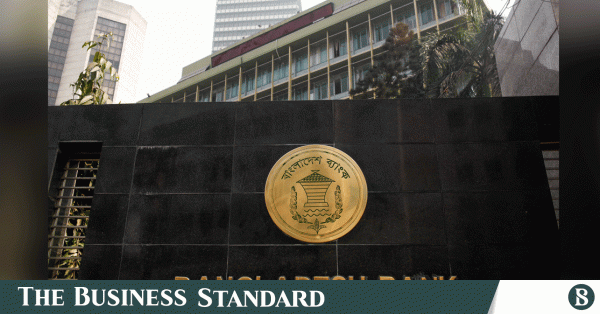
Dhaka, August 6, 2026 — The Bangladesh Bank has decided to withdraw its appointed administrators from the remaining four banks under the merged Sammilito Islami Bank by August 15, as the central bank moves to hand over full operational control to the new management — marking a decisive step in the normalisation of one of the country's most troubled banking segments.
🏛️ Why the Withdrawal Now?
The decision follows the appointment of the merged bank's new chairman and managing director, allowing the consolidated institution to operate under its regular management structure, central bank officials said. The Bangladesh Bank had withdrawn the administrator from Exim Bank on July 30 as the first step. Administrators will now be removed in phases from the four remaining constituents — Social Islami Bank, First Security Islami Bank, Global Islami Bank and Union Bank — all of which now form Sammilito Islami Bank, the consolidated entity created from the forced merger of five Islamic banks.
💬 Spokesman's Explanation
"The administrators were appointed temporarily after the formation of Sammilito Islami Bank. Their primary responsibility was to coordinate the integration of the five banks' loans, deposits and information technology systems," Bangladesh Bank Executive Director and spokesperson Arief Hossain Khan told The Business Standard. "Now that the bank has a chairman and a managing director, who has already assumed regular duties, retaining the administrators would create administrative duplication. That is why we have decided to withdraw them by August 15."
Officials also said there is no administrative justification for retaining both an administrator and a managing director within the same institution after the appointment of the MD. Under standard governance practices, the two roles cannot operate simultaneously with overlapping authority — a conflict that prompted the phased withdrawal.
🖥️ Technology Integration Still Pending
However, the technological integration of the merged entities has yet to be completed. The integration of the core banking software, information technology infrastructure and nostro accounts — the foreign currency accounts used for international transactions — remains underway. As a result, some banking operations are still being conducted under the banks' existing individual names rather than under the unified Sammilito Islami Bank identity. Officials said the merged institution would begin operating fully under Sammilito Islami Bank branding once the technology integration is completed, a process that typically takes 6–12 months even for voluntary mergers.
👥 Why Exim Bank Was First
According to the officials, Exim Bank was selected for the first handover because the newly appointed managing director will operate from its office as the principal administrative base. Consequently, Exim Bank's transition was completed first, while the remaining four banks are expected to come fully under the management of Sammilito Islami Bank by August 15. The phased approach is designed to avoid a single "big bang" cutover that could disrupt customer service across the merged network.
📊 Capital Structure and Government Stake
The merged bank began operations with paid-up capital of Tk 35,000 crore — making it one of the largest banks in Bangladesh by capital base. Of the total, the government contributed Tk 20,000 crore, while the remaining Tk 15,000 crore will be converted into shares against depositors' funds. This hybrid capital structure — mixing sovereign capital with depositor equity — is unusual in Bangladeshi banking and reflects the emergency nature of the merger. The structure also means that the government will be the dominant shareholder, at least until depositor equity conversion is completed and any future divestment strategy is determined.
🎯 Chairman's Warning: Failure Is Not an Option
Sammilito Islami Bank Chairman Kazi Shairul Hasan described the integration and administrative transition as a challenging process, saying its success was essential for maintaining financial stability. He said failure to complete the restructuring successfully could have adverse implications for both the banking sector and the broader economy. Efforts were under way to restore normal operations and place the bank on a stronger financial footing, while seeking cooperation from all stakeholders — including depositors who have faced months of uncertainty, employees anxious about job security, and regulators monitoring the transition for compliance slippage.
🧪 The S Alam Group Legacy
Before the merger, Exim Bank was controlled by former Bangladesh Association of Banks chairman Nazrul Islam Mazumder during the previous Awami League government. The other four banks — Social Islami Bank, First Security Islami Bank, Global Islami Bank and Union Bank — were controlled by the S Alam Group, a Chattogram-based conglomerate that became synonymous with the alleged financial irregularities exposed after the political transition of August 2024. After the four S Alam-affiliated banks failed to repay depositors — creating severe financial stress that rippled through the entire banking system — the interim government merged the five institutions to form Sammilito Islami Bank as part of efforts to stabilise the sector and protect depositors.
🌏 Macro Implications for Banking Reform
The August 15 administrator withdrawal deadline is not an isolated event. It runs in parallel with the broader Bangladesh Bank reform agenda announced the same week — including the 18-month NPL action plan targeting the 36 percent bad-loan overhang, the Tk 60,000 crore private sector credit stimulus scheduled for September, and the policy rate cut to 9.5 percent. Together, these moves represent the central bank's most coordinated attempt since the political transition to restart the credit pipeline and restore depositor trust. The Islamic banking segment is particularly important because it serves a large share of the country's remittance customers and small-business depositors who historically preferred Shariah-compliant finance.
✅ What to Watch Between Now and August 15
Over the next 10 days, three indicators will determine whether the transition succeeds. First, whether the new managing director can complete the technology integration cutover for at least two of the four remaining banks without service disruption. Second, whether deposit growth at Sammilito Islami Bank turns positive in August — a key depositor confidence signal. Third, whether the central bank's concurrent NPL recovery action plan is applied to the inherited bad-loan portfolio of the merged entity with the same rigour as the rest of the banking system, or whether the merged bank receives special forbearance during the transition window. The answers to these three questions will shape not only the future of Islamic banking in Bangladesh but also the credibility of the broader banking reform programme.
This news was originally published by The Business Standard. For the full original report, please visit: https://www.tbsnews.net/economy/banking/cenbank-withdraw-administrators-merged-islamic-banks-15-aug-1507741
📬 Get Bangladesh Trade News in your inbox
Weekly digest of export industry news, policy updates, and market analysis.
📰 Related Stories