Bangladesh Bank Stimulus Fails To Buoy Private Sector Credit Demand
Private credit growth stuck at 4.62% in July — second historic low — despite Tk 600 billion stimulus, rate cut and loan rescheduling facilities; energy crisis and NPL fears deter investment
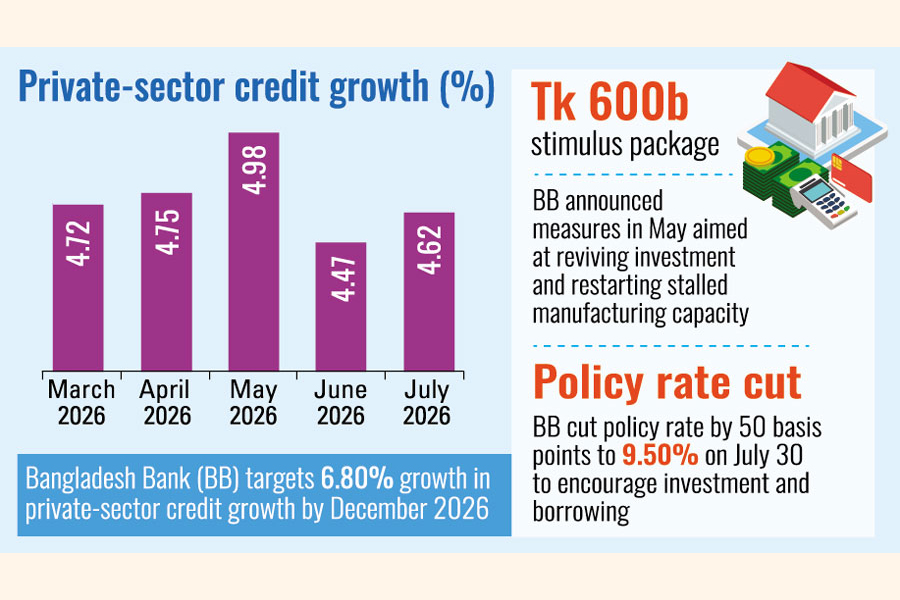
📊 Formal credit growth for the private sector stayed almost stagnant in July, indicating that fund demand and concomitant bank lending have yet to pick up despite government stimulus for revamping economic activity. According to latest statistics, the private-sector credit growth hit a historic low at 4.47 per cent in June and then edged up to 4.62 per cent by end of July. The growth had remained pegged below 5.0 per cent for five consecutive months as 4.72 per cent, 4.75 per cent and 4.98 per cent were recorded in March, April and May respectively.
💰 The private credit growth stayed weak, belying a number of financial and fiscal measures taken up by Bangladesh Bank (BB), including a Tk 600-billion stimulus package, to breathe life into economic activity and generate employment by way of reopening stalled manufacturing bases across the country. Even in the half-yearly monetary policy statement (MPS) for July-December, the central bank made a private-sector-credit-growth projection at 6.80 per cent by December. To achieve the end, the regulator cut the policy rate by 50 basis points to 9.50 per cent on July 30.
📜 Multiple BB Facilities Fail To Stimulate Demand
Yet, the muted credit growth suggests that both demand for fresh loans and banks' willingness to lend remain subdued. A Bangladesh Bank official has said the regulator has provided policy support to struggling borrowers, including a facility allowing them to regularise loans with a two-year moratorium after paying 2.0 per cent of their outstanding loans as a down payment. The central bank later eased the payment requirement in February after many borrowers struggled to make the 2.0-percent payment. Under the revised arrangement, half of the stipulated amount has to be paid upon approval, with the remaining 50 per cent due within six months of the effective date.
"Despite these facilities, the credit growth for the private sector has not got momentum yet," the official said. The combination of stimulus package, policy rate cut, loan regularisation facility and payment easing — all deployed within a few months — has failed to move the needle on private credit growth. This suggests that the constraint is not on the supply side (banks have liquidity and policy support) but on the demand side (borrowers do not want to invest).
- 📊 Private credit growth (June): 4.47% (historic low)
- 📊 Private credit growth (July): 4.62% (second historic low)
- 📊 BB MPS projection (December): 6.80%
- 💰 Stimulus package: Tk 600 billion
- 💵 Policy rate: 9.50% (cut 50bps on July 30)
- 📊 Capital machinery import growth: -3.57% (July)
- 📊 Industrial raw material import growth: -5.78% (July)
- 📅 Below 5% for: 5 consecutive months
⚠ Why Borrowers Are Reluctant: Energy Crisis, NPLs, Uncertainty
Such reluctance in investment credits is attributed to banks becoming more cautious amid higher non-performing loan (NPL) regime and private borrowers losing their credit appetite due to multiple anti-business factors, including energy crisis, prevailing global economic uncertainty due to geopolitical tensions, exchange-rate shocks, and higher inflation which is deemed not investment-friendly.
Bangladesh Knitwear Manufacturers and Exporters Association (BKMEA) President Mohammad Hatem says entrepreneurs have been battling hard to survive on the market under these prevailing desperate business and investment climates. Terming the ongoing energy crisis a severe blow to businesses, the business leader says many factories have been struggling to continue production in the industrial belts.
"Under such circumstances, who dares to think of business expansion? I don't know how the growth (4.62 per cent) has happened and who are the borrowers? Will they be able to repay the loans? I have enough doubt," he adds. The BKMEA president's candid scepticism — questioning both the source of the minimal credit growth and the repayment capacity of any new borrowers — reflects the depth of uncertainty in Bangladesh's industrial sector.
💵 Negative Import Growth Confirms Investment Freeze
According to BB data, the import growth for capital machinery and industrial raw materials became negative of 3.57 per cent and 5.78 per cent by the end of July. The negative import growth for capital machinery is particularly significant — it confirms that businesses are not investing in new equipment or capacity expansion. Capital machinery imports typically precede industrial investment by 6-12 months, meaning that the negative growth in July translates into near-zero new industrial capacity coming online in the first half of 2027.
The negative raw material import growth similarly confirms that manufacturing activity is contracting rather than expanding — businesses are importing fewer raw materials because they are producing less, not because they have built domestic supply chains. This contractionary signal, combined with the private credit growth stagnation, paints a picture of an economy in investment freeze — where monetary easing cannot stimulate activity because the structural barriers (energy crisis, NPL overhang, policy uncertainty) have not been addressed.
🌏 Strategic Implications For Bangladesh's Economic Recovery
For Bangladesh's broader economic recovery, the private credit growth stagnation carries strategic significance. The government's Tk 600 billion stimulus — equivalent to approximately 1.4% of GDP — was designed to catalyse industrial revival, but its deployment has been blocked by the structural barriers that monetary policy alone cannot address. Without resolving the energy supply crisis, restoring banking sector health (so that banks are willing to lend rather than hoarding liquidity against NPL provisions), and providing the policy predictability that businesses need to make investment decisions, the stimulus will remain largely undeployed.
The BB's December projection of 6.80% private credit growth — nearly 2 percentage points above the current 4.62% — appears increasingly unrealistic given the structural barriers. Achieving this target would require not just continued monetary easing but meaningful progress on energy supply restoration, banking sector recapitalisation and the kind of policy predictability that would give businesses the confidence to borrow for expansion rather than merely borrowing to survive.
The coming months will reveal whether the structural barriers can be addressed quickly enough to translate the BB's monetary easing into actual credit growth — or whether the investment freeze persists through FY27, constraining the economic recovery that Bangladesh needs ahead of LDC graduation in November 2026.
This news was originally published by The Financial Express. For the full original report, please visit: https://thefinancialexpress.com.bd/economy/bb-stimulus-fails-to-buoy-up-private-sector-credit-demand
Related on BangladeshExport
📬 Get Bangladesh Trade News in your inbox
Weekly digest of export industry news, policy updates, and market analysis.
📰 Related Stories