Bangladesh Bank Introduces KPI Framework For Bank CEOs
Five-area performance evaluation with 50% minimum threshold, bi-annual assessments and penalties for poor performance in six critical areas including NPLs and CMSME finance
🏛 Bangladesh Bank has rolled out a structured Key Performance Indicator (KPI) framework for managing directors (MDs) and chief executive officers (CEOs) of commercial banks, marking one of the most significant governance reforms in the banking sector in recent years. The framework, issued through a circular today, aims to strengthen accountability among bank CEOs and safeguard the interests of depositors while improving discipline, good governance and financial stability in the banking sector.
📊 For current CEOs, the first assessment period will run from October 1, 2026 to March 31, 2027. The framework represents a structural shift from qualitative performance evaluation to a quantitative, score-based assessment system that ties CEO remuneration, reappointment and succession decisions to measurable performance outcomes.
📜 Five Assessment Areas With Weighted Scoring
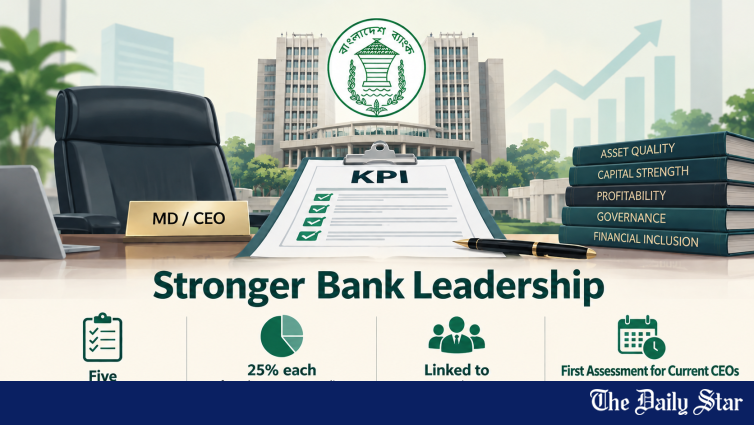
Under the framework, the performance of an MD or CEO will be assessed on five broad areas: bank solvency and liquidity, asset quality, profitability, governance and internal control, and inclusion, customer and market conduct. The weighting reflects Bangladesh Bank's priorities — solvency and asset quality together carry half of the total score, signalling that prudential fundamentals remain the central bank's primary concern.
Bank solvency and liquidity and asset quality will each carry 25 percent of the total score, while governance and internal control will also account for 25 percent. Inclusion, customer and market conduct will carry 15 percent and profitability 10 percent. The relatively low 10% weighting for profitability is strategically significant — it signals that Bangladesh Bank does not want CEOs to chase short-term profit at the expense of asset quality, governance or financial inclusion objectives.
- 📊 Bank solvency and liquidity: 25%
- 📊 Asset quality: 25%
- 📊 Governance and internal control: 25%
- 📊 Inclusion, customer and market conduct: 15%
- 📊 Profitability: 10%
- 📅 First assessment period: October 1, 2026 to March 31, 2027
- ⏳ Assessment frequency: Bi-annual (every 6 months)
- ✅ Minimum threshold for KPI score: 50% of target
- ⚠ Performance categories: Above Average (≥75), Average (65-74), Below Average (<65)
💰 KPI Will Drive CEO Remuneration And Tenure
The central bank said the KPIs will be used not only to evaluate the performance of MDs and CEOs but also in determining their remuneration, incentives and benefits, as well as decisions on appointment, reappointment, extension of tenure and succession planning. This effectively makes the KPI framework the central regulatory instrument for bank CEO accountability — converting what was previously a qualitative, board-driven assessment into a structured, regulator-monitored process.
A CEO will receive a score for an individual KPI only if at least 50 percent of the predetermined target is achieved. If performance falls below 50 percent of the target, the score for that KPI will be zero. Performance at 50 percent or above will receive a proportionate score, according to the circular. The 50% threshold creates a clear minimum standard — preventing CEOs from accumulating partial credit for performance that falls well short of expectations.
⚠ Penalty For Poor Performance In Six Critical Areas
The framework also introduces an additional penalty for poor performance in six critical areas. If an MD or CEO achieves less than 50 percent of the target, or scores zero, in any of these KPIs, 25 percent of the maximum weighted score of the relevant KPI will be deducted from the overall score. The penalty mechanism creates a strong disincentive for failure in areas that Bangladesh Bank considers systemically critical.
The six areas are advance-to-deposit ratio (ADR), gross non-performing loan (NPL) ratio, net NPL ratio, large-loan and top-borrower concentration, recovery of classified and written-off loans, and outreach in CMSME, agriculture, green finance and financial inclusion. The inclusion of NPL ratios, large-loan concentration and loan recovery as penalty-triggering KPIs directly addresses the structural weaknesses that have driven the banking sector's NPL crisis — Tk 6 lakh crore in defaulted loans as of June 2026.
📈 Three Performance Categories
The central bank has set three broad performance categories. An overall score of 75 or above will be considered "Above Average", a score of 65 to below 75 will be rated "Average", while a score below 65 will be considered "Below Average". The categorisation provides boards with a clear benchmark for reappointment, succession or termination decisions — and gives Bangladesh Bank a structured basis for regulatory intervention when CEO performance falls below the "Average" threshold.
The board of directors of each bank will have to set targets for every KPI based on the bank's performance in the immediately preceding quarter, while also considering regulatory expectations, its risk profile, business strategy and international best practices. For newly appointed or reappointed MDs and CEOs, the targets must be set at the beginning of their tenure. For existing MDs and CEOs, the targets must be set within one month of the issuance of the circular. The targets will cover three years or the remaining tenure of the CEO, with performance targets set on a rolling six-month basis.
🤝 Implementation And BB Review
After setting the targets, the board will have to approve the KPI framework and submit it to Bangladesh Bank's Banking Regulation and Policy Department-2 within seven working days. The central bank will review and approve the framework, with changes, if necessary. The board will then assess the MD or CEO after every designated assessment period, generally every six months, and submit the review report to Bangladesh Bank within 15 days of the end of the assessment period. Bangladesh Bank may issue further directives or determine the next course of action after reviewing the performance.
The 15-day submission window and BB's authority to issue further directives create a tight regulatory feedback loop — boards cannot delay reporting, and the central bank retains the right to intervene if performance assessments reveal governance or prudential concerns. This is a meaningful upgrade from the previous system, where CEO performance reviews were largely internal board matters with limited regulatory oversight.
🌏 Implications For Bangladesh's Banking Sector
The KPI framework carries significant implications for Bangladesh's banking sector, which has been grappling with record-high NPLs, weak corporate governance and capital shortfalls across multiple lenders. By making CEO accountability quantitative and regulator-monitored, the framework creates a structural mechanism for addressing the governance failures that have plagued the sector — particularly the politically influenced lending that drove NPLs to 32.78% of total loans by June 2026.
For CEOs of weak banks, the framework creates a clear pressure point: failure to meet KPI targets in NPL reduction, loan recovery and capital adequacy will directly affect their tenure and remuneration. The penalty mechanism for the six critical areas means that CEOs cannot offset poor asset quality performance with strong profitability or governance scores — a structural change that aligns CEO incentives with regulatory priorities.
For Bangladesh's broader economic recovery, the framework is strategically important. Banking sector health is a prerequisite for financing the export growth, infrastructure investment and industrial capacity expansion needed to navigate LDC graduation in November 2026. By strengthening CEO accountability, Bangladesh Bank is laying the institutional foundation for a more disciplined, prudently managed banking sector — though the framework's effectiveness will depend on rigorous enforcement and the willingness of boards to act on BB's directives when CEO performance falls short.
The coming months will reveal whether the framework translates into measurable improvements in banking sector health, or whether it joins the long list of regulatory initiatives that have struggled to translate policy intent into operational outcomes. The first test will come in April 2027, when the inaugural October-March assessment period concludes and the first set of CEO performance reports reaches Bangladesh Bank.
This news was originally published by The Daily Star. For the full original report, please visit: https://www.thedailystar.net/business/news/bangladesh-bank-introduces-kpi-bank-ceos-4271906
Related on BangladeshExport
📬 Get Bangladesh Trade News in your inbox
Weekly digest of export industry news, policy updates, and market analysis.
📰 Related Stories